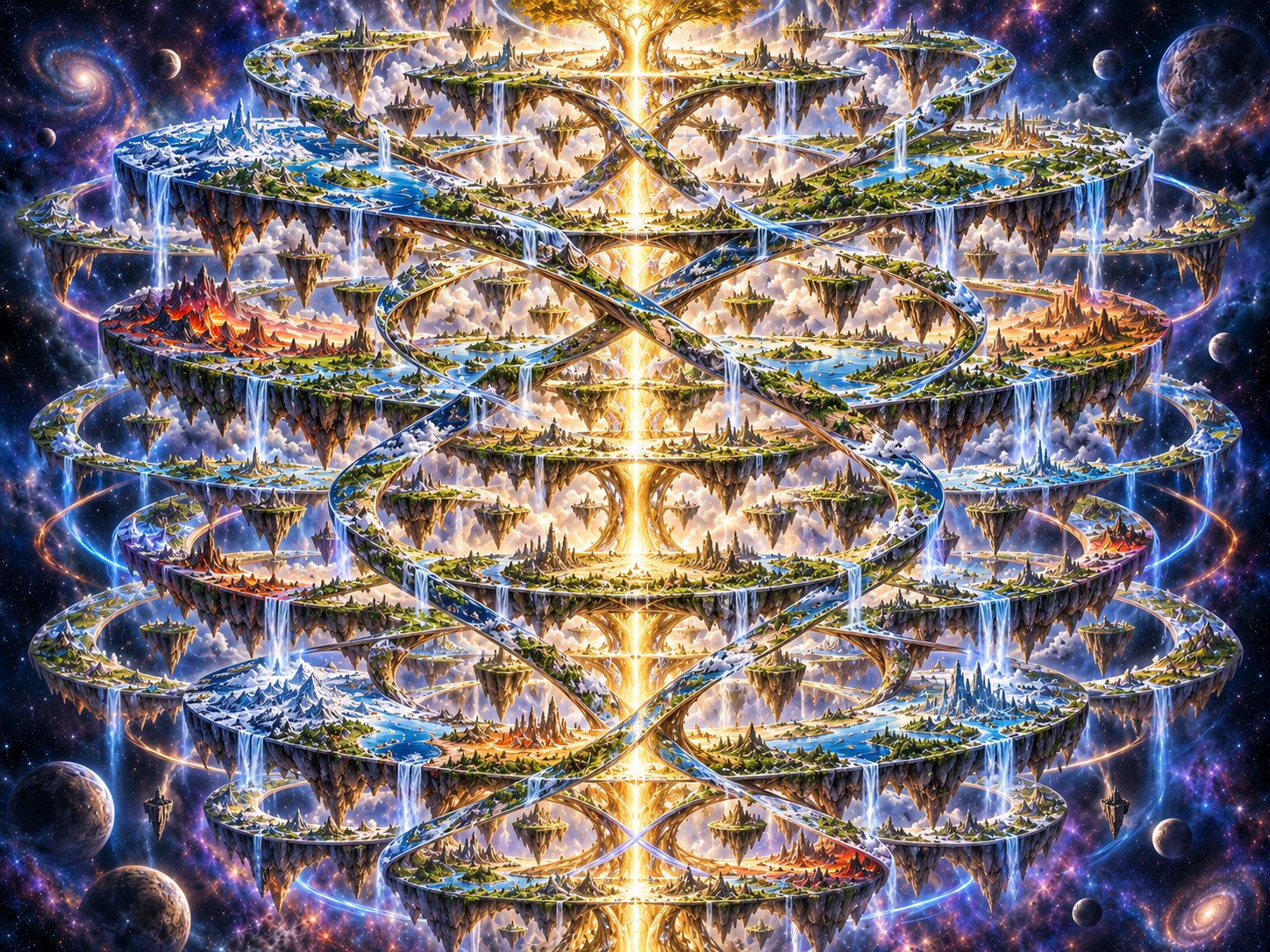
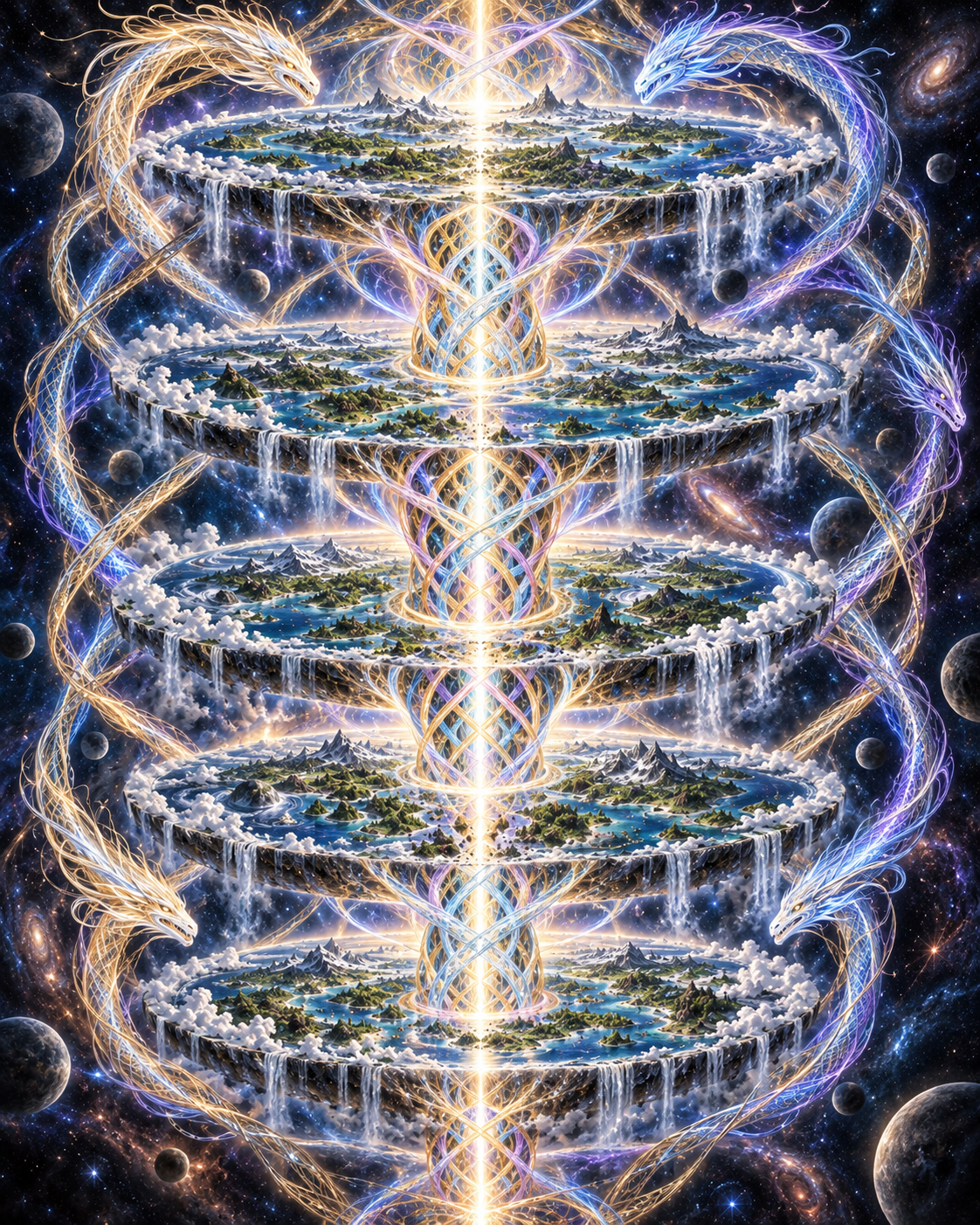
Vardath Cosmology — video overview
This video presents Vardath Cosmology in audiovisual form before the written overview and experimental interactive model below.
Current cosmological overview — read this first
This is the present working shape of Vardath Cosmology. The rest of the page preserves how the idea was reached, including earlier versions, tests, failed branches and later refinements.
Current model — consolidated reading order
The current material is now grouped before the historical archive so the latest model can be read as one sequence rather than as scattered additions. The order is: world-tree / switch → central spire / time throat → carriers and boundary travel → Revelation event-sequence comparison → full 453-post synthesis → historical development.
The worlds or layers are successive stabilised turns of a larger growing spiral structure. The inhabited world is one settled turn, with a previous/lower turn beneath it and a next/upper turn forming beyond it. In the present model each inhabited turn is a broad, materially deep flat world-disc supported and enclosed by a woven lattice-dome; the larger world-body can still curve, spiral and grow around those locally flat inhabited surfaces. Between and through those turns runs a two-directional woven lattice: one part of the structure can move upward while another moves downward, the strands crossing without needing to be cut.
During a quiet phase the lattice is broad and the worlds appear separated and stable. Under changing tension it can gather toward one or many convergence throats, collapse its many surface directions toward an axial state, and narrow into the scroll-like finger-trap rod. In that contracted phase the geometry can change which layers are adjacent, open temporary gates between them, and carry energy, atmosphere, water, debris or other material through the axial path. When the tension changes again, the structure reopens and a new stable arrangement forms.
Paired rods — narrow path / broad path

What I see in the viral image
What caught my eye is a piece of geometry rather than an archaeological identification. Two dominant vertical anthropomorphic or axial forms occupy the centre of the composition. The left-hand central form is extremely narrow, tapering and cord-like; the larger central form is much broader, patterned and body-like. Long lateral limbs branch away from both axes, while the main forms remain visually continuous in the vertical direction. In the Vardath model I read those two widths as a useful picture of two states of one finger-trap geometry: a constricted rod and an opened or broadened rod.
This produces a comparative echo with the narrow-gate teaching in Matthew 7:13–14: the narrow gate and way are associated with life, while the broad way is associated with destruction. I am not claiming that Lower Pecos artists encoded Matthew, and the uncertain/likely modern provenance of the viral image means it cannot establish an ancient connection. The useful observation is geometric: narrow axial state ↔ restricted passage; broad axial state ↔ opened passage. In a woven finger-trap, narrowing and broadening are mechanically linked states of the same tube, which is why the paired forms immediately suggested the comparison.
one woven axis → constricted / narrow state ↔ restricted path → opened / broad state ↔ discharge, rupture or destructive path
Source trail: the surviving 2025 provenance discussion records the vanished Facebook attribution and flags the spectacular paintings as fake. For documented Fate Bell context, see the Handbook of Texas entry for Fate Bell Shelter and the source-linked Wikimedia Commons photograph above.
A second core part of the present model is the vapour-canopy / upper-water flood cycle, and I now place it inside the active-door phase rather than treating it as a permanent background atmosphere. As the door opens and the plasma environment intensifies, the model proposes that the frozen upper-water reservoir is heated: ice melts → liquid water steams → a dense vapour canopy forms. During that interval the atmosphere becomes hotter, wetter and more strongly pressurised, with the high-oxygen/plasma-rich biological conditions explored later on this page. As the event weakens, the world cools → the steam condenses → the canopy falls as floodwater. In this version, the vapour canopy and the flood are two successive phases of the same water cycle.
stable shell → activation → convergence → axial gate / scroll rod → layer contact and transfer → deformation / catastrophe → reopening → stabilised world
The familiar symbols in the archive are read as different views of that changing geometry. Serpents and dragons describe the winding or braided current; trees, mountains, pillars, crosses, ladders and rods describe the gathered axis; wheels and eyes describe nodes or end-on views; arks, baskets, eggs, caves and enclosed worlds describe contracted or protected carrier states; opened heavens, floods, fires and wars of the gods describe the transition; and renewed worlds describe the reopened stable phase.
The three-world intuition therefore becomes three phases of one continuing growth process rather than three permanently independent cosmic objects: previous/lower stabilised turn → present inhabited turn → next/upper forming turn, with the active braid as the mechanism joining them.
The shortest statement of the model remains:
SERPENT → AXIS → ENCLOSURE → GATE → POLARITY → LATTICE → SHELL → SCROLL ROD → RESET → NEW WORLD
Yggdrasil as the time-switch — self-to-self, Norns, moving lands and the plenum
This branch began by returning to Odin’s ordeal on Yggdrasil and asking what the story would look like if the ash tree were not only a world-axis but the physical door in the Vardath cosmology. The result sharpened the door model considerably. I am no longer picturing a simple portal that removes a traveller from one place and drops them somewhere else. I am picturing a temporary switching junction in the woven finger-trap tree, where normally separated world-layers and times become physically adjacent and exchange what occupies them.
woven world-tree → strands converge → door / switch opens → separated times become adjacent → people and land exchange positions → weave closes → ordinary local time continues
Odin — “self to self” at the junction
In Hávamál, Odin hangs for nine nights on the tree, wounded by a spear, sacrificing himself to himself, looking downward before taking up the runes. Elsewhere, the prose tradition places Mímir’s well beneath one root of Yggdrasil and says that Odin leaves an eye there as the price of wisdom. The same larger tree-complex also places the Norns beside Urðr’s well.
The new interpretation is that Odin is fixed to the junction while the weave changes around him. If different positions on one life-thread are temporarily brought together at the same gate, “self to self” can be read in the model as more than sacrifice: two locally separated states of the same person can become neighbours at the switch.
Odin(t₁) → Yggdrasil junction ← Odin(t₂)
The mirror-self scenes that recur in modern stories became useful here as narrative analogies. The NeverEnding Story makes the traveller confront the self at the Magic Mirror Gate. Annihilation culminates in a lighthouse encounter where the humanoid double mirrors the traveller’s movements. These films are not evidence for the cosmology; they show how persistent the threshold → doubled self → identity transformation structure remains in modern storytelling.
 Odin’s self-sacrifice on YggdrasilLorenz Frølich · 1895 · Wikimedia Commonstree / axis · suspension · wound · self-to-self · revelation
 Yggdrasil and the well beneath itLorenz Frølich · 1895 · Wikimedia CommonsThe world-tree presented as a vertical connector with a lower water boundary.
The Norns — temporal relations at the root of the tree
The three named Norns — Urðr, Verðandi and Skuld — stand at Urðarbrunnr beneath Yggdrasil and shape lives. I am using their names less as three sealed boxes called “past, present and future” and more as three relations to one changing weave: what has become, what is becoming, and what is due / shall become.
That makes the Norns useful for the switch model. They are not merely observers looking along a timeline; in the cosmological reading they stand where routes through the tree are assigned. “Fate” then becomes analogous to which strand a person, population or piece of land follows when the junction changes.
 The three Norns at UrðarbrunnrLorenz Frølich · 1895 · Wikimedia CommonsUrðr · Verðandi · Skuld at the well beneath the world-tree.
 Norns and the threads of fateL. B. Hansen · 1893 Edda illustration · Wikimedia CommonsA later visual tradition makes the thread metaphor explicit beside Yggdrasil.
The door becomes a switch rather than a hole
The important correction in this conversation was switch places. The event is not only somebody entering a doorway. During the active phase, time rearranges adjacency. A piece of one world-layer can meet a piece of another, and matter can move through the temporary contact while each traveller still experiences ordinary forward motion locally.
Diagram · The Yggdrasil switch
This also changes the scale of the event. The gate could carry one person, but if the open seam extends across the lattice it could also move settlements, coastlines or larger pieces of land. Partial engagement could instead drag, compress, bury or deform material without completing an exchange.
| state of the weave | Vardath interpretation | possible experienced result |
|---|---|---|
| stable | ordinary adjacency | continuous local geography and time |
| partial convergence | strands pull against one another without full transfer | compression, displacement, burial, deformation |
| full switching contact | two separated layers become locally adjacent | people, structures or land physically cross / exchange |
| closed after exchange | new routes become locally normal | inhabitants continue forward inside a changed world-context |
The Mad Tea Party — a locked-time special case, not the whole event
The Mad Hatter’s tea party helped distinguish two phenomena. In Alice’s Adventures in Wonderland, the Hatter explains that after his quarrel with Time it is always six o’clock at the table. That is a useful image for a local loop or locked temporal address, but it is only one possible failure-mode of the larger mechanism I am describing.
The main event is dynamic: people and lands can move while the weave is rearranging. A locked region would instead be a strand that reconnects to the same temporal position repeatedly rather than being routed onward.

Moving lands — absence is only half the prediction
Once the door became an exchange switch, the disappearance of a culture or land was no longer the main thing to look for. Every removal should imply an arrival or replacement somewhere else in the larger structure. That means the stronger signature is not merely “something vanished,” but mismatched adjacency: material, people, architecture, stories or landscapes appearing in a context that does not fit the sequence around them.
During the conversation, Tartaria and the Maya were raised as possible examples to think with. At this stage I am treating them as candidate test cases, not confirmations. The useful question is not “can I make a vanished civilisation fit the model?” but “what physical or chronological signature would a real exchange leave that ordinary political change, migration, environmental collapse, relabelling or rebuilding would not?”
transfer hypothesis → predict paired discontinuity first → then inspect archaeology / geology / maps
This keeps the hypothesis falsifiable. A completed land exchange should ideally leave some combination of paired boundary effects, abrupt material discontinuities, unusual chronological adjacency or matching displaced signatures elsewhere. If those are absent and ordinary historical continuity explains the record, the transfer interpretation loses support.
The plenum — rearrangement without empty space
The final concept added in this conversation was the plenum: a space completely filled rather than containing true empty gaps. In René Descartes’ mechanical philosophy, material extension filled space and celestial motion was described through interlocking vortices. A body could not simply move into an empty place; motion required the surrounding matter to move as part of a larger circulation.
That is not being adopted as modern physics. Its importance here is conceptual. A plenum gives the Vardath switch a clean rule: if every available position is already occupied, movement through the event must be displacement, circulation or exchange rather than disappearance into nothing.
A B C D E → E A B C D
In that sense the plenum analogy joins the finger-trap and Yggdrasil ideas. The woven structure does not need an empty external container into which land temporarily vanishes. The weave changes its connections, and occupied regions push, trade or reroute one another as the event runs.

Current statement of the time-door idea
The model coming out of this exchange is therefore:
Yggdrasil is the woven world-tree and temporary switch. The Norn-like temporal relations describe where strands have come from, what is changing now and what route becomes due next. During the event, normally separated layers can become physically adjacent. People and land can move through that adjacency and exchange positions. Local time still feels continuous to those carried along the strand. A plenum-like rule means the event rearranges occupied reality rather than sending matter into empty nothingness.
This makes the earlier “door” language more exact. The door is not primarily an opening in space. It is the moment when the weave changes who and what is next to whom — and therefore when time can physically rearrange the world.
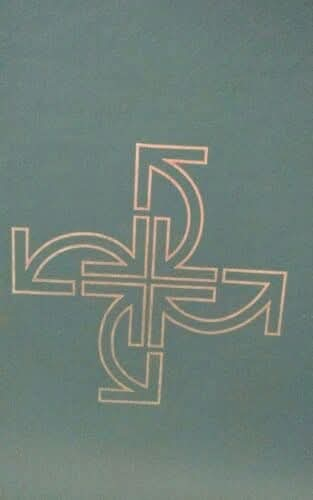
The central spire as the fast-time throat — Fountain of Youth, plasma flow and the open door
This adds another piece to the Yggdrasil time-switch. If the past, the now and the future are not completely separate places but different positions in the same woven structure, then the central spire may be the place where the distance between those positions becomes shortest. I am not picturing the spire as a clock sitting in the middle of the world. I am picturing it as the temporal throat of the world-tree: the place where a small movement through the structure can correspond to a very large movement through history.
past + now + future remain separated while the door is closed → the weave opens at Yggdrasil → temporal layers approach one another → the spire becomes a high-throughput route through time → the weave closes → ordinary local time resumes
Fast time does not have to mean fast aging
There are two different things I need to keep separate. One is how quickly the world advances relative to another layer. The other is how much time the traveller personally experiences. They do not have to be the same.
If the open spire allows a thousand years of world-history to pass while a traveller experiences only a short interval, then from the traveller's point of view the world has moved through time enormously quickly. The traveller has not necessarily aged through those thousand years. This gives the old Fountain of Youth idea a possible place in the same mechanism: the "fountain" may not reverse age at all. It may be a place where very little personal time is accumulated while a great deal of world-time passes around it.
small traveller-time + enormous world-time = return to a much older world while remaining comparatively young
That would make the Fountain of Youth less like magical water that repairs the body and more like a surviving description of the central temporal current. Someone goes into the fountain, well, spring, tree, cave or central opening and later returns without having aged in proportion to the world outside.
The spire as a temporal gradient
The central spire may therefore be the place where time is not simply "faster" or "slower" in one universal sense. It may be where the difference between temporal rates is greatest. Far from the door, neighbouring places share roughly the same time relation. Near the door, one step toward the axis could place a traveller beside a part of the weave that is much farther ahead or behind in the larger history.
Diagram · The spire as a temporal throat
The plasma may be the visible current, not the clock
This also changes how I interpret the intense plasma flow I associate with the open door. I do not need the plasma itself to be the thing that magically speeds time up. The more coherent possibility is that the door changes the geometry first, and the plasma is what matter and electromagnetic energy do while being forced through that changed geometry.
When the door is closed, the temporal layers are separated and the local world follows its ordinary rhythm. When the door opens, the central path is established and the plasma fountain becomes the visible current through it. The flow may therefore mark the period in which the different layers are coupled. While that coupling remains open, time here could advance very differently relative to another layer. When the structure closes again, the ordinary relationship is restored.
door closed → ordinary temporal relation
door opens → temporal throat + intense current → different layers accumulate different amounts of elapsed time
door closes → ordinary relation resumes, but the layers now contain different amounts of history
Why fountain, tree, well and spire may be one thing
This gives me a reason that the old images keep overlapping. The tree is the vertical structure. The well or fountain is the opening at its root. The spire is the same axis seen as a rising column. The flowing water is the human-scale image of a current through that axis. In the physical version I am exploring, that current may instead be plasma, charged matter or another energetic flow associated with the opening.
The names then describe different views of one structure:
| image | Vardath interpretation |
|---|---|
| Yggdrasil / world-tree | the full woven architecture connecting the layers |
| central spire / world-axis | the narrowest and strongest temporal-gradient region |
| well / fountain | the accessible mouth of the central route |
| water / plasma fountain | the visible flow through the active route |
| Fountain of Youth | a possible memory of travellers accumulating little personal time while much more world-time passes |
Past, present and future interacting with the now
The most important change is that the present is no longer a razor-thin line isolated from everything else. In this model the present is the part of the weave I currently occupy. The past still exists as the route the weave has already taken and the future exists as routes available farther along it. Normally they are separated by the structure itself. During the opening, that separation can collapse locally.
That means the strange effects around the central spire would not have to be "time travel" in the simple machine sense. Past, present and future can become neighbours at the same junction. A person, a population or even a piece of land can continue moving forward locally while the route under it is switched to a different temporal address.
the traveller does not need to run through a thousand years → the door can change which thousand-years-apart part of the weave is next to the traveller
This fits the larger model better than treating the spire as an engine that merely accelerates clocks. Yggdrasil is the structure, the door is its temporary switching state, the central spire is the temporal throat, and the fountain is the current through that throat. If the opening lasts long enough, enormous differences in elapsed history could build up between connected layers. When it closes, everybody again experiences ordinary local time, but they may now be standing in a world whose history has advanced by a radically different amount.
Interactive nine-disc dragon-lattice simulation — closed lattice, open door
I am now picturing the larger structure as nine flat disc-worlds stacked above one another. The moving Möbius-like action belongs to the sky-dragon lattice rather than to the discs themselves.
When the door is closed, the lattice is separated and flattened into the layers. Under each disc, two twines combine to form one supporting lattice. During activation those flattened twines begin to energise, lift away from the layers, and reorganise into the opposed rising and descending weave. The crossing weave then tightens through the middle as the finger-trap / door structure. In the working sequence, plasma builds the conductive path first, atmosphere and vapour follow, water completes the bridge, and land transfer becomes possible once the geometry is fully engaged.
Waterborne children — the prediction meets the corpus
The baby-in-the-river stories became important to the travelling-fingertrap model for one reason: they gave it a way to be wrong. The idea was no longer simply that many traditions contain a child, a basket and water. The proposed sequence was more specific: a living child enters a contracted carrier, moves with a current, reaches a boundary or receiver, and emerges into a changed household, identity or world.
That sequence is close enough to the proposed sky mechanism to test directly:
life / child → contracted fingertrap / basket / ark → current → boundary / gate → reception / reopening → changed household, identity or world
Before the search was run, the sequence was frozen into three parts: F1 — enclosure geometry, F2 — a boundary or receiver, and F3 — changed household, identity or second-birth language. The point was to see whether those parts actually travel together more often in waterborne-child stories than in exposed-child stories that do not use water.
The twenty-language test
The search was split across twenty languages: English, French, German, Spanish, Italian, Portuguese, Dutch, Polish, Czech, Russian, Ukrainian, Greek, Turkish, Arabic, Hebrew, Persian, Hindi, Bengali, Japanese and Chinese. The discovery terms deliberately did not contain the basket, enclosure, receiver or rebirth words being tested. Local discoveries were mapped through Wikidata to English records and then scored against the vocabulary that had already been fixed.
The finished search produced 5,204 raw discoveries, 4,599 English-mapped occurrences and 3,628 unique English candidates. Evidence was recovered for 4,547 of the 4,599 mapped occurrences — 98.9%. After deduplication there were 3,584 usable records. The frozen eligibility rules retained 399 exposed-child records: 203 waterborne stories, 160 non-water controls and 36 ambiguous-water records kept out of the direct comparison.
The six stories chosen in advance as a coverage check were all recovered: Moses, Sargon of Akkad, Karna, Romulus and Remus, Danaë and Perseus. They were checks that the search could find the obvious family members, not stories forced into the result.
 Moses in the bulrushes1910 illustration · Wikimedia Commonschild · floating enclosure · current · receiver
 Sargon of AkkadAkkadian royal head · Wikimedia Commonsriver exposure · enclosed carrier · reception · new life
 KarnaMahabharata painting · Wikimedia Commonsriver passage · recovery · changed household
 Romulus and Remus on the TiberGiovanni Battista Fontana · 1575 · Wikimedia Commonswater transport · reception · transformed upbringing
 Danaë and Perseus cast away16th-century print · Rijksmuseum / Wikimedia Commonsenclosure / vessel · sea journey · receiving shore
What came back
| frozen test | waterborne | non-water controls | risk ratio | result |
|---|---|---|---|---|
| At least 2 of F1/F2/F3 | 110/203 = 54.2% | 49/160 = 30.6% | 1.77×p=7.37×10⁻⁶ | PASS |
| F1 — strict enclosure geometry | 37/203 = 18.2% | 12/160 = 7.5% | 2.43×q=0.00417 | PASS |
| F2 — boundary / receiver | 132/203 = 65.0% | 68/160 = 42.5% | 1.53×q=0.0000833 | PASS |
| F3 — changed identity / second birth | 138/203 = 68.0% | 95/160 = 59.4% | 1.14×q=0.0987 | FAIL |
| All three together | 18/203 = 8.87% | 2/160 = 1.25% | 7.09×q=0.00360 | PASS |
| unrelated comparison motifs | 71/203 = 35.0% | 51/160 = 31.9% | 1.10×p=0.576 | flat |
The pattern did not come back as a vague “water stories contain water” effect. The combined package appeared in 54.2% of the waterborne group against 30.6% of the non-water exposed-child group. The strict carrier geometry was 2.43 times as common, and a distinct receiver or boundary was 1.53 times as common.
The sharpest result was the whole sequence. Enclosure + receiver + identity change appeared in 18 waterborne records but only 2 controls — a 7.09× difference. That is the closest corpus version yet of the full travelling-fingertrap path rather than one isolated motif.
What the test changed
One part of the original expectation separated from the others. F3 did not distinguish the groups by itself. Changed parentage, adoption, renaming and second-life themes already belong strongly to exposed-child stories in general. So identity change is not the water-specific key.
What is different in the waterborne group is the geometry around that change: a bounded carrier and a distinct receiving edge. In other words, the result tightens the model. The sequence now looks less like “water causes rebirth” and more like:
enclosure → carried transition → receiving boundary → changed state
That matters because it is exactly the part of the story that resembles the travelling fingertrap: something alive is enclosed in a contracted form, carried through a channel, reaches an edge, and is received on the other side.
The next test
The first multilingual pass has now done its job: it found a real separation and it also showed which part of the original prediction was too broad. The next experiment can therefore be narrower. Build a second corpus made only from deliberately curated myths, fables, epics and religious narratives, freeze the same carrier → boundary → changed-state structure again, and ask whether the 1.77× combined effect and especially the 7.09× complete sequence survive.
That is the useful progression of the Cosmology research: the picture produces a prediction; the prediction is frozen; the corpus pushes back; and the model becomes more specific rather than simply absorbing whatever result appears.
A second pass — each mythology against the same mechanism
The regional survey below becomes more useful when every tradition is asked the same question. I am not looking for identical names or theology. I am asking whether the story preserves one or more of the same structural stages: enclosure or primordial medium → differentiation → axis or gate → crossing/conflict/transfer → rupture → renewed order. This second pass makes the comparison explicit rather than leaving the reader to infer it from the separate stories.
shell / water / enclosure → axis / gate → movement between layers → material or living transfer → catastrophe / release → new stable world
Finnish / Karelian
Primeval water + cosmic egg + Sampo. The egg gives the bounded shell that breaks into an ordered cosmos; the Sampo supplies a generative centre or support whose making, struggle, breaking and dispersal can be read as the axial state becoming active and then redistributed. This is one of the clearest northern combinations of enclosure, axis and re-formation.
Second-pass — Estonian / Baltic-Finnic
Bird + egg + water + world pillar/tree. The same watery-egg creation family is paired more visibly with a turning or supporting sky axis. In the Vardath sequence this fills the missing middle stage between shell and reopened world: shell → gathered axis → ordered heaven.
Sámi
Layered worlds + vertical cosmogram + movement between levels. The important correspondence is not an egg but access. Drum cosmograms, upper/middle/lower regions and the noaidi’s movement between them resemble a world in which layers are normally distinct but can be reached through a structured vertical relation.
Komi, Mari, Mordvin, Udmurt and related Uralic traditions
Primordial water + bird/earth-diver + dual ordering powers. Here the emphasis shifts to how stable land is extracted from or organised within an undifferentiated watery field. In Vardath terms this is the medium-to-node-to-world phase rather than the catastrophe phase.
Mesopotamian
Apsu/Tiamat + net/winds + division + flood survivor. Primordial waters become structured through capture, conflict and division; Gilgamesh then preserves the flood/reset memory at the human scale. This gives nearly the whole sequence from undifferentiated medium to divided world to catastrophic reset.
Egyptian
Nun + first mound + Nut/Shu/Geb + solar passage. The world emerges from water, an upper canopy and lower earth are separated, and a cyclical path operates through the enclosed cosmos. The strongest Vardath correspondence is water → emergence node → separated shell layers → repeated traversal.
Iranian / Zoroastrian
Yima’s Vara + preservation through catastrophe + renovation. Life is enclosed and protected while a destructive transition passes outside, then survives into renewed order. This is the large-scale equivalent of the travelling-carrier pattern: life → enclosure → catastrophe → preservation → next world.
Greek / Roman
Encompassing sky + forced separation + monster conflict + flood/enclosed survivors. Uranus/Gaia, generational replacement, Deucalion and Danaë/Perseus repeatedly return to a world that changes order through separation, conflict and transport. The strongest fit is closed state → violent opening → transfer/survival → new order.
Hebrew / Jewish
Waters divided by firmament + ark + Moses basket + ladder/mountain/rod/chariot. The same tradition carries the pattern at several scales: world enclosure, preserved life in enclosure, child in enclosure, and traveller at gate. This nesting is important to my model because the same geometry appears from world scale down to human scale.
Christian
Cross/axis + opened heaven + Revelation sequence + renewed world. Revelation adds the most complete single-text progression: fourfold activation, eyes, dragon, rod, falling stars, rolled sky, displaced land and then a new world with gates, river and tree. The separate Revelation section follows that sequence in detail.
Second-pass — Islamic / Qur’anic
Layered heavens + ark + Musa in chest + staff opening the sea. The carrier enters water, reaches a receiving boundary and later the rod itself opens a passage through water. This gives a particularly compact cluster of enclosure, current, receiver, rod and opened gate.
Second-pass — Vedic / Hindu
Primordial waters + Vṛtra + Indra + churning axis + Meru + repeated dissolution. Few traditions place so many relevant geometries together: serpent obstruction, released waters, axial churning, cosmic mountain and cyclical destruction/recreation. In my reading this is a near-complete mechanical vocabulary distributed across many stories.
Buddhist
Meru + layered heavens/continents + Bodhi tree/witness. The emphasis is the stable cosmogram rather than catastrophe: a multi-level world ordered around a centre. The Bodhi image brings the large world-axis into human scale as person beneath living axis.
Jain
Layered cosmic geography + central organising geometry + cyclical time. The correspondence is structural rather than narrative: worlds arranged in ordered levels and repeating temporal phases resemble the stable architecture before and after a transition.
Chinese
Pangu enclosure/separation + Nüwa sky repair + Yu flood ordering + dragons. Creation, rupture and repair are all explicit. The model correspondence is enclosed beginning → sky/earth separation → damage → repair → reordered water flow.
Japanese / Shintō
Floating Bridge of Heaven + heavenly spear + primeval ocean + Yomi boundary + Amaterasu reopening. This is unusually geometric: an upper platform, an axial implement entering a fluid medium, material gathering into land, then crossings and closures between realms.
Norse
Yggdrasil + Odin + Sleipnir + Bifröst + serpent + Ragnarök. Axis, operator, vehicle, bridge, boundary-serpent, catastrophe and renewed world are all present but distributed among different myths. In Vardath terms the tradition preserves almost every role in the event grammar.
Second-pass — Celtic / Insular
Otherworld across sea/beneath land + mounds + wells + trees + vessels + woven/interlaced forms. The strongest fit is not one creation myth but repeated threshold access: another layer is nearby, special places or vehicles permit crossing, and water frequently marks the boundary.
Slavic
Perun above + Veles below/watery/serpentine + world-tree conflict. The vertical opposition resembles the Indra–Vṛtra pattern: upper electrical force acts along an axis against a lower serpent/water power. The story preserves the activated axial conflict phase.
Second-pass — Yoruba
Sky above + waters below + descent by chain + formation of land. This is a direct vertical-interface story: upper realm → connecting line/axis → lower watery medium → stable land/node. It maps closely to the emergence of an inhabitable layer from a connected upper/lower system.
West African serpent / water / sky traditions
Serpent, rain, river, sky and underworld-water powers. The recurring geometry is mediation: winding force linking atmosphere, terrestrial order and water. I place this beside Rainbow Serpent, Vṛtra and Veles as another regional expression of the serpent/current role.
Haudenosaunee
Sky World + fall through boundary + water below + reception + land formed on Turtle. Sky Woman is one of the clearest vertical-transfer creation stories: life crosses from an upper world into a watery lower field and a new habitable surface grows from the receiving event.
Nahua / Aztec
Quetzalcoatl + wind + feathered serpent + repeated world ages. The serpent is joined to atmospheric motion and cyclical world replacement. In my reading it contributes the winding atmospheric current + repeated reset side of the mechanism.
Maya
Creation from primordial conditions + sky/earth ordering + rain/water powers such as Chaac. The useful comparison is the building of an ordered world through layered sky, land and water relations, then maintaining it through celestial and rain powers.
Australian Rainbow Serpent traditions
Winding creator current + water + land shaping + emergence from/return to water. This remains the earliest branch of the whole Cosmology. It is the clearest mythic image of the model’s persistent current moving through a landscape and changing the shape of Country.
Māori
Rangi and Papa enclosed together + forced separation + light/space + ordered world. The world begins compressed between sky and earth; separation opens the inhabitable realm. This maps directly to closed adjacency → axial/separating action → expanded stable world.
Wider Polynesian
Layered heavens + oceanic travel + islands raised/fished from sea + genealogical creation. The model correspondence is strongest where vertical layering meets oceanic emergence: land is brought out of a fluid medium and worlds are arranged as levels connected by descent or ascent.
What survives across the whole comparison
Once every tradition is forced through the same sequence, the recurring structure is narrower than “all myths are the same.” The strongest recurring families are primordial water or enclosure; a vertical support, tree, mountain, rod, chain or bridge; a serpent/current or conflict at the boundary; movement of life or material between levels; flood/fire/rupture; and a rebuilt or reopened world.
That is why I now treat the mythologies as different camera positions around one proposed mechanism rather than as copies of one story. Finland and the Baltic-Finnic field preserve the shell/egg and support; Mesopotamia preserves primordial medium, capture and division; Egypt preserves canopy and separated layers; India preserves serpent, waters and axis; Norse myth preserves axis, vehicle and reset; Haudenosaunee preserves vertical transfer into a water world; Māori preserves separation of compressed sky and earth; Revelation preserves an unusually long event sequence. The differences are part of the model: each tradition emphasises what its viewpoint made memorable.
The source-linked thumbnails attached to the regional subsections are there to keep the comparison tied to real manuscript, monument, codex, carving and historical-art traditions while the textual argument stays here in the Cosmology itself.
Waterborne-child / travelling-fingertrap test
These images are source-linked visual anchors for the canonical retrieval audit in the completed 20-language test. The images do not determine the statistics; they make the source traditions inspectable.
Moses in the bulrushes1910 illustration · Wikimedia Commonscanonical audit · floating enclosure · Nile journey · receiver
Sargon of AkkadAkkadian royal head · Wikimedia Commonscanonical audit · ancient river-exposure birth tradition
KarnaMahabharata painting · Wikimedia Commonscanonical audit · river exposure · changed household
Romulus and Remus exposed on the TiberGiovanni Battista Fontana · 1575 · Wikimedia Commonscanonical audit · water transport · reception · transformed upbringing
Danaë and Perseus cast away16th-century print · Rijksmuseum / Wikimedia Commonscanonical audit · enclosure/vessel · sea journey · receiving shore
Corpus-hit thumbnails — exact records scored in the 20-shard test
These are not generic illustrations added after the statistics. Each card below is an actual Wikimedia Commons target record contained in the successful 20-shard artifact. The caption records the symbol-family flags assigned by the frozen test vocabulary. Click a thumbnail to open the exact source record.
 The Masonic LadderMasonic target record · 1850Test hit: gate / ladder. This is the literal ascent family behind the Masonic gate/ladder prediction.
 Washington Masonic printMasonic target record · 1870Test hit: four / eight geometry. It belongs to the family that finished 8.00× more frequent than matched Masonic controls.
 Collection of Freemasons’ symbolsWellcome Collection · sampled Masonic targetTest hits: central node / radiance + four / eight geometry. One image carries the radial-node and ordered-geometry families together.
 Interior of the Old Masonic TempleDPLA / Commons · sampled Masonic targetTest hits: axis + gate / ladder. Architectural verticals and passage geometry occur together in the same scored record.
 Alchemical manuscriptWellcome Collection · 1574Test hit: serpent / braid. It is one of the historical visual records contributing to the strongest alchemical family.
 Amphitheatrum sapientiae aeternae — laboratoryAlchemical target record · 1595Four test hits in one record: axis + gate / ladder + serpent / braid + water / vessel. This was among the densest actual corpus matches.
 Ripley alchemical scrollLeonard Smethley after George Ripley · 1624Three test hits: axis + serpent / braid + central node / radiance. This is a direct multi-family corpus record rather than a post-test analogy.
 Lion-headed serpent devouring its tailAlchemical target record · 1728Test hit: serpent / braid. The catalogue itself describes an entwined tail and alchemical mercury/sulfur combination.
 Alchemical symbolic pen drawingsWellcome Collection · 1702Test hits: serpent / braid + central node / radiance. A scored historical record combining winding and luminous/node language.
 Ripley Scroll — prime matter in a vesselLeonard Smethley · 1624Three test hits: gate / ladder + central node / radiance + water / vessel. It shows how the corpus could carry process families without carrying the whole Vardath package.
What these exact hits show: the statistics are not being illustrated with unrelated art. The Masonic sample contains literal square/four-eight and passage/ascent records, while the alchemical sample contains a much denser historical run of serpent/entwining records. The cards also show why the broad ≥3-family prediction failed: some individual images are multi-family, but most corpus hits specialize in one or two families rather than reproducing a single complete diagram.
Water goats and water horses — Enki, the World Door and Sleipnir
The water-horse family adds a new kind of transport to the cosmology. The basket and ark carry life through a dangerous current while the passenger remains enclosed. The water horse does something different: the boundary itself produces a vehicle. A rider meets the creature at a pool, river, waterfall, loch, shore or other edge, couples to it by mounting, and is carried somewhere that ordinary movement should not reach.
The Welsh Ceffyl Dŵr is especially striking inside this reading. It belongs to the wider water-horse family alongside kelpies, each-uisge and northern nix/nøkk traditions. It is associated with mountain pools and waterfalls, but also rivers and seashores. In some accounts it carries riders enormous distances with unnatural speed; in others it flies into the sky, dissolves into air or mist, changes form, or returns violently to the water.
That combination makes the horse more than an animal beside water. In the Vardath model it behaves like a moving interface at the edge of worlds. The water marks the boundary. The horse emerges from that boundary. The rider joins to it. Distance collapses. Water, air, mist and sky become different faces of the transition medium. The journey ends when the coupling breaks.
boundary water → vehicle appears → rider couples → impossible transit → mist / sky / other shore → release
Ceffyl Dŵr → World Door
The name also gives me a useful symbolic bridge. I hear Dŵr / Door beside the older gate language already running through the Cosmology. In that reading the water is not scenery around the horse: it is the World Door, the unstable boundary between one region and another, and the horse is the thing that can move through it.
This sharpens the older gate idea. A gate does not always have to appear as a stone doorway, mountain cleft or visible opening. A pool, waterfall, shoreline, fog bank or dark river can perform the same role if crossing it changes what world, layer or state can be reached.
Water goats and water horses — was one image replaced by another?
Before the water horse there is another, older figure worth putting beside it: the water goat, or more precisely the goat-fish. I suspect we may be looking at a long change in how people pictured the same class of boundary phenomenon. In one tradition it is a horned animal joined to a fish; in another it is a horse joined to a sea-creature's tail; elsewhere it is a seemingly ordinary horse that rises out of a lake and takes its rider somewhere impossible. The resemblance is worth examining, but resemblance alone does not establish that one people replaced the goat with a horse.
The older goat-fish — Enki, Ea and the water beneath the world
Mesopotamia gives us a securely documented starting point. The Sumerian/Akkadian Suḫurmāšu (goat-fish) has the forequarters of a goat and the tail of a fish. It is the emblem of Enki/Ea, the god associated with wisdom, incantations and the Abzu/Apsu, the subterranean freshwater domain. This is not a modern reconstruction from the appearance of Capricorn: actual Mesopotamian texts and objects preserve the association. A Middle Assyrian vessel of the fourteenth–thirteenth centuries BCE bears the goat-fish emblem; a Neo-Assyrian terracotta figurine, now in the Louvre, depicts the animal explicitly and identifies its connection with Ea.
The figure also survived in the stars as the Goat-Fish, Capricorn. Its earliest significance therefore cannot be reduced to a story about a rider or a monster at a loch. The older documented role is a divine emblem of the waters below, and later an astronomical image. In the Vardath reading, a land-animal front joined to an aquatic lower body makes a useful picture of one form belonging to two environments, at a junction between land and the water reservoir beneath it. That last sentence is my cosmological interpretation, not an ancient statement of finger-trap mechanics.
Primary anchors: ORACC, Ancient Mesopotamian Gods and Goddesses — Goat-fish; Metropolitan Museum, Art of the Ancient Near East; Louvre, Suhurmashu figurine (AO 10884).
Capricorn and Aegipan — the goat changes element without disappearing
Later Greek and Roman accounts give the horned hybrid a narrative life. In the Typhon cycle Pan is said to have escaped into water and taken a partly piscine form; another tradition tells of Aegipan, a goat-associated being who, with Hermes, helped recover Zeus's stolen sinews. The stories are not all the same, and the surviving variants do not prove that their authors knew the original Sumerian explanation. They do show that the goat-fish could be recast as transformation, rescue and movement between elements while remaining recognisably a goat-fish. Most importantly, it was not erased: Capricorn kept the horned aquatic creature visible in later zodiacal imagery.
Classical source guide: Aegipan in Greek and Roman texts (Apollodorus, Hyginus and the constellation traditions).
The Greek hippocamp — the horse takes the aquatic tail
Alongside that goat-fish stands the Greek hippocamp, usually shown with the front of a horse and the twisting tail of a marine creature. It accompanies sea gods and Nereids and can draw the chariot of Poseidon. Surviving Greek depictions extend to the late seventh century BCE. We therefore have a documented water-goat form and a documented water-horse/fish form in the ancient Mediterranean world, but not a text saying, “the goat became the horse.” They could coexist because they served different divine and artistic contexts. The Greek hippocamp should also be distinguished from the later Celtic water horse: one is visibly a composite sea mount; the other often looks like a complete horse until it reveals its supernatural nature.
Comparative research: Between Ancient Animal Studies and Mythology: The Case of the Hippocamps and Other Mixokētē, Greece & Rome.
The later folklore horse — the boundary becomes dangerous and rideable
The Gaelic each-uisge, Scottish kelpie, Welsh Ceffyl Dŵr and related northern water-horse stories shift the emphasis to an encounter. The animal comes from loch, river, pool or shore; a person may mount it, be carried into water, vanish, or be unable to escape. Not every version ends in travel to another realm: some are explicit drowning warnings. The recurrent features are the water boundary, an animal crossing it, and the peril of contact or passage. One study of Gaelic water-horse folklore even proposes connections with the Pictish Beast and early medieval imagery, although that proposal does not trace the horse back to Mesopotamian goat-fish iconography.
Folklore research: Raghnall MacilleDhuibh, An t-Each-Uisge, Scottish Studies; University of Edinburgh thesis on water-kelpies and liminal freshwater traditions.
The forms compared
Goat-fish / Suḫurmāšu
Goat forequarters + fish tail. Mesopotamian emblem of Enki/Ea, the freshwater Abzu and later Capricorn. The source-water or junction side of this comparison; no ordinary human rider is necessary.
Hippocamp / sea horse
Horse forequarters + marine tail. Graeco-Roman mount and chariot animal of sea divinities. It joins the same land/water anatomy to the more active function of carrying someone.
Each-uisge / kelpie / Ceffyl Dŵr
Often an apparently entire horse. A shapeshifting or dangerous being at freshwater and shore boundaries. The crossing, lure and rider dominate the narrative rather than a permanently visible fish tail.
Capricorn's survival
The counterexample to complete replacement. The goat-fish image persisted while horse forms were also known. This points to overlapping and changing motifs, not a demonstrated worldwide substitution.
My hypothesis — an older boundary image, retold through another animal
What I want to test is not merely that goats and horses both appear near water. The sharper possibility is a change in emphasis: from the goat-fish as a visible sign of the subterranean source, to the hippocamp as a creature able to move through the water, to the later water horse as the moving gate itself. If people preserved the experience of a dangerous water boundary but changed which familiar animal expressed it, then the imagery could evolve while the underlying crossing motif survived. In my cosmology, the candidate constant would be water / lower reservoir → boundary → transfer between regions or layers. Goat, horse and fish would be different symbolic bodies placed over that proposed mechanism.
goat-fish: source / land-water junction → hippocamp: aquatic mount → water horse: rider + dangerous threshold
The next useful test is to compare dated examples by animal form, habitat, divine owner, rider, route, danger, sky/underworld association and source date. If goat-fish figures give way to horse forms with the same associated names and functions in a traceable tradition, the replacement hypothesis gains evidence. If goat and horse remain parallel or their functions differ, the model must keep them as separate branches of the wider water-boundary motif.
Why this connects to Sleipnir
This is where the water horse meets Sleipnir. Sleipnir is already the vehicle in my Norse event grammar: Odin is the operator, the spear is the rod, and Sleipnir is the mount that carries the operator between otherwise separated realms. The old Gotland image-stone tradition even preserves the rider and extraordinary horse together as an arrival/journey image.
The water horse and Sleipnir are not identical creatures, but they occupy the same functional position. Both are supernatural mounts whose defining power is not strength alone but boundary-crossing movement. The Ceffyl Dŵr appears from water and can carry a rider into impossible distance, sky or mist. Sleipnir carries Odin through the worlds and is also used for the journey to Hel and back. One is remembered through the local language of pool, river, shore and dangerous water; the other through the cosmic language of the Nine Realms.
water horse = local boundary mount | Sleipnir = world-system boundary mount
That makes the horse motif more useful to the mature model. The horse is not simply “transport.” It is a coupling mechanism between traveller and gate. The rider cannot make the crossing alone; the mount can. The same broad role appears in the earlier Vardath grammar as OPERATOR → VEHICLE → GATE, but the water-horse material shows the order from the other side: GATE → VEHICLE → RIDER TRANSFER.
Two carrier modes now appear
Enclosed carrier
Basket / ark / chest / vessel. Life is protected inside a bounded form and the current carries the whole enclosure through the transition. This is the passive carrier mode seen in the waterborne-child family.
Mounted carrier
Water horse / Sleipnir. The traveller couples directly to a living or supernatural vehicle capable of crossing the boundary. This is the active carrier mode.
The two modes may be different cultural views of the same transport problem: how does something living survive or traverse a boundary that ordinary movement cannot cross? In one family the answer is enclosure. In the other the answer is a mount.
What this predicts next
If this is a real structural family rather than a loose resemblance, supernatural-horse traditions should cluster around boundary media more often than ordinary heroic-horse stories do: water edges, mist, sky, bridges, caves, underworld roads, funeral passages, realm crossings and abrupt disappearance or return. The useful comparison is therefore not “how many myths contain magical horses?” but whether the horses that cross worlds disproportionately appear at gates and transition media.
 The Water Sprite as a White HorseTheodor Kittelsen · 1907A Nordic water spirit made explicitly horse-shaped: water boundary and vehicle occupy the same figure.
 The KelpieThomas Millie Dow · 1895Scottish water-horse tradition beside the Welsh Ceffyl Dŵr and the wider Celtic boundary-horse family.
 Odin on SleipnirTjängvide image stone · Gotland · Viking AgeThe realm-crossing mount appears in an archaeological image tradition, linking the local water-horse carrier role to the larger Norse world-crossing vehicle.
Revelation — the full event sequence beside the Vardath mechanism
Revelation deserves its own section because it does more than repeat one or two familiar symbols. Read from inside the present Vardath model, it repeatedly places axis, sevenfold light, opened heaven, fourfold movement, eyes, water, dragon, rod, falling stars, a rolled sky, displaced land, vertical transfer and a renewed world inside one sustained apocalyptic sequence.
The comparison I am making is therefore not simply “Revelation has a dragon” or “Revelation has a flood.” It is the order in which the images accumulate:
revealed axial figure → opened upper realm → fourfold activation → celestial disturbance → sky-scroll contraction → land displacement → dragon / rod / vertical transfer → global rupture → rider / rod return → renewed world
Placed beside the mechanical model:
stable shell → activation → convergence → axial manifestation → changed adjacency → transfer through the gate → deformation / catastrophe → reopening → stabilised world
Revelation 1 — the axial figure inside a sevenfold field
Revelation 1 begins the visual sequence around a central anthropomorphic figure standing among seven lampstands and holding seven stars. The figure has fiery eyes, bright metal-like feet and a voice compared with many waters. In my reading this is the rod becoming visible as a figure: a central manifestation inside a sevenfold luminous field, with active eye-nodes and a direct association with water.

Revelation 4 — open door, throne, lightning, crystal sea and eyes
Revelation 4 begins with a door standing open in heaven. Beyond it are the throne, flashes of lightning and thunder, seven lamps, something like a sea of glass or crystal, and four living beings covered with eyes. In the Vardath reading the open door is the temporary gate; the throne is the central ordering position; lightning and thunder are activation; the seven lamps are active nodes; the crystal sea is the upper water/ice boundary; the four beings occupy four sectors around the centre; and the many eyes are luminous apertures distributed through the canopy.
The important part is that these images are assembled in one scene: gate + central axis + electrical activation + upper boundary + fourfold support + many eyes.

Revelation 6 — four moving powers, falling stars and the sky rolling like a scroll
The opening seals produce the four horsemen. I read them as a moving fourfold system around the event rather than four isolated riders. The decisive transition arrives with the sixth seal: Sun and Moon change appearance, stars fall, the sky withdraws or rolls up like a scroll, and mountains and islands are moved from their places.
That combination is central to the mature model. A woven sky contracting toward the rod is what the finger-trap mechanism is meant to describe. The text then pairs the sky change with surface displacement. In the Vardath sequence that is the transition from canopy contraction to crustal/material deformation.
fourfold activation → celestial disturbance → scroll-sky contraction → land displacement
 The Four HorsemenAlbrecht Dürer · 1497–1498The fourfold moving phase at the opening of the seals.
 Opening of the fifth and sixth sealsAlbrecht Dürer · Apocalypse seriesCelestial disturbance and terrestrial upheaval belong to the same seal transition.
Revelation 7 and 14 — the 144,000 thread
The number 144,000 appears in Revelation 7 in the sealing of the servants and again in Revelation 14 with the Lamb on Mount Zion. That matters here because 144,000 had already appeared in my separate timing and number research. I am keeping the relationship open rather than forcing one physical unit onto it. Inside the cosmology its useful role is as a repeated completion/state-count marker attached to preservation through catastrophe and the re-established ordered state, alongside Revelation’s wider 12/24/144 numerical architecture.
Revelation 8–11 — transfer between sky and surface, opening of the abyss
With the trumpets, the imagery becomes explicitly transfer-like: fire and burning material fall into earth and sea; a great star descends; waters are altered; the Sun, Moon and stars are struck; then the abyss is opened and smoke rises out of it. Later the temple is opened and the sequence again ends in lightning, thunder, earthquake and hail.
In the Vardath model this is the exchange phase. Upper and lower regions are no longer sealed from one another. Material, light and destructive effects cross the boundary. The abyss is the lower gate-image corresponding to the upper door of Revelation 4: the event exposes vertical connectivity in both directions.
Revelation 12 — Sun, Moon, dragon, stars, child, iron rod and flood
Revelation 12 is the closest single chapter to the symbolic vocabulary I had assembled from many different traditions. A woman appears clothed with the Sun and standing over the Moon. A great dragon appears. Stars are swept downward. A male child associated with an iron rod is born and taken upward. War occurs in heaven. The dragon is cast down and later sends a river or flood after the woman.
In my reading those details form a continuous mechanical story: celestial alignment → serpent/dragon activation → loss or descent of sky nodes → appearance of the rod → vertical transfer through the gate → conflict between levels → water release.
This is also where the travelling-child research meets Revelation most directly. The child is not carried down a river in a basket here; instead the orientation is vertical. The role remains life crossing a dangerous boundary during a structural transition.

Revelation 16 — the deformation phase becomes global
By the seventh bowl, lightning, thunder and a great earthquake return, cities fall, islands disappear and mountains are no longer found in their former state. This echoes the sixth seal at a larger scale. In my model that repetition suggests successive intensifications rather than one instantaneous snap: electrical activation, opening, falling material and geographic movement recur as the structure approaches complete reconfiguration.
Revelation 19 — the rider and iron rod as the ordered axial state
Revelation 19 returns to a white-horse rider with fiery eyes and iron-rod rulership. Earlier the rod appeared with the child; here rider and rod appear as active authority after the destructive sequence. In my synthesis this is the operator/manifestation phase: the axis that looked catastrophic during contraction becomes an ordering structure of the next state.
Revelation 21–22 — reopening into the next ordered world
The final chapters complete the cycle: a new heaven and new earth, a geometrically ordered city with gates, then a river of the water of life and the tree of life. Within Vardath Cosmology this is the reopened lattice after reset. The destructive rod becomes tree; chaotic or weaponised water becomes ordered river; the dangerous gate becomes the structured gates of the renewed world; unstable adjacency resolves into a stable inhabited configuration.
scroll contraction → displacement → transfer/conflict → reset → gate re-forms → river stabilises → tree/rod becomes generative → new world

The whole Revelation sequence in Vardath terms
| Revelation cluster | Vardath reading | mechanical phase |
|---|---|---|
| 1 — seven lamps/stars, fiery eyes, many waters | central rod appears inside active nodes | axial manifestation |
| 4 — open door, throne, lightning, crystal sea, four beings, eyes | upper gate and canopy become visible | activation / opened adjacency |
| 6 — four riders, stars fall, sky rolls, land moves | fourfold motion gathers the sky toward contraction | convergence / deformation |
| 8–11 — falling material, altered waters, abyss opens | exchange between upper and lower regions | transfer through gates |
| 12 — dragon, stars, iron rod, child lifted, flood | serpent/current conflict around rod and vertical passage | contact / transport / water release |
| 16 — earthquake, islands and mountains displaced | surface reconfiguration reaches global scale | catastrophic deformation |
| 19 — white rider, fiery eyes, iron rod | axis reappears as ordering power | operator / stabilisation |
| 21–22 — new world, gates, river, tree | geometry reopens and becomes inhabitable again | new stable shell |
For me, this makes Revelation one of the strongest single-text sequence comparisons in the Cosmology. Other traditions may preserve one especially clear camera angle — the world tree, cosmic egg, serpent, flood, carrier, mountain or gate. Revelation repeatedly moves through many of those roles in sequence and ends not with annihilation alone but with a rebuilt ordered world.
The mature operating rules that emerged across the 453-article archive
The long article series sharpened several parts of the model that were previously scattered across individual myths, tests and mechanical notes. The important result is not another list of symbols. It is a set of rules that now govern how the Vardath world-cycle is supposed to behave.
Core mechanics: operating rules · gate roles · gate cargo · shell variables · shell clock · number/JANUS boundaries · celestial branch · surface reset · material reset · vapour-canopy flood cycle · waking biology · event handoff.
Comparative atlas: mountain roles · Finnic/Sámi · Near East/Mediterranean · Abrahamic boundaries · South Asia · China/Japan · Pacific/Australia · northern Europe · Africa · Americas.
Research history: late narrative mirrors · retired branches.
Quiet does not mean motionless
A stable world is a dynamic equilibrium. Water, air, heat, life and celestial cycles continue moving, while the deeper lattice remains distributed enough that no single throat or axis dominates the world. Stability means the motions remain mutually compatible.
Adjacency is not ordinary distance
Two world-turns do not have to move metre by metre until they touch. The gate is defined by a change in effective connectivity: normally separated regions acquire a short, high-capacity route through the changing weave.
A gate has duration and capacity
An opening is not simply on or off. Width, duration, pressure difference, temperature difference, direction and cargo type determine what can cross. A narrow, brief opening may transmit gas or heat while blocking large debris or living organisms.
The gate sorts what crosses
Water, air, fine sediment, large rock, heat, seeds, microbes, animals and people do not respond identically. The receiving world therefore inherits a filtered cargo, not a perfect copy of the source world.
Water is the tracer
Water reacts quickly to changed geometry. Tilt a surface and drainage changes; open a boundary and water can cross; raise a ridge and rivers divide; lower a basin and water accumulates. In the mature model, flood is often the visible handwriting of a deeper structural change rather than the original cause.
Reset is not rewind
Reopening restores a broad stable geometry, but it does not restore the old material arrangement. Sediment, coastlines, drainage, populations, ruins and ecological relationships can all be different. The next world belongs to the same structural class while carrying a different history.
Local throats can exist inside a global system
The mature model does not require one permanent pole. A broad lattice can contain many local convergence points, with only some participating strongly during a given event. A local sacred centre or mountain therefore need not be the one centre of the entire cosmos.
Projection changes the symbol
Broadside views favour mesh, braid and serpent; side views favour tree, rod, pillar, spear and ladder; end-on views favour eye, wheel, rosette, star, ring and cross; survival states favour egg, cave, ark, basket and shell. These are projection families inside the Vardath reading, not claims of one historical meaning.
dynamic equilibrium → activation → many-to-one convergence → finite-capacity throat → sorted transfer → surface response → reopening → settling → successor equilibrium
Gate roles, scale and closure — distinctions recovered from E270–E278
The gate articles sharpened the event grammar by separating roles that earlier versions sometimes collapsed together.
Guardian ≠ gate
A guardian marks, watches or restricts a threshold. The gate is the changed adjacency itself. Monster, serpent, paired sentry, giant or divine watcher can occupy the guardian role without being the mechanism that opens the boundary.
Gatekeeper ≠ operator
The gatekeeper regulates local passage; the operator belongs to the larger apparatus or event. A traveller can encounter boundary control before ever reaching the figure associated with command.
Closed and open are two states of one boundary
The quiet world does not lack the gate location. The same interface exists in a non-traversable state. Activation changes its function from stable separation to temporary passage, and recovery changes it back.
Surface threshold ≠ global reset
Mountain, cave, well, bridge, mound, river edge and similar landscapes can represent local access. The archive explicitly separates local crossing → regional activation → multi-node event → global reset.
Ascent and descent share one axis
The route does not need a different mechanism for each direction. Upward emergence and downward descent can be opposite senses through one changing throat.
Impossible distance follows changed adjacency
Realm travel need not mean extraordinary speed along ordinary geography. If the gate shortens the effective route, sudden arrival is a consequence of topology rather than velocity.
Return is a timing problem
A traveller can come back only while the route remains coupled strongly enough. The mountain, cave or river may remain after closure while the exceptional destination is no longer reachable.
Mythic memory begins after closure
The witness preserves only one viewpoint. Later retelling can convert node to eye, winding strand to serpent, axis to tree or rod, enclosure to ark or egg, and material reset to flood, fire or opened heaven.
boundary → guardian / gatekeeper → opening → traversal → operator or destination → return window → closure → cultural memory
Gate cargo and counterflow — the archive’s more detailed transfer model
Once the gate became a physical transfer state, the articles stopped treating “something crosses” as sufficient. Different cargo has different response times and constraints.
| cargo | Vardath expectation during a gate interval |
|---|---|
| gas / atmosphere | can respond rapidly to pressure gradients and may move before bulk liquid or rock |
| water | can dominate mass transfer once a hydraulic path opens; direction depends on pressure, height and geometry |
| heat | can cross without bulk matter through radiation, conduction or moving hot material |
| fine sediment | travels efficiently with water or air and becomes part of the renewed surface |
| large debris / rock | moves more slowly, can jam a narrow throat and may only cross during the strongest openings |
| living material | requires not only passage but survivable pressure, temperature, chemistry and destination conditions |
The archive also makes transfer explicitly two-directional. Present-world material may be carried toward the next turn while water, atmosphere, debris or living material from the neighbouring turn moves toward the present one. The gate therefore behaves more like a temporary exchange throat than a one-way elevator.
This is where the Haudenosaunee down/up sequence, the travelling-carrier family and the older Watcher/descending-world imagery become structurally related without being historically equated.
Radius, thickness, pitch, phase and chirality — the state variables behind the shell picture
The archive eventually gave each recurring geometric word a separate job.
| variable | role in the mature model |
|---|---|
| radius | sets the scale of a particular turn; later turns may be larger without being different universes |
| thickness | makes a world a volume rather than an infinitesimal line, allowing partial overlap and internal structure |
| pitch | sets separation between successive turns along the growth direction |
| phase | locates a strand or turn inside its cycle and determines when relative geometry becomes special |
| chirality | records handedness; mirror-related structures need not open the same way under the same motion |
| overlap | distinguishes mere angular alignment from actual shared volume or transfer-capable contact |
This is why the mature model separates geographic coordinates from shell coordinates. Latitude and longitude describe position inside one stable world. Turn, braid phase, local expansion and overlap describe the world’s address inside the larger structure.
The shell clock after the full archive — recurrence, strength, reversal and pitch
The article bank separates several questions that were originally mixed together.
The fitted timing branch retained the useful construction in which a 1,104-year turn with eight gates gives 138-year spacing, opposite stronger gates give a 552-year relation, and the 1,104/736 pair closes its relative phase after 2,208 years. The archive is explicit that this is a constructed toy clock, not a derivation of the Archaix chronology.
Later articles also make strength a depth variable rather than another clock. A gate can recur at the same phase while differing in width, duration, number of participating strands, pressure gradient or degree of layer overlap. That is a better physical distinction than assigning a separate celestial mechanism to every event class.
The shell model still owes radius, thickness, chirality, growth law, phase, overlap and a real coupling force. Timing alone does not produce contact.
The celestial branch after the archive — motion model first, ontology second
The later posts make a useful distinction: the model can ask what organises celestial motion without claiming it already knows what the Sun, Moon and planets physically are.
The working possibilities remain open: material bodies, luminous structures, plasma phenomena, electromagnetic convergence points, or different classes of object. The more definite Vardath proposal is that their apparent tracks are organised by the broader sky geometry and its slow breathing or phase changes.
The archive separates several roles:
- Sun — annual dominant light path inside the stable sky;
- Moon — faster repeating cycle and possible boundary marker in the symbolic atlas;
- planets / wanderers — independently moving concentrations with slower drift;
- star field — the broad-state celestial background;
- rod-body — the speculative peak-convergence state in which separate luminous nodes could become more strongly coupled;
- release — the return to differentiated paths after convergence.
No version is complete until one explicit model reproduces real solar, lunar and planetary observations in both hemispheres and then predicts what, if anything, changes during the proposed gate event.
The surface-reset branch in full — what a deeper moving lattice would have to reproduce
The article bank develops the “surface is cargo” idea beyond coastlines. A successful deeper-driver model would have to account for the same observed system that plate tectonics already describes quantitatively.
Compression
Mountain belts and thickened crust would be surface responses above regions where deeper flow converges or where transported blocks jam.
Extension
Rifts and opening basins would correspond to regions where the deeper pattern pulls support apart rather than together.
Oblique shear
Alternating or offset motion could generate curved chains, hinges and S-shaped transport paths rather than simple radial spreading.
Trenches and island arcs
These become hard controls: the same fixed field must reproduce their location and orientation, not merely explain continent outlines after the fact.
Earthquakes
The speculative deeper model would interpret earthquakes as sudden release in a loaded crust, but it still has to match measured fault geometry and motion.
Ocean basins
Basins are the low regions in the surface cargo layer. Their shape, age structure and relation to ridges are constraints on any deeper-flow proposal.
Sediment
Flood and reset material does not disappear; it blankets, sorts and becomes part of the successor surface. Sediment is therefore a direct archive of transport conditions.
Volcanism and heating
The article bank allows material ascent, mechanical heating and speculative electrical heating during deformation, but these have to be distinguished from established magmatic and tectonic processes.
The falsification rule remains severe: one fixed deeper field must predict plate vectors, boundaries, mountain axes, trenches, arcs, earthquake zones and major deformation patterns simultaneously. Retuning the field for every region would make the hypothesis non-predictive.
From heating to cooling — the full material-reset chain
The later archive treats vitrification as only one possible stage in a longer materials sequence:
loading / fracture → heating → phase change → melt or glass formation → gas / vesicle development → recrystallisation → cooling → renewed weathering and sedimentation
That framing matters because “melted-looking” is not a diagnosis. A claimed reset sample would need petrography, chemistry, mineral phases, microstructure and dating that distinguish natural geology, ordinary fire, industrial heat and the proposed event. The article bank keeps ordinary brick expansion and quartz inversion as controls precisely because the measured changes are far smaller than the spectacular scale claimed by fringe Meltology interpretations.
The vapour-canopy flood cycle — ice, steam, cooling and flood
The present model now gives the vapour canopy a precise place in the door event. It is not simply assumed to sit permanently above the quiet world. It arrives as the upper waters are transformed during the active plasma phase.
door opens → plasma intensifies → upper ice melts → water steams → vapour canopy forms → world cools → steam condenses → world floods
1. Door opening and plasma heating
As the lattice contracts and the door becomes active, the plasma/electrical environment intensifies. In the model, that energy heats the frozen upper-water reservoir.
2. Ice melts
The upper ice changes first into liquid water. This supplies the water that will feed both the temporary atmosphere and the later flood.
3. Water steams
While the event remains hot, part of that meltwater is driven into steam. The atmosphere rapidly becomes wetter, denser and more highly pressurised.
4. Vapour canopy arrives
The steam accumulates as the vapour canopy. This is the phase in which the model places its high-pressure, high-oxygen, moisture-rich, plasma-active biological environment.
5. The world cools
As the peak plasma/door phase passes, the heat input drops. The atmosphere can no longer hold the same mass of water as steam.
6. Steam condenses and the world floods
The canopy condenses back into liquid water and falls. The flood is therefore the cooling end of the canopy cycle, not a separate event from it.
This ties several older Vardath branches into one sequence: upper ice/waters, plasma activation, vapour canopy, pressure increase, biological change, cooling and flood. The canopy is the hot atmospheric phase; the flood is what happens when that phase collapses through cooling and condensation.
Biology during the vapour-canopy phase — giants, longevity and mutation
In the present Vardath model, these biological conditions belong specifically to the vapour-canopy interval created by the active door. After the upper ice melts and the water steams, the canopy produces a high-pressure, high-oxygen, water-rich environment inside an intensified electrical/plasma state. Pressure, oxygen, moisture, warmth and electrical activity are therefore treated as one temporary interacting world-condition rather than unrelated variables.
Within this cosmology, giantism is therefore not a decorative mythic branch added afterward. It is a biological consequence of the canopy state. A denser atmosphere changes the physical medium in which organisms breathe, move and fly; higher oxygen changes respiratory availability; heavy moisture and warmth alter growth conditions; and the more active plasma environment changes developmental pressure. The model applies that package across life rather than to one selected species, allowing enormous plants, animals and people. Medieval and older images of outsized ordinary creatures — including giant-snail imagery — remain interesting here as possible cultural memories of such a regime.
The longevity branch follows the same logic. Vardath Cosmology proposes that under the strong canopy regime, repair does not run under the same limits as in the quiet world. The model links barometric/high-pressure conditions and oxygen availability with the possibility of telomere maintenance or regrowth, so organisms can remain alive and growing for extraordinary periods while the regime persists.
The most extreme biological version goes further. If growth and repair remain strongly supported by the environment, tissue that would normally fail quickly may remain viable. The model therefore allows the possibility that separated or abnormal living tissue can continue to grow — for example a severed tissue fragment or removed tumour — rather than automatically dying once separated from the body. This is part of the same speculative biological regime, not a separate claim about present-day medicine.
This biological interval ends as the world cools. Steam condenses out of the atmosphere, the vapour canopy collapses into rain and floodwater, pressure and oxygen conditions move away from the canopy state, and the plasma environment becomes less intense. In the model, biological scale, lifespan and mutation pressure change with that environmental transition.
The archive’s numerical distinctions — what survived, what failed, and what must not be merged
The 453-post archive repeatedly returns to 7, 8, 11, 33 and 137, but the later articles are much stricter about keeping unlike meanings apart.
7 and 8
Seven is treated symbolically as the completed internal field, the missing/harvested component or the seven nonzero directions inside selected JANUS structures. Eight is the closure or threshold beyond that field. This remains a Vardath symbolic relation unless a specific mathematical construction forces it.
11 as doorway
Eleven entered the project visually as two pillars, two rods or two eyes with an interval between them. In JANUS the value 11 also appears as the selected seed sum 1+3+7. Those are different reasons for the same number and should not be treated as one proof.
The Ogdoad / generative surround
Eightfold creation or enclosure imagery is grouped by role: a generative surround through which a centre appears. The comparison is functional, not a claim that Egyptian Ogdoad material historically encodes JANUS.
Fruit, eye, seed and world
The archive develops a generative-node family in which fruit, eye, egg, seed and enclosed world are all stable products organised around a centre. This is a symbolic projection family, not an etymology or biological derivation.
The exact JANUS statements remain narrower. The 3–4–5 decomposition belongs to the chosen operator and is not a pyramid code. The determinant value 33 is mathematically unrelated to the later 33rd-direction name for the axis through a 32-bearing surface. The integer 137 arises in the canonical completion used in JANUS, but the audited core does not derive the physical fine-structure constant 137.036.
One failed branch became especially productive: two static rods did not automatically generate a third spatial dimension. The project only obtained a genuine changing spatial relation when phase/time was introduced. That failure fed directly into the mature braid, where opposed strands plus phase can move in opposite axial senses inside one structure.
The archive forced a four-way distinction between sacred mountains
Earlier versions of the project tended to treat every important mountain as another name for the axis. The expanded article bank made that too simple. Mountains can occupy at least four different structural roles.
This distinction matters mechanically. A convergence throat may appear mountainous near its base, but not every mountain need be a throat. A distributed world can have many anchors and supports while the transient axial state appears only during particular phases.
Finnish, Karelian and Sámi material — enclosure, overgrowth, fragmentation and access
The larger archive adds several stages beyond the familiar cosmic egg and Sampo. In the Finnish/Karelian sequence, primordial water and Ilmatar provide the formative medium; the egg provides enclosure; rupture differentiates the cosmos; the great oak then shows that a central growth can become too dominant, blocking ordinary light until it is reduced. The Sampo is treated as a bound engine of order and abundance: an organised productive centre whose later breakage shows that an old system can continue to affect the future through fragments. The hidden Sun and Moon add another systems rule: a source can still exist while access to it is cut off.
The sequence therefore becomes:
primordial water → gestation → enclosure → rupture → axial overgrowth → reduction → productive centre → fragmentation → hidden light → reconnection
Sámi material contributes a different part of the mechanism. Layered cosmograms, drum surfaces and accounts of exceptional travel or communication between domains make the strongest comparison at the level of access, not catastrophe. The useful Vardath lesson is that worlds can coexist before any reset occurs; a boundary can change what is reachable or perceptible without the entire cosmos collapsing.
Near East, Egypt, Iran and the Mediterranean — a fuller sequence of old body, boundary and renewal
Mesopotamia — the old world becomes the material of the new
The archive separates the roles more carefully than the earlier summary: Apsu is provisionally the deep or basal watery condition; Tiamat is the old structural world-body; Kingu is explored as activated authority; Marduk occupies the storm-operator role; net and winds provide containment and directional force; division of the old body becomes inheritance into a new order. The key principle is reorganisation rather than replacement from nothing.
Egypt — the world must be raised, supported, traversed and renewed
Nun and the first mound describe stable land emerging from primordial water. Atum adds the first self-organising centre: ordered differentiation begins from a local emergent point rather than from a finished world. Nut, Shu and Geb then describe maintained separation. The djed adds a stable-axis state after the violent transition: a pillar can represent endurance rather than an opening gate. The solar barque through the Duat makes disappearance a transit phase; Akhet makes the horizon a gate-like boundary; Apophis represents disruption at the edge of the route; Osiris adds dismemberment and reassembly; Khepri makes sunrise the renewed emergence at the end of the hidden passage.
water → first land → separated sky/earth → stable support → hidden transit → disruption → reassembly → renewed emergence
Iranian material — catastrophe as renovation
Hara Berezaiti, the world sea, the Chinvat Bridge, Gaokerena, ordered celestial stations, molten-metal purification, Saoshyant and Frashokereti form a complete architecture of centre, boundary, dangerous crossing, continuity of life, high-energy transition and renewed world. For Vardath the important comparison is that the world survives by becoming new, not by being discarded.
Greek and Roman material — succession, containment and boundary roles
The wider archive adds Oceanus as enclosing water, the Orphic egg as closed pre-world form, Cronus as containment before release, Zeus as release operator, Typhon as serpentine challenge to the new order, Deucalion as flood survival and re-seeding, Styx as water boundary, Hermes as guide across boundaries, Hestia as still centre, Olympus as upper region still connected to the human world, and Janus as the doorway that faces both ways. The Delphic omphalos adds an important local-node distinction: a sacred “navel” can mark a remembered centre of connection without being the one geometric centre of Earth. Phaethon adds the opposite celestial lesson: a path can exist yet become catastrophic when motion is no longer correctly coupled to it. These roles do not form one Greek technical sequence; together they sharpen the Vardath distinction between centre, enclosure, guide, gate, operator, route, survivor and successor world.
Abrahamic boundary architecture — witnessed ladder, traversed heavens and controlled passage
The expanded archive distinguishes catastrophic opening from authorised or controlled passage. Jacob at Bethel gives the witnessed vertical road: earth, ladder/stairway, moving messengers and the designation of a place as gate of heaven. The Israʾ and Miʿrāj tradition adds a traveller, guide, vehicle, repeated guarded thresholds, differentiated heavens, an upper limit and return.
The combined structural lesson is:
surface transfer → vertical access → repeated gate → differentiated level → upper boundary → return
This is important because a mature layered-world model cannot make every crossing a catastrophe. It needs at least three states: quiet separation, selective passage and destructive rupture. The article bank repeatedly returns to that distinction.
South Asian additions — axis, circulation and an eternal layered cosmos
The Vedic/Hindu branch becomes more precise when Meru is separated from Mandara and the churning image. Meru represents organised centre; Mandara in the churning sequence is an active axial implement around which opposed forces produce transformation. Vṛtra remains the obstruction-and-release pattern, while recurring dissolution and recreation give the larger rhythm.
Jain cosmology adds a useful contrast. Its universe is eternal and layered rather than created once from nothing. For Vardath this provides a structural neighbour to the idea that previous, present and next worlds are regions or phases of one continuing total system. The comparison is architectural only: one cosmos, internally layered, differently inhabited, recurring through large temporal phases without requiring creation ex nihilo.
China and Japan — the detailed state transitions recovered from the archive
Chinese sequence — separate, support, fail, repair, channel
The extended Chinese branch adds Gonggong and Mount Buzhou, multiple heavenly supports, Kunlun, Jianmu, Fusang and the dragon to the Pangu–Nüwa–Yu material already on the page. In the Vardath synthesis they form a coherent systems sequence:
connected condition → separation → distributed support → support failure → deformation and abnormal water → repair → re-channelled flow → stable world → local vertical nodes → phase-dependent thresholds
Buzhou forces a distinction between structural failure and the flood that follows it. Nüwa makes reset into repair rather than annihilation. Gun and Yu distinguish blocking water from reorganising its routes. Kunlun acts as local vertical address; Jianmu as living continuity between levels; Fusang adds phase or timing to location; the dragon becomes current made visible through water, cloud and weather. The deeper lesson is that the quiet world is a distributed network; the axis is a temporary state of that network.
Japanese sequence — boundary, axis, sealing and controlled descent
The Japanese article sequence is one of the clearest collections of boundary states in the bank:
Floating Bridge → Heavenly Spear → Onogoro → Yomi descent → sealed return → purification → Rock Cave closure/reopening → Orochi network/hidden blade → Ninigi descent
The Floating Bridge supplies the suspended interface; the Heavenly Spear gives directional axial action into unstable material; Onogoro shows local stability before global stability; Yomi provides lower-world contact; Yomotsu Hirasaka makes resealing explicit; purification becomes the recovery process after contact; Amaterasu’s cave demonstrates that excessive closure can also make a world fail; Yamata no Orochi provides distributed serpent multiplicity containing a concentrated blade; Ninigi adds controlled descent from above. The important correction is that not every useful boundary should be open and not every closure is safe: world order depends on the right pattern of connectivity.
Polynesian and Australian archive expansion — opening worlds and distributed paths
Polynesian sequence — compression, separation, emergence, regulation and hard boundaries
The 453-post bank develops the Māori/Polynesian material beyond the shorter Rangi-and-Papa comparison already on the page. Rangi and Papa provide the compressed beginning; Tāne supplies the operator who increases the spacing and makes ordinary life possible; Te Pō → Te Ao Mārama gives creation as successive differentiation from darkness into a world of light; Māui fishing up islands makes stable land emerge from the hidden waters; Māui slowing the Sun adds regulation, showing that a world can already exist yet still require its celestial rate to be brought into a habitable range; Hine-nui-te-pō adds a boundary that cannot simply be crossed twice; and Tangaroa keeps the ocean as an enduring domain rather than merely a catastrophe.
compressed sky/earth → forced separation → light → land emergence → regulation → irreversible boundary → oceanic continuity → stable world
The contribution is a correction to the idea that world-formation ends when layers separate. A viable world also needs rates, boundaries and domains to settle into workable relationships.
Australian branch — world as distributed relation rather than one centre
The expanded Australian branch deliberately does not turn distinct Aboriginal traditions into one sequence. Instead it contributes a network grammar. Rainbow Serpent traditions emphasise winding movement, water and land-shaping; songlines show geography, memory, law and ancestry carried through routes rather than one central monument; Tiddalik gives a withholding-and-release pattern in which catastrophe comes from maldistribution rather than lack of total water; Seven Sisters traditions connect movement through Country with a moving star group; the Emu in the Sky shows that a coherent celestial figure can be defined by negative space; and the Milky Way supplies a broad sky band that can be read as route, river or medium.
serpent path → water node → route network → concentration / release → sky journey → negative-space figure → broad celestial band
The mature Vardath lesson is path before centre. A woven world can be organised by routes and intersections, with local centres appearing where routes cross or become important. This branch also strengthens the observational distinction between nodes, paths, fields and the spaces between them.
Norse, Irish and Slavic detail — boundaries that fail, open and return
Norse — a full before-and-after architecture
Ginnungagap gives separation before stable relation; opposed primordial regions provide strong gradients around formation; Jörmungandr gives a quiet circumferential boundary; Fenrir gives dangerous force held under restraint; Ragnarök begins when ordinary constraints fail; Surtr gives the high-energy destruction phase; Líf and Lífþrasir preserve continuity through enclosure; the renewed earth establishes that the ending is a reset rather than permanent absence.
separation → formation → boundary → stored tension → release → fire / water / breakdown → refuge → renewed world
Bifröst and Sleipnir remain useful precisely because they are not the same role: bridge is infrastructure, mount is vehicle, rider is operator/traveller.
Celtic / Insular — a vocabulary of local access
Welsh Annwn and Irish Tír na nÓg supply neighbouring-realm imagery; sídhe mounds supply local gate landscapes; the Voyage of Bran supplies sea-route travel; Tech Duinn supplies a receiving boundary at the western edge; the Well of Segais supplies hidden water and knowledge; Newgrange adds a bounded passage whose illumination depends on a celestial time. The strongest Vardath contribution is not catastrophe but threshold geography: nearby otherworld, route, mound, vessel, receiver, source and timed opening.
Slavic — vertical opposition inside one world tree
Perun and Veles provide upper thunder force and lower watery/serpentine power; the world tree keeps sky, human world and lower region in one connected vertical architecture; Vyraj adds a distant realm associated with birds and return; zmey/dragon traditions place serpentine power at boundaries. The useful pattern is upper activation ↔ lower water/serpent ↔ axial relation, without reducing the distinct traditions to one event.
African additions — controlled descent, enduring deep water and the hidden half of a cycle
Yoruba — world formation through controlled transfer
The fuller Yoruba sequence is one of the archive’s cleanest non-catastrophic gate models:
Orun and Aiye → chain → controlled descent → enclosed cargo → land seed → outward spreading → Ile-Ife centre → Olokun deep water → stable relation between realms
The chain is the connector rather than the destination. Carried earth-making material shows that a gate can transfer cargo. Land spreading over primordial water is the inverse of convergence: concentrated delivery becomes distributed stability. Ile-Ife functions as remembered local centre, while Olokun shows that the older deep-water domain can persist after land forms. The mature rule is that new order partitions an older medium rather than necessarily destroying it.
Kongo — cycle, Kalunga and continuity through the unseen phase
The dikenga cosmogram adds cross-and-cycle geometry rather than another catastrophe story. The Kalunga line provides a water-associated boundary between visible and hidden domains; the Sun’s four major moments provide emergence, height, descent and hidden passage; the unseen phase still belongs to the cycle. For Vardath this becomes a compact rule:
emerge → manifest → descend → hide → return
The important contribution is that disappearance is not annihilation. A phase can continue beyond the observer’s present boundary and return later without time reversing.
The Americas — emergence, succession, bidirectional transfer and distributed sacred geography
Mesoamerica — world tree, underworld route and succession of worlds
The Maya world tree gives an axis connecting sky, earth and underworld; Xibalba is reached through a difficult route of descents and crossings; the Hero Twins add descent, transformation and return; the wooden people provide a failed-world-and-flood sequence; the maize people represent stable humanity formed from the established world. Mexica material adds the Five Suns as explicit successive worlds, Cipactli as primordial body becoming structured earth, and Quetzalcoatl’s descent to Mictlan to retrieve the bones of earlier humanity as inheritance from a previous human order.
layered cosmos → dangerous descent → transformation / return → failed world → clearing catastrophe → stable humanity → successor ages → old material carried forward
Haudenosaunee — one of the clearest bidirectional transfer sequences
Sky World already exists. A local opening allows Sky Woman to descend into a water world below. Animals receive her. Turtle provides support. The Earth-Diver brings world-material up from the deep: earth moves upward from beneath the waters while life has moved downward from the Sky World. Land then expands and paired world-shaping forces differentiate it.
upper world → local gate → downward life-transfer → receiving water world → support → upward material-transfer → expanding surface → differentiation
Diné — previous world, crisis, narrowing route, emergence and new directional frame
The Diné branch is one of the closest narrative analogues to the fingertrap transition. Earlier worlds precede the present one; rising water makes a former world uninhabitable; movement concentrates on a reed-like vertical route; the passage is narrow; the next world opens broad again; sacred mountains then establish the directional frame of the present homeland.
world n−1 → crisis → convergence → narrow axis → emergence → world n → distributed anchors → stability
The reed belongs to transition geometry; the mountains belong to stable-world geometry. This prevents the project from treating the gate and the settled world as the same structure.
Hopi — successive worlds and the remembered small opening
The Hopi comparison contributes successive-world emergence and the sipapu: a small opening that can preserve the memory of passage from an earlier world into the present one. In the Vardath reading, the significance is scale: a tiny architectural aperture can symbolise a much larger transition without needing to be the physical portal itself.
Andean — event becomes geography, then network
The larger Andean sequence begins with water and darkness around the Titicaca–Viracocha creation complex, includes an earlier humanity destroyed before a later order, then becomes distributed through paqarina origin places, the radial ceque network and regional apus.
formative water → local creation centre → ordered light → failed earlier world → flood / clearing → successor population → local emergence nodes → radiating lines → regional mountain anchors
This is especially valuable because it shows how an extraordinary world-transition can end as ordinary sacred geography: the cosmos becomes landscape, the landscape becomes network, and the network becomes culture.
Two late narrative mirrors kept as research history — Saint Christopher and the beanstalk
Two of the WordPress articles deliberately used much later stories, not as ancient evidence, but as exceptionally clean narrative mirrors of mechanisms the model had already developed.
Saint Christopher — embodied carrier, river boundary and rod becoming tree
In the medieval Christopher legend, the giant carries a child across dangerous water while using a staff for stability; the burden becomes impossibly heavy and is revealed as Christ and the weight/maker of the world; afterward the planted staff becomes a living, fruiting tree. The Vardath interest is the compressed role sequence:
embodied carrier → water boundary → exceptional child / world-weight → portable rod → far bank → planted rod → living tree
This adds a third carrier class beside enclosed carriers and mounted carriers: the body itself becomes the vehicle. It also makes the portable staff a reversible human-scale form of the living axis. The source is medieval hagiography, so it is retained as a research-history analogy, not an independent ancient witness.
Jack and the Beanstalk — a temporary living route that must be severed
The beanstalk story gives an unusually explicit temporary-gate sequence: seed, sudden vertical growth through the clouds, human ascent, giant-associated upper domain, material transfer downward, pursuit and deliberate severing of the route.
closed separation → living connector → crossing → cargo transfer → dangerous pursuit → connector cut → separation restored
Its recorded literary history is modern, so the value is mechanical rather than evidential. It demonstrates in story form the distinction between a permanent world-axis and a transient access state whose closure is necessary for ordinary separation to return.
Retired branches preserved as part of the research history
The article archive contains several ideas that mattered to the development but are no longer required by the mature cosmology. Keeping them visible prevents the page from rewriting its own history.
- The −113 °C upper-water branch: an early attempt to make the upper region a very cold ordered water/ice layer. The temperature was exploratory and never physically derived.
- Outward-pressure gravity: an early buoyancy-like alternative in which apparent gravity was linked to pressure inside the enclosure. This branch did not survive the later model.
- Sun and Moon at serpent ends: a February-era caduceus interpretation in which paired channel ends were assigned to Sun and Moon. The mature braid no longer requires that identification.
- Moon as star projector: an attractive enclosed-sky story that was later retired because it was not required and had no adequate observational derivation.
- One literal polar-map implementation: rejected when its direct distance and shape predictions failed, especially at southern latitudes. This retired a specific map construction, not the broader flat world-disc premise retained in the present cosmology.
- Spiral angle as longitude: rejected because a logarithmic spiral does not close after one full turn, making ordinary geography discontinuous.
The surviving lesson from these failures is methodological: a visual idea can contribute a useful structural intuition without its literal first interpretation surviving.
The archive’s final refinement: the event is a handoff, not a single catastrophe
Across the 453 articles, the model gradually stopped treating reset as one spectacular instant. The mature picture is a handoff between world states. The transition has a lead-in, a peak coupling interval and a long recovery.
| regime | what the model now assigns to it |
|---|---|
| Quiet / distributed | dynamic equilibrium, broad lattice, closed nodes, ordinary circulation, distinct world-turns |
| Activation | growing preferred paths, stronger nodes, increasing coupling, atmospheric or hydraulic precursors in speculative branches |
| Convergence | many directions narrow, local throats strengthen, braid becomes axial/fingertrap-like |
| Gate interval | finite-duration adjacency, capacity-limited counterflow, sorting of gas/water/heat/sediment/debris/life |
| Surface response | flood, wind, heat, darkness, debris movement, changed drainage, deformation and possible local material transformation |
| Reopening | one-to-many geometry returns, coupling drops, nodes close, local directions reappear |
| Recovery | cooling, drainage, settling, sedimentation, ecological and atmospheric re-equilibration |
| Successor world | same broad structural class, different material history; inherited cargo and memory remain |
This is why the model now treats flood, fire, violent wind, darkness, falling material and moving land as potentially different surface expressions of one deeper transition rather than requiring every region to remember the same catastrophe. It is also why failure of one speculative branch—giants, upper-water physics, celestial incorporation or a particular chronology—does not automatically remove the geometric core. The strongest internal sequence remains:
quiet lattice → convergence → axial throat → temporary adjacency → transfer → reopening → successor equilibrium
Historical development and research archive
The sections below preserve how the cosmology developed from February 2025 onward: early branches, discarded models, comparative work, tests, corrections and the route by which the present model was reached. The current model and current research are kept above so this archive can be read as development history rather than mistaken for the latest state.
Historical archive and living model — February 2025 to September 2026
Working thesis: a long-running speculative investigation into whether recurring forms in myth, pictographs, numerical systems, old maps, catastrophic traditions and the shape of the lands can be organized as different views of a single structured event: an enclosed world with an axis and paired channels, periodic activation, opening or convergence of normally separated regions, violent redistribution of water and surface material, and re-stabilization into a new phase.
Research boundary. This is a personal research model, not established cosmology. The page keeps four things separate: (1) what the old conversations actually proposed, (2) what source traditions and physical measurements independently say, (3) mathematical toy models we constructed, and (4) later Vardath interpretations that connect them. Similar symbols do not prove a common physical event.
1. The investigation before the three shells
The present three-layer / braided-lattice model is not where the cosmology began. The earliest recoverable thread reaches back to 26 February 2025, when the Rainbow Serpent was reimagined as a charged, plasma-like or filamentary phenomenon whose motion could shape Country: carving channels, lifting land, producing storms, water, coloured sky phenomena and, in the speculative retelling, participating in the origin of life. A later version of that same story had the Serpent bite a plasma-like Sun, provoke dangerous flaring, and be forced away by wind and water.
Diagram 1 · Development spine
Already present were three ideas that later became central:
- a serpentine energetic structure rather than a static object;
- a world whose land and water are physically reshaped by that structure;
- a cycle of activation, danger, water, retreat and renewal.
By late 2025 the research had moved toward the recurring anthropomorphic petroglyph sometimes called Squatter Man. The interest was not simply that an ancient image “looked like a person.” Its geometry could be read as an axis with a pinched or hourglass body and paired lateral structures. Anthony Peratt’s controversial plasma-petroglyph hypothesis supplied one possible physical vocabulary: high-current plasma instabilities can produce columnar, pinched and lobed forms. This was never settled archaeology; it became a visual hypothesis to compare against other axis figures.
On 28 December 2025, the geometry became architectural. The inhabited world was pictured at the bottom of a bell-like tube or enclosure. Above it was a fourfold arrangement: four lands, four thin rivers and a central circular sea. The exercise repeatedly asked how that structure would appear from below, because perspective became as important as object identity. The upper pattern was refined into a cross-like arrangement, then a central spike and hanging sphere were added beneath the centre.
By 10 February 2026, the enclosure had become a literal biological/cosmic room. The proposal was that there might be many such chambers. Ours contained the inhabited floor, an upper flooded or vapour-canopy region, and a central caduceus-like structure: a rod or axis, a living/crystalline cap, and two serpent-like plasma channels. The open ends of those channels were explored as Sun/Moon positions; a separate historical branch considered the Moon as a projector of stars and the planets as plasma formations inside the enclosure. Those astronomical details are not required by the mature model, but they show where the paired-channel / central-axis language came from.
By 8 August 2026, the separate symbols had been collapsed into one working proposition: many gods and mythic machines might be different cultural descriptions of the same recurring form. The top cross became the four lands/four rivers. Mount Meru became a central source mountain or axial structure. Plasma snakes became the caduceus. Phoenix, Odin, Valkyries, Baal, Nimrod, Gilgamesh and other figures were compared as phases, operators or manifestations. Importantly, the model began to distinguish the device/vehicle/form from the commander/operator: the recurring apparatus could be one thing while cultures attached changing divine names to whoever appeared to command or embody it.
Sleipnir was a particularly important conceptual shift. Instead of treating Odin’s eight-legged horse merely as an animal-shaped plasma figure, the user proposed that it “seems to be an elevator”: a transport or interface between realms. That role later maps naturally to the lattice throat or gate.
By 10 August 2026, numbers became architectural. Eight was treated as completion or the completed world/gate. Seven became 8−1, the missing or harvested component. Eleven became doorway, channel, two rods, two pillars or two eyes looking through a threshold. This numerological period then fed into JANUS, where some of the numerical patterns were subjected to a formal mathematical audit.
By 30 August 2026, the role-equivalence had acquired a name cluster: Atel = 8 = Aetio = Ase/Àṣẹ, later placed in a larger structural family with H/Het, Meru, Logos, Yaldabaoth and Gilgamesh. This was never a claim that the words share one historical etymology. The proposal was that they occupy the same role: centre, generator, mediator, threshold, doorway or completion.
Then Exploration of 8 changed the method. Instead of collecting attractive numbers, it built a state-space discipline: inventory → order → coordinates → product space → symmetry → gates → allowed paths. That method eventually produced the phonetic work and also taught the cosmology to distinguish forced mathematics from cultural choice, historical transmission and coincidence.
Only after all this, on 12–13 September 2026, did the present three-shell / ammonite / finger-trap model arrive. It is therefore best understood as the latest mechanical explanation for a much older set of recurring intuitions: axis, serpent, enclosure, threshold, opening, catastrophe and reset.
Chronology at a glance
| Period | Development | What survived into the mature model |
|---|---|---|
| Feb 2025 | Rainbow Serpent as charged creator/land-shaper | serpent/energy + land deformation + water/reset |
| late 2025 | Squatter Man / pictograph-plasma comparison | axial/hourglass morphology, perspective problem |
| Dec 2025 | bell enclosure; four lands/four rivers; central spike | enclosure, fourfold upper geometry, axis |
| Feb 2026 | caduceus-like world apparatus; canopy/flooded upper room | paired channels, central rod, hidden upper region |
| Aug 8 2026 | many gods as one recurring phenomenon; Sleipnir as interface | one event, many cultural “camera angles”; transport/gate role |
| Aug 10–16 | 7/8/11/33/137; JANUS | threshold language; formal lattice and polarity |
| Aug 28–30 | nested layers; Aetio/Atel/Ase role equivalence | shell layers; centre/generator/doorway category |
| Sep 3–4 | Exploration of 8 | rigorous gate/state-space classification |
| Sep 12–13 | Archaix three-shell timing; ammonite; finger-trap sky | present braided shell model |
2. Rainbow Serpent: the earliest recoverable branch
The Rainbow Serpent branch matters because it supplies the oldest recovered version of the same geometry later attributed to dragons, caduceus snakes, Vṛtra, Tiamat and the braided lattice.
The traditional Aboriginal Australian material must be kept distinct from the Vardath reinterpretation. Rainbow Serpent traditions vary between language groups and regions; there is no single pan-Australian canonical story. In Kakadu, for example, the Rainbow Serpent is a major creator ancestor associated with waterholes, rock passages, hills, habitat, seasonal life and care for Country. The plasma interpretation is a modern Vardath layer placed on top of that tradition, not an Indigenous teaching.
Within the Vardath model, the Serpent became a moving high-energy channel that could leave topographic traces. This was the first form of what later became the moving lattice: a structure that is not merely seen in the sky but moves matter.
The early “Serpent bites the Sun” retelling introduced another motif that later recurs with Indra/Vṛtra and Tiamat/Marduk: a dangerous energetic or serpentine obstruction is confronted by a storm/wind/water counterforce, after which water and life return to a new equilibrium.
3. Squatter Man, petroglyphs and the hanging-figure geometry
“Squatter Man” became useful because the figure compresses several later motifs into one diagram: vertical axis, pinched middle, lateral extensions, possible upper and lower lobes, and an anthropomorphic appearance.
Diagram 2 · Axial/hourglass morphology
The Peratt plasma-petroglyph hypothesis proposed that some globally recurring petroglyph forms could record intense auroral/plasma phenomena associated with high-current Z-pinches. That is a controversial proposal, not an archaeological consensus. Vardath Cosmology treats it as a candidate visual mechanism, not as a demonstrated reading of the art.
The important historical move in our chats was broader than Peratt. Once an axial plasma form could look anthropomorphic, other religious figures could be compared by geometry rather than name:
- a figure suspended on a cross;
- a figure beneath or attached to a world tree;
- a god hanging from a tree;
- a living rod that buds like a tree;
- a mountain or gate with an axial passage;
- a caduceus whose paired snakes wrap a rod.
This gave rise to a working rule that still governs the model: the same structure viewed from below, from the side, from inside, or after cultural personification can become very different icons.
4. The axis atlas: cross, tree, rod, mountain and gate
Several user-recalled branches are not fully recoverable verbatim from the old chat index, especially the exact Buddha/Bodhi, Loki, Aaron/rod-of-iron and “Gilga-mesh” exchanges. They still belong in the historical atlas because the user explicitly remembers them as part of the development. They are therefore marked here as recalled branches, while their underlying source motifs are checked independently.
Diagram 3 · One axial role, many symbolic projections
Jesus and the cross — recalled branch
The Christian cross entered the investigation through the hanging-figure geometry. The comparison is not “Jesus was a plasma discharge.” It is structural: a human body fixed to a vertical axis crossed by a horizontal member produces the same basic silhouette that the Squatter-Man/hourglass/plasma discussions kept returning to.
The mature interpretation adds perspective: the cross can function as an axis plus transverse plane, while the hanging body personifies the point where those dimensions meet. In a fourfold upper-world model, the cross also resembles four directions/rivers around a centre. These are Vardath comparisons, not claims about historical Christian doctrine.
Buddha beneath the Bodhi tree — user-recalled branch
The independent source motif is firm: Buddhist tradition locates awakening beneath the Bodhi tree at Bodh Gaya, and early Buddhist art could use the tree itself as a symbol of the Buddha and enlightenment. The Vardath comparison treats this as an axis-tree + human witness + revelation configuration.
Unlike Odin, Buddha is not hanging from the tree. That difference is important. The shared structural element is not body position but the relationship between human figure, central tree/axis and transformative knowledge. In the event architecture, this belongs mainly to the Witness and Axis roles rather than catastrophe.
Odin and Yggdrasil — partly recovered directly
The August conversations already connected Odin and Sleipnir to the recurring phenomenon. The source tradition adds a strong axis/hanging motif: in Hávamál, Odin says that he hung on a windy tree for nine nights, wounded by a spear, sacrificing himself to himself, then takes up the runes and gains knowledge.
For Vardath Cosmology this is a remarkably dense structural package:
world tree / axis → suspended figure → wound/spear/rod → ordeal → downward gaze → acquisition of symbols/knowledge → return transformed.
That does not prove a physical event. It does explain why Odin became a central comparison once the Squatter-Man and hanging-axis patterns were already in play.
Loki and Sleipnir — partly recalled, partly recovered
The exact Loki discussion has not been recovered verbatim. Sleipnir, however, is directly remembered in the August thread, where the user proposed that the eight-legged mount “seems to be an elevator.” That was a key conceptual change. The mythic object stopped being merely an animal-shaped sky form and became transport architecture.
Within the current shell model, Sleipnir therefore fits the Vehicle/Gate role: an interface that carries an operator between regions that are normally separated. The eight-legged form also naturally fed the contemporaneous fixation on 8 as completion, gate and threshold, although the myth itself should not be retrofitted as a numerical proof of JANUS or Exploration of 8.
Loki’s relevance is preserved as a user-recalled branch around Sleipnir’s origin and boundary-crossing/transformation themes. Because the old wording is not retrievable, the site does not claim a more specific historical mapping than that.
Aaron’s rod and the rod of iron — user-recalled branch, two different biblical motifs
The old exact exchange is not currently recoverable, but the source material clarifies why it appealed to the developing model. In Numbers 17, Aaron’s rod is placed among twelve rods and then sprouts, buds, blossoms and bears almonds. It is a rod that becomes tree-like/living while standing as a sign of chosen authority.
That makes it structurally relevant to the cosmology’s persistent transition:
rod → living branch/tree → authority/sign → central sacred enclosure.
The “rod of iron” is a separate biblical motif associated with rule/authority. It should not be conflated with Aaron’s rod as though the texts describe one object. Vardath Cosmology groups them only at the level of the broader rod/axis/authority symbol family.
Gilgamesh, Mashu and “Gilga-mesh” — source branch plus modern wordplay
Gilgamesh had already entered the August comparative framework. The important source episode is Mount Mashu: a boundary mountain associated with the sun’s path and guarded passage. Gilgamesh traverses an extraordinary route in the larger journey that leads eventually to Utnapishtim, survivor of the flood.
This is the traveller’s view of the gate. From below, the same geometry might be “sky opening.” From the surface, it may become a mountain with a guarded entrance. From inside, it becomes a tunnel or dark passage.
The user’s later “Gilga-mesh” idea is retained explicitly as modern structural wordplay, not etymology. The attraction is obvious in the mature model: “mesh” is the woven lattice, and Gilgamesh is already the hero associated in our comparison with Mashu/gate/flood-survivor geography. No historical linguistic claim is made from the pun.
Meru — central mountain as geometry
Mount Meru became one of the earliest cross-cultural axial analogues in the August synthesis. It was treated as a mountain only at the level of human perception: a huge central plasma/structural formation seen from the inhabited plane could be mythologized as the world mountain.
The mature model now has a possible mechanical equivalent: the convergence rod or throat. A local axial structure that appears mountainous near its base, columnar from the side and point-like end-on can generate multiple symbol families without requiring several unrelated objects.
5. The early enclosure and caduceus model
Before the shells there was a simpler “room” cosmology. Reconstructing it is essential because nearly every later component existed there in embryonic form.
The lower region was the inhabited world-floor. Above it sat a fourfold pattern of lands and rivers around a central circular region. A spike/rod descended from the centre. Later the upper zone became a flooded or vapour-canopy region. That canopy was not ultimately discarded, but its role changed again: in the present model it is a temporary active-door state. The high-intensity plasma phase heats the frozen upper waters, the meltwater steams into a pressurised vapour canopy, and the later cooling phase condenses that steam into the flood. The central rod acquired two winding plasma channels, giving the entire structure a caduceus-like appearance.
This model was also explicitly perspectival. If a structure hangs high above a flat inhabited floor, observers do not see its blueprint. They see projections: circle-crosses, hanging bodies, hourglasses, paired snakes, suns/moons at endpoints, wings or eyes around nodes.
The current shell model can absorb this without retaining every astronomical detail. One stabilized shell-turn can contain an inhabited geography and a local lattice/enclosure. The finger-trap mechanism then explains how its upper structure could tighten toward an axis and why normally separated regions might temporarily become visible.
Early enclosure → mature shell translation
| Early concept | Mature interpretation |
|---|---|
| bell/bubble room | one stabilized world-region inside a larger shell system |
| four lands / four rivers | fourfold surface partition / projected cross geometry |
| central spike | convergence axis / scroll rod |
| paired plasma snakes | two opposed braid strands |
| flooded upper region | neighbouring/upper layer plus water-reset imagery |
| canopy collapse | transition/reset phase, not yet physically derived |
| Sun/Moon tube ends | historical branch; not required by mature model |
| stars projected by Moon | historical branch; not required by mature model |
6. “One phenomenon, many gods”: operator versus apparatus
A major August 2026 insight was that the recurring form and the deity attached to it did not have to be the same thing.
The conversations explicitly distinguished a recurring god-form/device/vehicle from changing commanders/operators. A culture might see a luminous structure, vehicle, gate or projection and give it the name of the apparent agent associated with it: Baal in one tradition, Odin in another, or another divine ruler elsewhere. The apparatus might even magnify or project the operator’s image, making “god” and “machine” inseparable in memory.
This is where the user grouped Watchers, waiters, Æsir and “8ers” into roughly the same threshold/operator category. The phonetic resemblance was exploratory; the structural role was the important point: beings stationed at, crossing, guarding or operating the boundary.
That distinction solved a persistent comparative-myth problem. Instead of forcing every god to equal one physical object, the model could assign roles:
- Axis — central mountain/tree/rod;
- Gate — opening/throat/portal;
- Operator — god, Watcher, guardian, king;
- Vehicle — chariot, wheel, mount, Sleipnir;
- Manifestation — luminous many-eyed/winged/serpentine form;
- Medium — wind, fire, lightning, radiance/plasma;
- Witness — prophet, hero, initiate, survivor;
- Reset — flood, cosmic battle, land rearrangement, new age.
This later became the page’s compact event grammar:
AXIS → GATE → OPERATOR → VEHICLE → MANIFESTATION → MEDIUM → WITNESS → RESET
7. Serpents and the release of waters
The serpent/water motif became one of the strongest cross-cultural structural comparisons because it recurs in several traditions while occupying different moral roles.
Diagram 4 · Serpent / water / reset role family
Rainbow Serpent
Creator ancestor, landscape shaper and water-linked being in many Aboriginal Australian traditions. In the Vardath reinterpretation it became a moving energetic channel that creates or rearranges topography.
Vṛtra and Indra
The Rig Veda repeatedly presents Indra as the thunderbolt-wielding slayer of Vṛtra/Ahi, after which confined waters or rivers are released. In one translation, the waters had been obstructed and Indra “let loose the seven rivers to flow.” Elsewhere, Vṛtra is broken and the waters of the sea are released.
For Vardath Cosmology this is structurally important:
serpentine obstruction / mountain confinement → storm/thunderbolt operator → rupture → release of waters → renewed world.
This fits the existing canopy/flood/reset grammar without requiring the Vedic poets to have described a literal sky lattice. It is a comparative match between event roles.
Tiamat and Marduk
Tiamat occupies a different position. She is primordial sea/chaos and then the body out of which ordered cosmic structure is made after Marduk’s victory. Marduk’s net and winds became especially suggestive after the woven-lattice model appeared. The most useful Vardath reading is not “Tiamat is one snake” but living primordial structure becomes dead/stabilized architecture.
Caduceus / paired serpents
The caduceus geometry was part of the model before the shell braid. Two intertwined channels around a central rod naturally anticipate the later equations with opposed strands A and B. This does not make every twin-serpent symbol a record of the same machine; it explains why the mature braid felt like a mechanical realization of a much older visual intuition.
Dragon/serpent as morphology
A long luminous, twisting or braided structure can become a serpent or dragon under narrative compression. A culture seeing an obstruction may cast it as monster; a culture seeing a creator current may cast it as ancestor; a culture seeing a controlled pair may produce a staff with snakes. The model predicts role variation around common geometry, not identical theology.
8. Aetio, Atel, Ase/Àṣẹ and the threshold identity
The Aetio branch belongs to the August 30 symbolic phase, after the axis/gate model already existed and just before Exploration of 8 imposed stricter evidence classes.
The working equivalence was stated as:
Atel = 8 = Aetio = Ase/Àṣẹ
and then widened through comparisons with H/Het, Meru, Logos, Yaldabaoth and Gilgamesh.
This should be read as a role-equivalence hypothesis, not an etymological equation. The proposed shared role was:
- centre;
- generator;
- mediator;
- life/creative force;
- doorway or threshold;
- completion beyond a sevenfold order.
The same period explored H/Het as an 8/doorway figure, 11 as two pillars/door, and Q/Qoph as serpent/egg/dragon-pearl imagery. Sophia was explored as an 8 that unfolds or produces a 7+1 structure; Yaldabaoth as a one/centre/door relation; and the Gospel of the Egyptians / Ogdoad material as another example in which 8, 7 and 11 could be read as layered completion and gate counts.
The historical danger here is obvious: it is easy to combine unrelated words, alphabets and late esoteric systems after noticing a desired number. That is exactly why Exploration of 8 later created a classification discipline. In the reconstructed site, Aetio is preserved as an important creative bridge in the history of the idea, but not elevated into proof of a universal ancient language.
9. JANUS: the mathematical core and its proper boundary
JANUS is the point where part of the symbolic research became actual mathematics.
Diagram 5 · JANUS formal chain and the cosmology boundary
The audited core begins with a selected binary seed depth:
1 → 3 → 7
with global scalar:
11 = 1 + 3 + 7
On an oriented Euclidean lattice, the chosen polarity and endpoint-neutral directions lead to the primitive rank-one operator:
Q = [[−1, 7], [1, −7]]
with exact properties:
- Q² = −8Q;
- rank(Q)=1;
- det(Q)=0;
- tr(Q)=−8;
- spectrum {0,−8}.
A transpose decomposition yields:
Q = −4I + 5X + 3J
with:
- X²=I;
- J²=−I;
- XJ=−JX.
Thus 3–4–5 is not merely painted onto the operator after the fact. Under the stated Euclidean/orientation assumptions it is an intrinsic decomposition. In the broader control family, the right-triangle mechanism is generic, but endpoint 7 is the first nondegenerate member that closes into an integral 3–4–5 triple.
With orientation fixed:
det(11I + Q) = 33.
A separately labelled canonical completion:
Z = 11I ± 4J
gives:
det(Z)=137.
And standard number theory independently gives 137 as the 33rd prime.
What JANUS did not derive
The audit is just as important as the attractive numbers. JANUS v1.0 explicitly did not derive:
- a physical time unit;
- the 138-year Phoenix cycle;
- an 11-year solar cycle;
- Earth’s axial tilt;
- the fine-structure constant 137.036 rather than the integer 137;
- a literal three-dimensional helix;
- Meru, rivers, doorways, stars, mythologies or historical traditions.
Those remained comparisons outside the theorem core.
This discipline is vital to Vardath Cosmology. JANUS can contribute a formal vocabulary—polarity, two-face exchange, 1|7, 8-state completion, gates, complementary directions—but it cannot be used as a mathematical certificate for the shell cosmology unless a real physical bridge is derived.
JANUS and the cosmological imagination
The non-core branch nevertheless influenced the later picture. The user explored two middle rods/columns, changing polarity, complementary triangles and an emergent third direction. Static rods alone were insufficient: a third spatial effect required phase/time. That insight foreshadowed the later braid model, where two opposed strands plus phase genuinely produce changing vertical relation.
The conceptual chain is therefore:
symbolic two rods → audited two-state/polarity mathematics → failed literal 3-D lift → later physical braid requiring explicit phase.
That is a genuine developmental connection even though JANUS does not mathematically derive the braid.
10. Exploration of 8: the method that disciplined the cosmology
Exploration of 8 is not just another numerology chapter. It changed the research method.
Diagram 6 · From inventory to gates and paths
Its central framework became:
finite set → order → coordinates → Cartesian product → dimensional power → symmetry/constraint → quotient/compression → orbit/cycle → emergent number
The crucial idea was that order creates coordinates. Once a finite inventory is ordered, product spaces and gate counts arise automatically. This let the investigation separate structural mathematics from attractive coincidences.
Sator Square
The Sator square has 25 cells but only 8 distinct letters. Under a four-element symmetry subgroup, the 25 cells compress into 9 geometric orbits, with sizes 1, four 2s and four 4s. Two distinct geometric classes carry the same R label, giving an intrinsic compression:
25 → 9 → 8.
The modern 26-letter ordinal diagonal SRNRS gives 88, while a classical-Latin ordering gives 83. That difference taught an important lesson: a path value depends on the chosen coordinate/gauge; it is not automatically invariant or anciently intended.
Elder Futhark
Elder Futhark gives an historically real 24=3×8 grouping. The Kylver palindrome SUEUS gives 55 under the tested ordinal assignment, exactly the fifth square-pyramidal number; ALU gives 27=3³. Those are exact correlations, but intention remains a separate historical question.
Sefer Yetzirah and 231 Gates
The 22 foundation letters are classified as 3 Mothers + 7 Doubles + 12 Simples. If every distinct unordered non-self pair is treated as a gate:
C(22,2)=231 = 3×7×11.
The mathematics is forced once the operation is chosen. The historical manuscript tradition, including 221/231 variants, must still be distinguished from the combinatorics.
Maya and 144,000
A Maya baktun is exactly 144,000 days, while Revelation separately uses 144,000 through 12×12,000 and 144=12² in New Jerusalem imagery. This is a striking exact convergence but does not establish historical contact.
The Maya Haab and Egyptian civil year both show a 360+5=365 architecture through different constructions. Maya Tzolk’in gives 13×20=260, numerically equal to the magic constant of a normal 8×8 magic square. Again: exact arithmetic equality, not automatic common origin.
Language as gauge, not alphabet mysticism
Exploration of 8 eventually reframed language as a gauge/path system. An inventory of n states provides lanes or coordinates. n^k counts ordered k-position state spaces. C(n,2) counts unordered pair gates. Grammar and phonotactics select allowed routes. A word is a path.
That framework directly produced the Phonetic Bridge project and also fed back into cosmology: a lattice is not defined only by its nodes. Its meaning lies in allowed paths, gates, symmetries and phase transitions.
The classification discipline
Every match should be classified before interpretation:
A. mathematically forced / inevitable; B. culturally selected but internally derived; C. historically transmitted / genealogically related; D. cross-cultural convergence without established transmission; E. hypothesis requiring evidence.
Vardath Cosmology inherits this system. It is the main protection against turning the site into a catalogue where every resemblance is treated as equal evidence.
11. The three-shell hypothesis and the Archaix timing test
The September 12 branch proposed three enormous spiral-shell organisms or shell systems. Each could carry world-disc sections that preserve whole eras or moments. Two remained active; a third was dead/reversed and supplied the stronger structural influence. Tiamat was proposed as a symbolic identity for that dead structural shell. Apsu and Kingu were deliberately left unassigned.
The Archaix-style chronology used three target tracks:
- Phoenix ≈138 years;
- Dark Satellite ≈395 years;
- Nemesis X ≈792 years, with a broader transit window.
The first hard failure
Treating these as the three pairwise beat periods of three constant-rate rotators fails. Once two relative angular rates are fixed, the third is constrained. No assignment of 138, 395 and 792 to the three pairwise differences works exactly.
That failure was productive. It forced the model to distinguish different kinds of recurrence:
- full rotations;
- gate crossings;
- half/full phase returns;
- radial growth thresholds;
- slower modulation envelopes.
The eight-gate Phoenix construction
A fitted toy model gave shell A a 1104-year turn relative to the dead frame. Eight equally spaced gates then produce:
1104 / 8 = 138 years.
Two opposite gates were made stronger, yielding a 552-year primary spacing. Shell B was given a 736-year turn, so in 2208 years:
- A completes 2 turns;
- B completes 3 turns.
The relative phase repeats after 2208 years. This can be represented as relative rates 0:2:3, or after adding a common frame as an equivalent 5:3:2 pattern.
The strength pattern was fitted with an explicit score; it was not independently derived. The value of the exercise was conceptual: events can occur at repeated gates inside a slower global cycle.
The unresolved spatial condition
Angular alignment is not enough. If shells grow, two angularly aligned world layers may sit at different radii or heights. A real mechanism must specify:
- shell radii and thickness;
- axis orientation;
- chirality;
- growth rate;
- location of each stabilized world layer;
- how old turns remain accessible;
- what force actually couples overlapping layers.
The mature lattice model is partly an attempt to supply that missing spatial mechanism.
12. Fibonacci / ammonite growth and the 395–792 near relation
The ammonite image suggested self-similar growth. A continuous toy law was tested:
R(t)=R₀ φ^(t/552).
Under that deliberately calibrated law:
- one φ increase takes 552 years;
- a √2 scale increase takes about 397.56 years;
- a doubling takes about 795.11 years.
Those values sit close to the proposed ~395 and 792 tracks, but they are not exact. Repetition accumulates phase error. If doubling is forced to exactly 792 years, the implied φ-step becomes about 549.84 years and a quarter-step about 137.46, not exactly 552 and 138.
The simple law therefore does not derive all target periods simultaneously.
The later braid added a second reason the 395/792 pair is interesting. A two-strand system naturally distinguishes an opposite-phase half cycle from a same-phase full cycle. If the full recurrence is 792, half is 396—one year from the ~395 chart value. That is a structurally natural 2:1 relation, but it is still not proof that those chronology tracks describe a physical braid.
144,000 days is not 144,000 in size
The research also separated two very different uses of 144,000:
- a duration of 144,000 days;
- a hypothetical terminal shell size of 144,000 units.
They have different dimensions. A number alone cannot turn time into length. Under the toy φ law, choosing Rmax/R₀=144,000 produces a conditional time of roughly 13,624.8 years, but the starting scale is arbitrary. Fibonacci numbers do not stop at 144,000.
That distinction remains important whenever the same sacred/chronological number appears in a physical-scale hypothesis.
13. The mature braid: the sky rolls into a finger-trap scroll rod
The current model begins with a large-scale logarithmic/ammonite-like growth envelope:
Diagram 7 · Expanded braid → scroll rod → re-opening
R(θ)=R₀e^(bθ)
and places a two-strand braid inside the active transition region:
zA = pθ + a sin(kθ)
zB = pθ − a sin(kθ)
The derivatives are p±ak cos(kθ). Whenever the oscillating term exceeds the slow pitch, one strand is literally moving upward while its partner moves downward. Half a braid cycle later the roles exchange.
This is the cleanest mathematical realization so far of the user’s phrase that part of the lattice grows up while part grows down, intertwining the layers before stabilizing.
The finger-trap part supplies the contraction mechanism. For a helical strand of approximately fixed length S:
S² = L² + (2πNa)²
so increasing axial length L reduces radius a. A broad woven tube can become a long, thin rod without cutting its strands.
This turns the phrase “the sky rolls up like a scroll fingertrap rod” into a specific geometric transformation:
- expanded lattice with distinct surface directions;
- tension increases;
- the lattice narrows around one or many convergence throats;
- angular distinctions collapse near the axis;
- opposed strands pass through the axial state in opposite senses;
- the lattice re-expands;
- a neighbouring shell turn stabilizes.
The three shells become three phases of one growth process
The mature version no longer needs three permanently independent shell-organisms. At a given epoch an observer may instead experience:
- previous/lower stabilized turn;
- present inhabited turn;
- next/upper forming turn;
- with the active braid between them.
This retains the original “three worlds” intuition while reducing the number of independent cosmic objects.
14. Many myths as different camera angles on one event
The earlier comparative work can now be rewritten in mechanical language.
Stable enclosure
The ordinary world is in a low-change phase. Adjacent shell turns are separated. The upper structure is mostly hidden. Land, sky and celestial tracks appear stable.
Activation
A pulse, stress change or phase condition increases tension in the lattice. Mythically this is where wind, fire, lightning, thunder, radiance or divine approach repeatedly appear.
Axis and gate become perceptible
Local convergence throats gather the mesh. From different viewpoints this can appear as:
- world mountain;
- world tree;
- rod or pillar;
- cross;
- ladder;
- tunnel;
- wheel or eye;
- guarded portal.
Layers approach
The active braid changes adjacency. Normally separated regions can become close through the throat. “Heaven opens” is the mythological expression of this phase in the Vardath reading.
Contact
Beings, information, debris or energy may cross the temporary boundary if the geometry permits actual physical overlap. Watchers, gods, giants, teachers, operators and forbidden knowledge are assigned to this role in the speculative synthesis.
Deformation and catastrophe
The surface rubble does not remain rigid while the substrate moves. Land is dragged, rotated, uplifted or broken. Water moves catastrophically. Myth remembers flood, war of the gods, dragon-slaying, destruction or world-renewal.
Re-opening and reset
The lattice expands again. The gate closes. Adjacent layers separate. Celestial tracks and geography re-stabilize. Survivors encode the episode in local religious and mythic vocabulary.
Traditions as viewpoint categories
| Tradition / motif | Main viewpoint in the Vardath synthesis | Mechanical role proposed |
|---|---|---|
| Rainbow Serpent | creator current moving through Country | energetic channel / land shaping |
| Squatter Man pictographs | visual silhouette of activated form | axial/pinched manifestation |
| Jesus/cross — recalled branch | body at transverse axis | axis + crossing plane + witness/sacrifice |
| Buddha/Bodhi — recalled branch | person beneath world/wisdom tree | axis + revelation/witness |
| Odin/Yggdrasil | hanging on tree, spear, runes | axis + suspended witness + knowledge acquisition |
| Sleipnir | realm-crossing mount | vehicle / interface / “elevator” |
| Aaron’s budding rod — recalled branch | rod becomes living/tree-like sign | rod → living axis / authority |
| Meru | central world mountain | axis/throat viewed as landscape |
| Gilgamesh/Mashu | guarded solar mountain passage | traveller’s view of gate |
| Vṛtra/Indra | serpent/obstruction broken by thunderbolt; waters released | obstruction → activation → water release |
| Tiamat/Marduk | net, winds, division, cosmic ordering | primordial lattice → divided scaffold |
| 1 Enoch/Watchers | portals, descent, knowledge, giants, judgment | contact phase across boundary |
| Ezekiel | wheels, eyes, wings, fire, throne | mechanical/visual view of moving lattice |
| Krishna universal form | special sight, luminous multiplicity | global view of hidden total structure |
My working reading is that these traditions can preserve different pieces of one event grammar even when their theology, geography and story language are completely different. The wider comparison below asks what happens when the same mechanical sequence is laid beside a much broader set of world traditions.
14B. Comparative mythology — the world traditions beside the Vardath mechanism
The comparison becomes clearer when I stop asking whether two myths tell the same story and instead ask which phase of the mechanism each tradition seems to remember most strongly. Across the material below, the recurring sequence is:
primordial water / enclosure → differentiation → axis / gate → crossing or conflict → flood / fire / rupture → renewed ordered world
That sits naturally beside the present mechanical sequence:
stable shell → activation → convergence → axial gate → changed adjacency / contact → material transfer and catastrophe → reopening → new stable shell
The traditions do not all carry every stage. Some preserve the enclosure, some the world-axis, some the serpent or dragon, some the opening between worlds, some the transport of life through water, and some mainly preserve the destruction-and-renewal phase. Read together, they form a kind of distributed atlas of the same geometry.
Finland, Karelia and the related northern traditions
This group is especially important to the present model because it combines primordial water, a broken cosmic enclosure, a rotating or supporting world-axis, layered worlds and passage between them in several neighbouring traditions.
Finnish / Karelian — Kalevala and older runo-song material
The Kalevala creation sequence begins over primeval water. A bird lays eggs on Ilmatar; the eggs fall and break, and their pieces become the ordered parts of the cosmos. Väinämöinen then belongs to the same watery creation environment. In my model this is an unusually direct enclosure → break/open → differentiated sky/earth/world sequence: one bounded form contains the future structure, then opens into the larger stable world.
The Sampo is even more striking. It is famously difficult to define, but one established interpretation is a cosmological pillar or support. Its making, possession, struggle, breaking and dispersal fit my axial reading as a memory of the world-support entering an active phase and then being redistributed. The Sampo does not need to be literally identical to my scroll rod for the geometry to matter: a central generative support, associated with rotation/milling and cosmic order, is exactly the role the axial state occupies here.
Estonian / Baltic-Finnic
Estonian and wider Baltic-Finnic creation songs preserve the same broad family of bird, egg, water and ordered sky motifs found around the Gulf of Finland. The old image of the heavens turning around a central tree or pillar, associated with the fixed northern sky, adds the part that the Kalevala egg sequence leaves implicit: the opened world still has an axis. In Vardath terms the egg is the shell-state; the pillar is the gathered axial state; the ordered heavens are the reopened lattice.
Sámi
Sámi cosmologies add a different northern camera angle. The Sun has a major cosmological role, the world is understood through relations between sky, earth and living beings, and drum imagery can organise upper, middle and lower regions into one traversable cosmogram. Traditions of a world tree or pillar reaching toward the northern sky fit the same vertical connection. In my reading the noaidi’s movement between levels is the human-scale narrative version of adjacent layers becoming reachable through an ordered vertical interface.
Broader Uralic — Komi, Mordvin, Mari, Udmurt and related traditions
The wider Finno-Ugric mythic field preserves recurring cosmic-egg, bird and primordial-water creation forms, while individual Komi and other Uralic traditions develop their own earth-diver, dual-creator and world-ordering stories. I read this not as one identical northern religion but as a family of related solutions to the same spatial problem: an undifferentiated watery field becomes a layered, supported and inhabitable world. That is close to the shell model’s transition from unseparated medium to stabilised world-turn.
Ancient Near East, Egypt, Iran and the Mediterranean
Mesopotamia — Apsu, Tiamat, Marduk, Gilgamesh
The Mesopotamian creation tradition begins in primordial waters. Tiamat becomes the great body whose division produces cosmic order; Marduk’s winds, net and act of separation turn an undifferentiated beginning into an organised heaven-and-earth system. In my mechanism this maps naturally to active medium → captured/gathered structure → division into stable layers. The Gilgamesh journey adds Mashu as a guarded passage and the flood-survivor as a human memory of reset.
Egypt — Nun, first mound, Nut and Geb
Egyptian creation systems begin from the primeval waters of Nun; ordered land emerges, while Geb and Nut form earth and sky as differentiated cosmic regions. Nut’s arched body and the solar journey through the sky give the structure an enclosed, traversable character. My reading sees primordial water → first emergence/node → separated earth and canopy → cyclical celestial passage: the same transition from an undifferentiated medium to a stable chamber with an upper boundary.
Iranian / Zoroastrian — Yima’s Vara and renovation
In the Avestan Yima/Jamshid cycle, Yima is warned of catastrophe and creates a Vara, a protected enclosure preserving living beings. Encyclopaedia Iranica summarises the tradition as Yima saving living beings from a natural catastrophe. This is one of the clearest large-scale versions of the carrier pattern already found in the waterborne-child work: life → enclosure → destructive transition → preserved life in a renewed order.
Greek / Roman — sky and earth, Titans, floods and enclosed survivors
Hesiod’s world begins with Chaos and Gaia, with Uranus as the encompassing sky. Later myth repeatedly returns to forced separations, divine generations replacing one another, serpent/monster conflict and flood survival. Danaë and Perseus placed into a chest at sea, and Deucalion surviving the flood, fit the transport/reset side of the model. The strongest Vardath correspondence is not one Greek god but the repeated movement from closed generation → violent separation → new ruling order.
Hebrew, Christian and Islamic traditions
Hebrew Bible / Jewish tradition
Genesis begins with waters and the separation of waters by a firmament, then later preserves the great ark/reset sequence. Moses repeats the pattern at human scale: child, bounded carrier, river, receiver and changed household. The same archive then develops the rod, ladder, mountain, temple, chariot and opened-heaven motifs. In my synthesis these are nested scales of one grammar: world in enclosure, life in enclosure, and traveller at gate.
Christian — cross, Revelation and renewed world
The cross supplies the transverse-axis image; Revelation intensifies the mechanical vocabulary with wheels/eyes inherited from Ezekiel, opened heaven, stars, lightning, crystal-like sea, dragon, flood, rod, the sky receding like a scroll, displaced mountains and islands, and finally a renewed world. Within Vardath Cosmology this reads almost like a phase sequence: activation → exposed machinery → conflict/contact → scroll contraction → terrestrial rearrangement → reopened order.
Islamic / Qur’anic
The Qur’an preserves Noah’s flood and ark, layered heavens, Moses and the staff, and a particularly sharp version of the travelling-carrier pattern: in Qur’an 20:39 infant Musa is placed in a chest, committed to the river, carried to shore and received into a new household. Later the sea itself opens under the staff. In my model these images cluster around bounded transport, water as transition medium, receiving boundary, and opened passage.
Vedic, Hindu, Buddhist and Jain world systems
Vedic / Hindu
The tradition supplies several of the model’s strongest geometric motifs at once: primordial waters and cosmic gestation; the serpent/obstruction Vṛtra and Indra’s release of the waters; churning around an axis; the cosmic serpent; repeated dissolution and recreation; and Mount Meru as the centre and world axis. My synthesis reads these not as separate coincidences but as different phases: enclosure → axial activation → serpent tension → water release → cyclical world renewal.
Buddhist / Jain cosmological systems
South Asian religious cosmologies retain Meru/Sumeru as a central organising mountain with multiple heavens, continents and lower regions arranged around it. In Buddhist cosmology, Meru stands amid a great ocean beneath higher heavens. In my model this is the stable-state map: a layered world organised around a central vertical relation. The Bodhi-tree image then supplies the human-scale witness beneath that axis.
China and Japan
Chinese — Pangu, sky repair, flood ordering and dragons
In the Pangu cycle, a primordial enclosed condition differentiates and heaven and earth are separated; Pangu’s body becomes features of the ordered world. Nüwa’s repair of the damaged sky and Yu’s ordering of floodwaters continue the same architectural language: the world can be built, damaged and repaired. Chinese dragons place winding power directly beside water and weather. My reading is cosmic enclosure → separation/expansion → structural support → rupture → repair and reordered flow.
Japanese / Shintō — bridge of heaven, spear and primeval ocean
Izanagi and Izanami stand on the Floating Bridge of Heaven and stir the primeval ocean with a heavenly spear; the dripping brine becomes the first land. Other episodes move through the boundary with Yomi and through Amaterasu’s cave withdrawal and re-emergence. The geometry is remarkably compatible with my model: upper platform/interface → axial rod into fluid medium → material gathers into land → descent across a realm boundary → reopening/light.
Norse, Celtic and Slavic Europe
Norse
Yggdrasil connects the worlds; Odin hangs upon the tree and gains runes; Sleipnir crosses realms; serpents occupy the world-boundary and roots; Bifröst is a bridge; and Ragnarök destroys the old order before a renewed world. This is almost the full Vardath vocabulary distributed across characters: axis, traveller, vehicle, serpent, bridge, catastrophe, survival and reopening.
Celtic / Insular
Irish and related Insular traditions repeatedly place the Otherworld beneath the land or across the sea on islands, reached through mounds, water journeys and special thresholds. Sacred trees, wells, cauldrons and later interlace art add vertical, vessel and woven forms. In my model this is less a creation story than a boundary-access tradition: another layer is nearby but normally separated, and particular places, times or vehicles permit crossing.
Slavic — Perun and Veles
The thunder god Perun belongs to the upper, storm and lightning pole while Veles is associated in reconstructed traditions with the lower/watery/chthonic pole and serpent form. Their conflict is organised vertically through the world-tree pattern. This strongly resembles the Indra–Vṛtra family in Vardath terms: upper electrical activation confronts lower serpent/water obstruction along an axial world structure.
African traditions
Yoruba
Yoruba creation traditions have multiple versions, but a recurring form begins with sky above and water below, followed by a descent from the upper realm and the formation of dry land at an ordered centre. In the Ife tradition preserved in Myths of Ife, a chain links the descent to the water-covered world. In my reading that is a direct vertical interface: upper realm → chain/axis → lower waters → land/node formation.
West African water / serpent / sky patterns
Across West African traditions, serpents, rain, rivers, sky powers and underworld/water powers repeatedly form linked symbolic systems. I place these beside the Rainbow Serpent, Vṛtra and Veles families as regional versions of a broader geometry: winding power mediates between upper atmospheric force, terrestrial order and water.
The Americas
Haudenosaunee — Sky Woman
In the Haudenosaunee creation story, there is a Sky World above; Sky Woman falls from it toward a water world; animals receive her and bring up earth, which grows upon Turtle. That gives an unusually clean sequence for this cosmology: upper inhabited layer → opening/descent → water boundary → reception → new land/world below. It is the travelling-fingertrap pattern at world scale rather than child scale.
Maya / K’iche’ — Popol Vuh
The Popol Vuh creation account begins with darkness and primordial waters, then builds the world through repeated acts of ordering and repeated attempts at humanity. The Hero Twins later travel into Xibalba through a sequence of dangerous thresholds. In my reading the creation side expresses water → differentiation → world-forming speech/order, while the Hero Twins preserve the gate-and-traveller side.
Aztec / Nahua — successive Suns
Aztec religion preserves successive world ages, with earlier eras ending through different catastrophes including flood; Britannica summarises the successive mythological eras. This is one of the strongest narrative correspondences to the shell-turn idea: world state → instability/catastrophe → replacement world state. The mechanism differs in each Sun, but the larger architecture is explicitly serial rather than a single creation followed by one final end.
Andean / Inca — Viracocha and Titicaca
Viracocha is a creator associated with Lake Titicaca and the making of sun, moon, heaven, earth and humanity; later versions also carry destruction/recreation and giant motifs. In my reading, Titicaca functions as an emergence boundary: water / darkness → creator emergence → celestial ordering → peopled world, another form of world-building out of a prior fluid state.
Australia and the Pacific
Australian Aboriginal — Rainbow Serpent traditions
In Kakadu traditions, the Rainbow Serpent is a major creation ancestor associated with forming waterholes and rock passages. This was one of the original starting points of the entire Vardath project. Its strongest mechanical correspondence remains the simplest: a long winding creator current moves through Country and leaves water-bearing landscape structure behind it.
Māori / Polynesian — Rangi and Papa
In Māori creation traditions, Ranginui and Papatūānuku begin joined together, with their children living between them in darkness until the parents are separated and light enters the world. In the Vardath model this is an exceptionally clear shell-opening image: compressed adjacent layers → inhabitants trapped in the gap → forceful separation → expanded living space and light. Ocean voyaging and island emergence then keep the wider Polynesian world strongly tied to movement through water and the making or raising of land.
What the whole comparison looks like from inside the model
| Repeated mythic form | Traditions where it is especially visible | Vardath mechanical reading |
|---|---|---|
| primordial water / undifferentiated deep | Mesopotamian, Egyptian, Finnic, Maya, Japanese, Yoruba, Māori/Polynesian and many others | pre-stabilised medium / boundary water before a new world-form |
| egg, ark, chest, cave, Vara or other enclosure | Finnish/Karelian, Greek, Hebrew, Islamic, Iranian, Chinese | contracted carrier or protected shell-state |
| tree, mountain, pillar, spear, chain, ladder or rod | Norse, Finnic, Sámi, Hindu/Buddhist, Japanese, Yoruba, biblical traditions | convergence throat / axial connection |
| serpent / dragon / winding power | Australian, Norse, Vedic, Slavic, Chinese, Mesopotamian, Mesoamerican and others | braided current / tension-bearing lattice morphology |
| upper and lower worlds become traversable | Norse, Celtic, Sámi, Haudenosaunee, Japanese, Enochic, Maya | changed adjacency during gate phase |
| flood, fire, sky rupture or cosmic battle | Mesopotamian, biblical, Iranian, Norse, Aztec, Hindu, Maya, Greek | active transition / material redistribution / reset |
| new land, new age or renewed world | Finnic, Māori, Haudenosaunee, Aztec, Norse, Maya, Andean, Mesopotamian | reopened lattice and stabilised next world-turn |
Seen this way, the mythologies do not collapse into one story. They become different camera positions around one proposed process. Finland and the wider Finnic/Uralic material strengthens the comparison because it contributes both ends of the mechanism at once: the cosmic enclosure breaking open into the world and the central support or axis holding the ordered world together.
15. The 32 + 1 direction and old navigation lattices
Portolan-style navigation charts became a stronger visual analogue than ordinary polar flat maps because they show repeated line convergence rather than one static latitude/longitude grid.
Diagram 8 · 32 around + 1 through
Historically, portolan rhumb lines encode navigation bearings. The Vardath reinterpretation is three-dimensional:
- 32 circumferential/horizontal orientations;
- plus 1 axis through the centre.
The “33rd direction” is therefore not claimed as a historical compass point. It is a modern structural addition: the direction that a flat chart cannot represent as another bearing because it passes through the plane.
The axis itself has two senses, +z and −z, but remains one geometric line. This matches the two braid strands: one can move one way along the axis while the other moves oppositely.
At a convergence:
32 → 1
because angular distinctions vanish as radius tends toward zero.
On re-expansion:
1 → 32
and the reopened lattice may carry a different phase.
The presence of many wind roses/convergence centres on old charts then suggested an important mechanical refinement: the sky need not collapse toward one single global pole. A large woven surface can contain many local throats, each participating in a larger global deformation.
16. Flat-map tests and the correction they forced
The similarity between an end-on lattice and a north-pole-centred flat map was initially attractive. Direct geometry tests made the literal interpretation untenable.
A north-polar azimuthal-equidistant layout preserves radial distance from its centre but strongly distorts circumferential scale away from it. Southern east-west distances and continent shapes inflate drastically. Australia is an excellent failure case: its east-west scale becomes far too large relative to its north-south dimension.
A direct logarithmic-spiral longitude is even worse. If longitude θ is inserted into R(θ)=R₀e^(bθ), then after θ→θ+2π the radius changes. A coastline crossing 0°/360° does not return to the same point. Closed geography fails.
The mature solution separates coordinate systems:
geographic state = (latitude, longitude)
shell state = (turn, braid phase, expansion)
The spiral describes the relation between world layers. It does not replace ordinary longitude within one stable world.
This is a good example of the project improving through failure: the visual similarity to flat maps survives as a projection analogy, while the literal flat-map geography is rejected.
17. Lands as rubble on a moving substrate
The latest physical intuition is that continents are not the lattice. They are the material sitting on it.
Diagram 9 · Alternating shear and S-shaped transport
If the substrate has radial and tangential velocity components:
v(r,θ)=vr(r,θ) r-hat + vθ(r,θ) θ-hat
and the tangential component changes sign across neighbouring cells, transported material follows alternating curvature. The natural trace is an S-shape.
That immediately suggested a global chain of regions the user had already been visually noticing:
North America → Central America → South America
The two continents do not form one straight strip. The Caribbean/Central American region looks like a hinge between broad masses swept in different senses. In the lattice hypothesis this is a major shear/convergence transition.
Europe → Mediterranean → Africa
Europe and Africa bend into a highly fragmented Mediterranean jamming zone. The lattice reading is differential motion and rotation around a convergence cell.
Arabia / Iraq / Zagros
Arabia appears wedge-like: pulled apart behind along the Red Sea/Gulf of Aden region and driven into resistance to the north/northeast. In the speculative model this is a projecting packet of rubble caught between divergence and compression.
India
India is the clearest “projectile” shape in the user’s description: a triangular block driven into Eurasia. Conventional geology already records large northward plate motion and collision, so this region becomes a critical control rather than merely a visual match.
Myanmar → Thailand → Sumatra → Java
The deformation chain bends sharply east/southeast from India into the Sunda system. Oblique convergence and along-margin motion in standard tectonics already produce curvature. A Vardath flow field would have to recover those measured directions from one deeper lattice geometry.
Eastern Australia → New Guinea → Indonesia
The eastern/northern Australian margin, New Guinea, Banda and Indonesia form another complex curve of arcs, collisions and fragments. Again, ordinary plate tectonics explains the observations. Vardath Cosmology only gains explanatory value if its fixed nodes and shear directions independently predict the same patterns.
The falsification condition is therefore strong:
one fixed lattice-flow field must simultaneously predict coastline curvature, mountain belts, faults, trenches, island arcs and GPS plate vectors.
If nodes are moved after each mismatch, the model is not predictive.
18. Meltology, plasma heating and the “expanded brick” hypothesis
Meltology entered the wider research as another possible trace of a catastrophic energetic reset. The Meltology community describes mountains and unusual stone formations as the remnants of melted or transformed buildings and “Old World” architecture. This is a fringe interpretation and is not accepted geology. The official Meltology site itself describes its subject as “the study of melted buildings,” including melted buildings, mountains, old-world architecture, civilization and technology.
Diagram 10 · Turning the Meltology branch into a materials test
The Vardath version became more specific than simple “rocks were buildings.” The question was whether an extreme plasma/electrical event could cause manufactured masonry or clay-rich material to:
- heat rapidly through Joule/plasma coupling;
- cross mineral phase transitions;
- soften, partially melt or vitrify;
- develop gas/bloating or fracture textures;
- recrystallize on cooling;
- emerge at a different apparent scale or morphology.
The phrase “plasma expanding bricks via crystallization” belongs here. It is a proposed materials mechanism that can be tested.
What ordinary brick science actually shows
Fired clay does undergo real thermal changes. Quartz has an α→β inversion around 573 °C that produces a measurable length anomaly. Experimental clay specimens can show soft thermal expansion up to a maximum around the 700–760 °C range. However, one published study found maximum expansions on the order of roughly 0.5–1.13%, followed by shrinkage as vitreous phases formed above roughly 780–800 °C. Other brick studies likewise use quartz inversion and residual shrinkage as indicators of firing history.
That does not support ordinary bricks swelling into mountain-sized blocks. It instead gives the old hypothesis a much sharper test:
- Are claimed “expanded bricks” chemically and mineralogically consistent with fired clay or masonry?
- Do they contain melt glass, vitrified surfaces, vesicles, recrystallized phases or former mortar boundaries?
- Are crystal fabrics consistent with rapid thermal processing?
- Can measured phase-volume changes explain the claimed scale, or would enormous additional porosity/gas expansion be required?
- Is there an energy source capable of heating the required mass?
- Do geologic ages and stratigraphy agree with a recent architectural origin, or contradict it?
How Meltology fits the cosmology if treated as a hypothesis
The shell-lattice event already predicts a period of extreme surface deformation. A high-energy activation could, in principle, add thermal/electrical effects to the mechanical movement. Meltology therefore sits at the Reset / surface-material stage of the event architecture rather than at the Axis/Gate stage.
The strongest version is not “every mountain is a melted building.” It is a testable narrower proposition:
Some anomalous masonry-like formations claimed by Meltology may preserve high-temperature transformation textures. If the Vardath event involved strong electrical/plasma heating, those samples should show a coherent, datable mineralogical signature distinguishable from ordinary geology and ordinary fire damage.
If they do not, the Meltology branch should be rejected without damaging the rest of the cosmology.
19. The full integrated event
Putting the historical strands together gives a much richer sequence than the current shell section alone.
Diagram 11 · Integrated event cycle
Phase 0 — Stable world
A present shell-turn is open and mechanically settled. Geography closes normally. Adjacent turns are hidden. The axis exists as geometry but is not necessarily visible as a luminous object.
Phase 1 — Trigger / pulse
An unknown driver changes lattice tension or field state. Historical vocabulary: thunder, divine anger, fire, lightning, Birkeland current, Phoenix event, “god” approaching.
Phase 2 — Manifestation of the axis
The changing field makes central and local convergence geometry visible. Different observers see:
- Squatter-Man/hourglass plasma forms;
- pillar or rod;
- world mountain;
- world tree;
- cross;
- wheel/eye;
- many-eyed or winged entity;
- serpentine channels.
Phase 3 — Roll-up / convergence
The expanded lattice tightens finger-trap style. Surface directions converge toward one or many axial throats. In projection this is the 32→1 transition.
Phase 4 — Boundary opening
Normally separated shell turns approach through the throat. Mythic vocabulary: doors of heaven, windows, guarded mountain passages, ladders, opened firmament, realm-crossing mounts.
Phase 5 — Operator / vehicle / contact
A recurring apparatus or gate is distinguished from whoever appears to command or inhabit it. Watchers, Æsir, gods, guardians or “8ers” are assigned to the operator/threshold class; chariots, wheels and Sleipnir to the vehicle/interface class.
If larger neighbouring shell turns also imply larger organisms—an unproven assumption—this is where giant traditions could enter.
Phase 6 — Water release and surface catastrophe
The event changes the distribution of water and land. Comparative motifs include Vṛtra’s confined waters released by Indra, Tiamat’s divided primordial body, Rainbow Serpent water/land creation, flood traditions and canopy-collapse imagery.
Mechanically, the rubble layer is sheared and jammed. Thermally, a speculative plasma event could alter exposed stone/masonry, which is where Meltology-type claims would need to be tested.
Phase 7 — Re-opening / separation
The rod expands back into a woven surface. The gate closes. Adjacent layers become inaccessible again. Surface directions reappear: 1→32.
Phase 8 — New stabilized world
Land and water settle into new positions. Celestial tracks appear regular again. Survivors inherit ruins, altered geography and narratives of gods, serpents, giants, flood, fire, revelation and world renewal.
Phase 9 — Cultural compression
Over centuries, a complex event fragments into different symbolic traditions. One culture preserves the serpent and waters, another the world tree, another the hanging god, another the cosmic battle, another the giant contact, another only a calendar of recurrence.
This final step is what makes the “many myths, one event” hypothesis possible without demanding word-for-word narrative agreement.
20. Status matrix: what belongs to which evidence class
Independently established or directly measurable
- the Bodhi tradition places Buddha’s awakening beneath the Bodhi tree;
- Hávamál preserves Odin’s hanging on a windy tree, spear wound and acquisition of runes/knowledge;
- Numbers 17 describes Aaron’s rod budding, blossoming and bearing almonds;
- Rig Veda traditions describe Indra defeating Vṛtra/Ahi and releasing confined waters/rivers;
- Rainbow Serpent traditions in multiple Aboriginal Australian regions are linked with water, creation and landscape features, while differing regionally;
- portolan charts historically encode navigation bearings and repeated line networks;
- clay/brick materials undergo quartz inversion, vitrification and measurable expansion/shrinkage under heat;
- plate motions, faults, mountain belts, trenches and inter-city distances are measurable;
- the exact JANUS algebra stated in its frozen audited core follows from its chosen axioms.
Archived Vardath ideas recovered from prior interactions
- Rainbow Serpent as plasma/charged land-shaper and Sun-biting retelling;
- bell/tube enclosure, four lands/four rivers, central spike/hanging sphere;
- caduceus-like cosmic apparatus, paired plasma channels, canopy/flooded upper region;
- Squatter-Man/plasma morphology as an early comparison;
- many gods as manifestations/operators of one recurring phenomenon;
- Sleipnir as realm-interface/elevator;
- Watchers / “waiters” / Æsir / “8ers” as a threshold/operator family;
- 7/8/11 doorway/completion symbolism;
- Aetio/Atel/Ase role-equivalence;
- JANUS physical-comparison branch, kept separate from formal core;
- Exploration of 8 gate/state-space method;
- three shell-organisms, Tiamat as dead structural shell, later three stabilized turns;
- scroll/finger-trap sky lattice;
- 32+1 axial direction;
- lands as rubble pushed into S-curves.
User-recalled branches whose exact old wording is not currently recoverable
- detailed Jesus-cross comparison;
- detailed Buddha/Bodhi comparison;
- parts of Loki/Yggdrasil discussion beyond the recovered Odin/Sleipnir branch;
- Aaron/rod-of-iron conversation;
- exact “Gilga-mesh” lattice wordplay exchange;
- exact Meltology/plasma-crystallization exchange.
These are included because they are part of the user’s remembered research history, but the site does not invent dates or quotes for them.
Constructed mathematical / mechanical models
- logarithmic spiral envelope;
- two-strand zA/zB braid equations;
- finger-trap relation;
- eight-gate 1104/736-year timing toy model;
- φ growth calibrated to 552 years;
- 32→1→32 convergence interpretation;
- proposed alternating-shear surface-flow field.
Failed or rejected versions retained on purpose
- 138, ~395 and 792 as three simple pairwise constant-rate rotation periods;
- literal north-pole azimuthal map as the physical geographic surface;
- logarithmic spiral angle used directly as longitude;
- current φ law as exact derivation of 395/792;
- automatic equation of 144,000 days with 144,000 units of shell size;
- any claim that JANUS v1.0 itself derives physical cycles, α, Earth tilt, mythology or a literal helix.
21. Falsification programme
The cosmology becomes more valuable when it can fail.
A. Global deformation field
Fix lattice-node coordinates and shear directions before comparing all continents. Generate a global vector field. Test it against coastlines, faults, trenches, mountain axes and GPS plate vectors.
Failure: each region needs its own ad hoc node placement.
B. Stable-layer metric
Specify the metric inside one stable world. Recover actual geodesic distances and closed coastlines.
Failure: southern distances inherit the extreme distortions of ordinary polar flat maps.
C. Celestial geometry
Specify Sun, Moon, star and observer trajectories in the shell/braid system.
Failure: northern and southern circumpolar observations cannot be generated simultaneously.
D. Chronology holdout
Calibrate gate layout and growth/phase laws on only part of the proposed event chronology. Predict withheld events.
Failure: every new event requires a new phase offset, gate or fitted strength rule.
E. Myth-sequence coding
Before reading target myths, define objective criteria for Axis, Gate, Operator, Vehicle, Manifestation, Medium, Witness and Reset. Compare target traditions with negative controls.
Failure: matches depend on flexible synonyms or only appear after the story is known.
F. Meltology materials test
Blind-test claimed transformed masonry against ordinary rock, known fired brick, vitrified brick and natural volcanic/metamorphic samples using petrography, XRD, chemistry and dating.
Failure: samples are normal geological material or show no coherent high-temperature architectural precursor.
G. Energy budget
Estimate the mass moved/heated and the duration of the proposed event. Derive a field/force/energy source.
Failure: required energy is impossible within the model or would produce unobserved global signatures.
H. Layer-contact mechanism
Specify real radial positions, thicknesses, chirality and overlap of shell turns.
Failure: “contact” exists only as symbolic phase language with no physical intersection.
I. Cross-cultural lattice-art prediction
This test is fixed before the corpus is examined. If the Vardath lattice is a repeatedly witnessed or culturally inherited world-form rather than a pattern invented only inside this research, ancient and premodern art should contain more than isolated knot decoration. The prediction is a recurring motif package across cultures that did not share one immediate decorative tradition.
The primary marker is a mesh state: interlace, knot, braid, plait, guilloche, lattice, meander or visibly entwined paths. A stronger Vardath match requires that the same object also contain at least two independent companion families from this pre-declared list:
- axis / living rod: tree of life, sacred/world tree, staff, rod, pillar, pole or axial column;
- serpentine pair or channel: serpent, snake, dragon, nāga, caduceus, twin/two-tailed figure or analogous winding creature;
- enclosure: ring, circle, roundel, medallion, halo, mandorla or oval boundary;
- four/eight organisation: fourfold, quadripartite, quatrefoil, octagon, eightfold or eight-point structure;
- nodes / eyes / lights: eye, star, rosette, jewel, boss, Sun or luminous disc;
- water relation: river, sea, ocean, wave or water imagery.
Celtic and Insular knotwork is an obvious target, but it is not allowed to define the rule. The same fixed vocabulary must be applied to Egyptian, Near Eastern, Greek/Roman, Byzantine, Islamic, South and East Asian, African, Mesoamerican, Andean, Oceanic and Indigenous American material wherever the museum corpus contains it. The modern Starbucks siren is treated only as a descendant/survival example because its designers deliberately drew from older maritime siren imagery; it is not an independent ancient hit.
Positive prediction: mesh/interlace records should be enriched for the companion motif package relative to culture- and description-length-matched non-mesh controls, and strong matches should recur across several independent cultural groups and more than one museum collection.
Failure or weakening: the mesh records show no enrichment beyond matched controls; apparent matches depend mostly on Celtic/Insular art; the effect disappears when catalogue-description length is controlled; or each culture requires a different post-hoc vocabulary.
Evidence boundary: a successful corpus result would establish a cross-cultural recurrence of the predicted visual grammar. It would not by itself establish that one physical plasma/lattice event caused the art; ordinary geometry, textile technology, cultural transmission and convergent decoration remain controls.
First corpus result — partial support, strongest in serpent/interlace coupling
The first pre-registered test has now been run rather than left as a future proposal. Three open museum corpora were combined: The Metropolitan Museum of Art, the Cleveland Museum of Art and the Walters Art Museum. The program scanned 575,927 catalogue records. After requiring a usable date no later than 1800 CE, 260,336 premodern records remained. Of those, 1,028 contained one of the fixed mesh/interlace markers. Each mesh record was paired with a non-mesh control from the same museum, broad culture group and catalogue-description-length bin, producing 1,028 exact matched controls.
The pre-declared stronger criterion was not simply “does interlace occur?” It was whether a mesh record is more likely than its matched control to carry two or more of the independent companion families. That prediction survived the first test: 5.64% of mesh records versus 2.72% of controls contained at least two companion families, a risk ratio of 2.07 (two-proportion test p≈0.001). For at least one companion family the rates were 29.67% versus 16.54%, risk ratio 1.79.
| pre-declared companion | mesh records | matched controls | risk ratio | first-pass result |
|---|---|---|---|---|
| serpent / dragon / nāga / twin channel | 10.12% | 2.63% | 3.85× | strongest enrichment |
| enclosure / ring / roundel | 9.63% | 5.06% | 1.90× | clear enrichment |
| axis / rod / pillar / sacred tree | 2.82% | 1.75% | 1.61× | direction predicted, low count |
| node / eye / star / rosette | 8.95% | 6.42% | 1.39× | modest enrichment |
| four/eight structure | 0.78% | 0.39% | 2.00× | too few records for a firm result |
| water / river / sea / wave | 3.60% | 3.50% | 1.03× | no enrichment |
The most striking result is the serpent family. Serpent/dragon language occurred in 10.12% of mesh records but only 2.63% of controls: nearly a fourfold association. The enclosure result is also in the predicted direction. However, the broadest version of the prediction did not survive: records carrying three or more companion families were 0.58% of mesh objects and 0.49% of controls, essentially no useful separation. No record in either group reached four companion families under this deliberately narrow catalogue vocabulary.
Negative controls stop this becoming an automatic “confirmation”
The same analysis also searched unrelated subject families. Some of them rose strongly in mesh records: flowers were 2.11× as common as in matched controls, birds 1.96× and lions 1.60×. Horses and vessels were actually less common. This matters because richly ornamented objects often receive richer catalogue descriptions, and interlace itself commonly shares space with floral and animal ornament. The Vardath package therefore has a real ornamental-description confound.
Against that control, the serpent signal remains notable: its 3.85× risk ratio was larger than any unrelated control family tested. But the honest result is partial support, not decisive confirmation. The corpus supports the narrower prediction that interlace/mesh imagery is unusually coupled to serpentine and enclosing visual grammar across these museum catalogues. It does not show that every predicted component travels together, and it does not establish a physical world-lattice as the cause.
Cross-cultural spread
The >=2-companion package was not confined to Celtic material. It appeared in multiple independently catalogued groups: China produced 12 such mesh records, medieval/early-modern Europe 8, Greek/Roman/Etruscan material 6, ancient Egyptian/Coptic material 4, Andean material 3, Near Eastern/Iranian material 2, South Asian/Himalayan material 2, and sub-Saharan African material 2, with further individual hits in Byzantine, Islamic and Mesoamerican records. China, Greek/Roman material, the Andes, sub-Saharan Africa and European material had qualifying examples in more than one of the three institutions.
The Celtic/Insular/Norse line looks artificially weak in this particular quantitative run: only 306 dated premodern records in the three bulk datasets were classified into that group, and only two carried the strict mesh vocabulary. Independent British Museum records show that this is a coverage/vocabulary problem rather than an absence of Celtic interlace: an 8th–9th-century Viking/Celtic disc brooch has running interlace knots around a raised central roundel and a quatrefoil; a Celtic pin has an openwork interlace-knot head; and an 11th-century Ringerike pin combines interlace, three interlocking triangles, paired spirals and a crossing bound by a ring.
Examples worth looking at directly
Moche, Peru, 500–800 CE — Nose ornament with intertwined creatures. The Met describes two gold serpents in bilateral symmetry joined by intertwined bodies; the twisted serpents create eye-shaped openings. This is a particularly close visual match to paired serpentine channels + interlace + eye/node geometry.
China, Warring States period, 481–221 BCE — Hu (Jar). Cleveland describes a narrow plait-pattern band and two broad bands of interlacing dragons, with circular patterning elsewhere on the vessel. This combines mesh, serpentine bodies and repeated enclosing/circular forms without Celtic mediation.
Iraq or Iran, Buyid period, 950–1050 — Fragment with star pattern and griffins. Interlaced bands form an eight-pointed star around a circular centre containing a floriated cross, with four corner compartments. This is an unusually direct mesh + eightfold + central-node/fourfold example.
Aztec Mexico, 1100–1520 — Knotted Rattlesnake. The object is literally a serpent formed into a knot; the Walters notes its detailed eyes and its traditional links with sky, rain, agriculture and cyclical life/death/rebirth. It is a strong independent mesh + serpent example, with a water/sky association supplied by the museum rather than added by this model.
Ethiopia, 14th–15th centuries — Processional Cross and Processional Cross. One is described as a radiating lattice of crosses dominated by circular and cruciform shapes around a central hub; the other is built from interlocking circles whose intersections generate thirteen crosses. These supply mesh + enclosure + central/fourfold organization in a non-Celtic Christian tradition.
Celtic/Viking external check — disc brooch, Celtic pin, and Ringerike pin. These British Museum records independently document running/openwork interlace, central roundels, quatrefoils, paired spirals, interlocking triangles and a crossing bound by a ring.
 China — Hu jarWarring States · 481–221 BCE · Cleveland Museum of Artplait band · interlacing dragons · circular/ring forms
 Iraq / Iran — interlaced eight-point star textileBuyid period · 950–1050 · Cleveland Museum of Artinterlaced bands · eight-point structure · circular centre · cross
 Aztec — Knotted RattlesnakeMexico · 1100–1520 · Walters Art Museumserpent literally forms a knot · eye detail · sky/rain/cycle association
 Ethiopia — Processional Cross14th–15th century · Walters Art Museumradiating lattice · central hub · concentric rings · repeated cruciform nodes
 Late Viking — Ringerike interlace pin11th century · British Museuminterlocking triangles · paired spirals · double tendrils · ring-bound crossing
These are the exact museum-linked examples named immediately above, shown here as thumbnails so the geometry can be inspected without leaving the section.
The Starbucks siren belongs to the survival test, not the ancient corpus
Starbucks itself records that designer Terry Heckler searched old marine books and selected an illustration of a twin-tailed siren from Greek mythology. The modern logo therefore preserves a central anthropomorphic figure, two symmetrical curling tails and circular enclosure, but it is not an independent modern rediscovery of the geometry. It is exactly what the test calls a cultural survival/descendant: old mythic imagery deliberately carried into a modern emblem. See Starbucks' own history of the siren.
The test is reproducible. The analysis script is preserved at research/lattice_art_corpus.py; the saved result report is at 2026-09-13_report.md, with culture statistics and candidate examples.
Freemason & alchemical art — 20-shard projection-grammar test
After the cross-cultural lattice-art test, the next targeted question was whether Freemason visual teaching and alchemical image traditions preserve the same structural families that accumulated in Vardath Cosmology. Both traditions deliberately compress complex systems into diagrams: pillars, ladders, squares, stars, eyes, circles, suns and moons in Masonic art; serpents, vessels, trees, solar/lunar pairs, enclosed worlds and transformations in alchemical art.
Prediction before the run
Eight families were fixed before the corpus was gathered: axis, gate/ladder, serpent/braid, enclosure, central node/radiance, four/eight geometry, water/vessel and paired polarity. The strongest prediction was that target records would more often combine three or more families. The second prediction was a division of labour: Masonic material should emphasise architectural axis/gate and four/eight/radial geometry, while alchemical material should emphasise serpent/braid, polarity and vessel/transformation around a related enclosure-axis-node grammar.
The 20-shard corpus
The preregistered test ran in 20 GitHub Actions shards: ten Wikimedia Commons visual/file shards and ten Open Library document shards, with neighbouring genres as controls. The merged corpus contained 8,486 unique records. Matching produced 3,568 target records and 3,568 controls.
8,486
unique visual and document records
3,568 + 3,568
target records versus controls
8 families
fixed before acquisition results
6 families
unrelated motif controls
Primary result — the full-package prediction failed
| criterion | target | control | risk ratio |
|---|---|---|---|
| ≥3 predicted families | 0.11% | 0.20% | 0.57× |
| ≥2 predicted families | 0.56% | 0.78% | 0.71× |
The broad idea that Masonic and alchemical records would simply contain more of the complete Vardath package at once was not supported.
What did appear — a specialization split
| tradition | predeclared family | target | control | RR | FDR q |
|---|---|---|---|---|---|
| Masonic | four/eight geometry | 1.38% | 0.17% | 8.00× | 0.000474 |
| Masonic | gate/ladder | 2.48% | 1.09% | 2.26× | 0.01697 |
| Alchemy | serpent/braid | 2.18% | 0.16% | 13.33× | 5.15e−8 |
| Alchemy | paired polarity | 2.02% | 0.33% | 6.17× | 1.96e−5 |
The result is therefore less like two traditions repeatedly drawing one complete machine and more like different projection families being selected for different jobs: Freemasonry preferentially preserves ordered division, square/four/eight structure, architecture, ascent and threshold; alchemy preferentially preserves winding transformation, serpent/ouroboros imagery and opposed states.
Historical robustness check
A post-run check restricted the corpus to known-year records through 1930 and rematched them. The broad three-family prediction still failed, but the historically anchored effects remained: Masonic four/eight RR 5.5×, Masonic gate/ladder RR 6.0×, and alchemical serpent/braid 5.65% versus 0 controls. The full-corpus paired-polarity result disappeared in this historical slice, so it is not treated as equally secure.
Visual atlas — the geometry the test was asking about
These source-linked images illustrate the declared families. They were not selected to determine the statistical outcome.
 First Degree Tracing BoardMuseum of Freemasonry · 1810architecture · ascent · celestial/radiant forms · ordered geometryThe Masonic LadderLibrary of Congress · 1850literal ladder/ascent inside an ordered symbolic architecture
 Cleopatra’s Chrysopoeia — ouroborossurviving manuscript copy · c. 10th/11th centuryserpent and closed enclosure become one figure
 Ripley Scroll — Tree of Life, Sun and Moon1624vertical axis/tree with explicit solar-lunar polarity
 Splendor Solis — Sun King and Moon Queenc. 1572celestial opposites personified as a complementary pairAmphitheatrum sapientiae aeternae — laboratorylate 16th centurymultiple declared families within one alchemical composition
What the result adds to the model
Taken together with the earlier lattice-art test, this experiment suggests a more constrained possibility: symbolic traditions may preserve different projections or operating states rather than complete duplicate diagrams. Masonic imagery preferentially preserves the framework; alchemical imagery preferentially preserves the process. That is a sharper hypothesis than simply collecting recurrent symbols, because the next test can ask whether those families occupy predictable positions relative to one another in the images themselves.
Reproducibility
Born of the KA–BA–GE — cabbage, lettuce, lattice and the field of eyes
A new phonetic-symbolic chain appeared out of the three-shell work:
KA + BA + GE → cabbage → lettuce → lattice → “lot of eyes.”
In the Vardath reading, the chain compresses several layers of the cosmology into one piece of language. KA is taken as the animating or vital principle, BA as the individuated or mobile being, and GE as the earth/material world. Read together as KA–BA–GE, the phrase becomes a symbolic formula for life becoming embodied in matter.
The next step is visual rather than merely verbal. A cabbage or lettuce head is a living structure produced by repeated growth around a centre. Leaves layer over one another, turn around the growth point and build a bounded body from a continuing generative pattern. In that sense the plant is a small biological analogue of the shell model: centre → repeated turning → layered enclosure → living body.
KA–BA–GE Patch Kids
Cabbage Patch Kids makes the word-chain tighter. Read through the same phonetic-symbolic lens, it becomes KA–BA–GE Patch Kids: children or offspring born from a patch of the KA–BA–GE.
The word patch matters because it is geometric as well as botanical. A patch is a bounded local region of a larger surface or field. In the shell model, a patch can therefore be imagined as one local neighbourhood of the greater lattice — a region around an eye, node, crossing or gate where the underlying structure becomes locally active.
KA–BA–GE PATCH KIDS = beings born from local living patches of the lattice.
The familiar image of children coming from a cabbage patch therefore lands on the same architecture as the cosmology: not life appearing from nowhere, but life emerging from a fertile local region of a larger generative structure. The cabbage is the layered growth-body; the patch is its local field; the kid is the new embodied being produced there.
This gives the earlier field of eyes idea a generative role too. If an eye/node is a local opening in the lattice, then a patch around an eye can be treated as a local growth zone:
lattice → eye / node → patch → turning growth → body / child.
Picture references — growth body and Patch Kid
Two source-linked visual references anchor the comparison. One shows the layered cabbage geometry; the other is an actual historical Cabbage Patch Kids object. Click either card to open its source record.
 Red cabbage cross-sectionWikimedia CommonsThe cut head makes the layered, turning growth around a centre visible rather than leaving “cabbage” as a word-only analogy.
 Cabbage Patch KidDPLA / Wikimedia Commons · Appalachian ArtworksA catalogued example of the modern “Cabbage Patch Kids” image: child / offspring associated with a cabbage patch.
Lettuce → lattice then moves from the visible living body to the proposed hidden ordering framework beneath it. The lattice is not necessarily the flesh of the world; it is the structure around which the flesh can organise.
The phrase “lot of eyes” adds another layer. A lattice naturally produces repeated openings, crossings and nodes. Seen symbolically, each opening can be read as an eye. A large woven field therefore becomes a field of eyes: many local apertures or nodes belonging to one larger structure.
lattice → openings / eyes → local nodes / gates → material growth around the framework → living world.
The idea also changes the role of the three shells. The shells do not have to be solid pre-made containers. They can be growth bodies: matter accumulating, layering and turning around an older organising geometry. The recent 20-shard shell test separated two jobs that had previously been blurred together: reversal creates recurring gates, while attraction changes the turning or pitch. In this biological analogy, the lattice supplies the recurring structure and attractive interaction helps determine how growth winds around it.
The KA–BA–GE is the living/material body; the lattice is the hidden ordering framework; the “eyes” are the repeated openings and nodes through which that framework becomes locally visible or active.
Read this way, cabbage, Cabbage Patch Kids, lettuce and lattice become successive views of one process: life enters matter, a local patch becomes fertile, matter grows by repeated turning, and the turning reveals the hidden geometry that organises the living shell.
The travelling fingertrap — ARK → ARC → SKY
The baby-in-the-river motif changes meaning when it is placed beside the mature fingertrap geometry. Across the stories, the transport object is rarely one fixed thing. It may be a reed basket, chest, ark, trough, drum, leather bag, wicker box, hollow bamboo segment or other bounded carrier. The recurring function is more stable than the material: a living seed is enclosed inside a small protected world, surrendered to a current, carried through danger, recovered at another boundary and opened into a new domain.
The cross-cultural waterborne-child grammar
The pattern is wider than the familiar Moses–Sargon comparison. The examples below differ in theology, date and transmission history, but they repeatedly preserve the same structural sequence: threatened or exceptional birth → enclosure → water/current → transport → retrieval → fosterage or changed identity → later emergence as hero, ruler, prophet, holy person or culture-founder.
| tradition | child / figure | carrier and current | source |
|---|---|---|---|
| Old Hittite / Anatolian | Thirty sons of the Queen of Kaneš | baskets launched into a river and carried toward Zalpa | Singer, Kaneš / Zalpa text |
| Akkadian / Mesopotamian | Sargon | reed basket sealed with bitumen, entrusted to the river | ETANA, Birth Legend of Sargon |
| Hebrew Bible | Moses | papyrus tēvāh, coated with bitumen and pitch, placed among Nile reeds | Exodus 2 |
| Qur'an / Arabic | Mūsā | al-tābūt cast into the water; the water casts it onto the shore | Qur'an 20:39 |
| Mahābhārata / Sanskrit | Karṇa | sealed wicker / casket-like container sent through connected rivers | Mahābhārata, Karṇa birth narrative |
| Roman | Romulus and Remus | floating vessel exposed to the Tiber flood | Livy 1.4 |
| Buddhist commentary | Padumavatī's 500 sons | five hundred sealed boxes thrown into the water and recovered downstream | Manorathapūraṇī tradition |
| Nyanga / Congo | Mwindo | newborn sealed inside a hollow drum and thrown into the river | Columbia World Epics — Mwindo |
| Welsh Taliesin tradition | Taliesin | infant enclosed in a leather bag and cast into the sea | Guest, Taliesin |
| Southwest Chinese origin tradition | Bamboo King | child found inside a hollow bamboo segment travelling on the river | Chinese Text Project — Bamboo King tradition |
The invariant object is a travelling enclosure
Once the stories are compared structurally, the important object is not a literal basket. What survives across cultures is a small enclosed world capable of carrying life through a moving medium. The Vardath model already has such an object: a woven fingertrap whose geometry changes with tension and opening.
ARK → ARC → SKY
The fingertrap supplies a single geometric object with several possible states. In the closed transport state it is the ARK: a narrow woven enclosure around the living interior. During reopening, the same structure widens and bows outward into an ARC. At maximum opening, seen from inside the new domain, the expanded woven surface becomes the SKY: the broad lattice overhead.
The sequence is therefore not “a boat travels under a sky.” In the Vardath reading it is more radical: life travels inside the structure that will become its next sky.
life → contracted fingertrap / ark → current → gate → reopening arc → sky / next world
Moses and Noah — the same enclosure at different scales
The Hebrew wording makes this comparison unusually sharp. The noun tēvāh is used for Noah's Ark and for the small enclosure carrying Moses. One story preserves a whole living remnant inside the enclosure; the other preserves one child. In the Vardath model this becomes a scale relation rather than two unrelated props:
child in ark ~ life in world ~ world in sky-shell.
Noah is the large-scale version: life is carried through a destructive water transition inside a bounded survival world and emerges afterward. Moses, Sargon, Karṇa and the other exposed children preserve the same grammar at human scale.
Krishna is the controlled-crossing variant
The Krishna tradition is not a passive foundling story, but it is visually important because it makes the same architecture explicit: the newborn is carried in a basket through the river from a death-threatened birth household into a foster household. Ancient Mathura imagery already depicts Vasudeva carrying the infant Krishna in a basket across the Yamunā. In this version the carrier is guided rather than abandoned to the current, but the sequence—child, enclosure, dangerous water, crossing, new household—remains visible.
Visual references — carrier, current, gate and reopening
 Fingertrap — changing woven tubeWikimedia Commons · CC BY 2.5the geometric carrier proposed by the Vardath model
 Moses — child inside the little arkGustave Doré · 1866 · public domainreed enclosure · water · reeds / shore · retrieval
 Sargon — birth legend tablet7th century BCE copy · British Museum traditionreed basket · bitumen · river · adoption
Romulus and Remus — Tiber exposureBattista Fontana · 16th century · public domainfloating vessel · flood/current · shore · fosterage
 Krishna — basket across the YamunāMathura tradition · c. 1st century CEchild · basket · river crossing · transfer to foster world
 Noah — the enclosure scaled up to a worldHerat · c. 1428 · public domainliving remnant carried through water inside one bounded vessel
Each thumbnail links to its source record.
What the waterborne-child pattern predicts next
The interpretation is testable. If the travelling-fingertrap reading is more than free resemblance, waterborne-child stories should disproportionately use woven, hollow, tubular, sealed, flexible or reopenable enclosures; they should disproportionately terminate at a distinct boundary or receiver; and the stories should disproportionately pair transport with changed household, changed identity or second-birth language. Those features can be frozen before a multilingual corpus search and tested against exposed-child stories that do not involve water.
24. Reference and control trail for the reconstructed page
The full website version should cite or link at least the following source categories:
- Kakadu / Parks Australia material for regional Rainbow Serpent creation-and-water traditions;
- Peratt’s plasma/petroglyph hypothesis, clearly labelled controversial and non-consensus;
- Hávamál translations for Odin’s hanging-tree/rune episode;
- Buddhist/Bodh Gaya references for the Bodhi tree and enlightenment;
- Numbers 17 for Aaron’s budding rod, with “rod of iron” treated separately;
- Rig Veda 1.32 and related hymns for Indra, Vṛtra/Ahi and release of waters;
- Enūma Eliš for Tiamat/Apsu/Kingu/Marduk;
- 1 Enoch and giant traditions for portals/contact/reset;
- Epic of Gilgamesh for Mashu and flood-survivor journey;
- Ezekiel for wheels/eyes/wings/fire/throne;
- Bhagavad Gita 11 for special sight and universal form;
- JANUS v1.0 Audited Core for formal 1–3–7 / Q / 3–4–5 / 33 / 137 boundaries;
- Exploration of 8 checkpoint for Sator/Futhark/231 gates/144,000/state-space framework;
- Archaix Three-Shell Review for the 138/~395/792 tests, eight-gate construction and φ-growth failures;
- historical cartography literature for portolan/rhumb-line geometry;
- standard map-projection/geodesy controls for flat-map failures;
- plate tectonic/GPS datasets for land-deformation tests;
- Meltology.org for the community’s own claims;
- materials-science literature on quartz inversion, vitrification, thermal expansion and firing shrinkage for the brick/crystallization control.
Selected external control links
- Parks Australia / Kakadu visitor guide — Rainbow Serpent and regional creation/water traditions: https://api.parksaustralia.gov.au/sites/default/files/2024-04/document/knp-visitor-guide.pdf
- Anthony L. Peratt, Characteristics for the Occurrence of a High-Current, Z-Pinch Aurora as Recorded in Antiquity (IEEE TPS 31(6), DOI 10.1109/TPS.2003.820956): https://zenodo.org/records/1232269
- Hávamál stanza 139 archive — Odin's hanging-tree passage: https://www.thehavamalarchive.org/havamal/stanza/passage-139
- British Museum — Bodhi Tree: https://www.britishmuseum.org/collection/term/BIOG138195
- Numbers 17 — Aaron's budding rod: https://www.biblegateway.com/passage/?search=Numbers+17
- IGNCA Rig-Veda translation, including Indra/Vṛtra/waters: https://ignca.gov.in/Asi_data/8737.pdf
- Meltology.org — community's own description as “The Study of Melted Buildings”: https://meltology.org/
- Materials 2021 brick study — thermal expansion, quartz inversion and vitrification/shrinkage: https://www.mdpi.com/1996-1944/14/23/7471
How the original intuition already contained the later model
The earliest branch did not yet speak in the language of shells, phase-space, gates or a woven sky. It began with a simpler visual intuition: a powerful serpent-like phenomenon moves through the world, reorganizes land and water, and leaves behind a changed landscape. In hindsight, that is already the basic grammar of the mature model. The later mathematics did not invent the idea of a moving substrate; it gave a more explicit geometry to something that was present from the beginning.
The recurring sequence was already visible: a normally stable world, an energetic activation, a serpentine or axial manifestation, violent interaction with water and land, and then a new equilibrium. Over time the question changed from “what is the serpent?” to “what kind of world-structure could repeatedly generate serpent, rod, tree, mountain, gate and flood imagery from different viewing positions?”
That shift is the real beginning of Vardath Cosmology. The project became less about identifying one mythic creature and more about reconstructing a hidden mechanism from many cultural projections.
The Serpent as the first moving line through the world
In the Vardath reading, the Rainbow Serpent is important because it is not merely a creature located in one place. It is a line of force that links sky, water, landscape and life. It moves, curves, coils, enters waterholes, crosses Country and alters the terrain. That makes it a natural ancestor of the later idea that the world contains preferred paths along which energy, matter and even boundaries can move.
The mature lattice gives this old intuition a larger setting. A single serpent can be interpreted as one locally visible strand of a much larger woven structure. Where two or more such strands interact, the geometry becomes caduceus-like. Where they tighten around a common axis, the form becomes the later finger-trap rod. Where the moving channel disturbs the rubble layer, rivers, ridges and curved landforms become possible physical traces.
The early Sun-biting retelling also becomes clearer in this broader model. Rather than requiring a literal animal attacking a solar body, it can be read as an encounter between two energetic structures whose interaction changes heat, light, wind and water. In that sense the “bite” is a narrative compression of contact.
Why Squatter Man became the visual hinge of the project
Squatter Man supplied something the serpent did not: a way for the same physical structure to become anthropomorphic. Once the central column narrowed, widened, branched and formed paired lobes, a human observer could naturally describe it as a body with arms, legs or a torso. That opened the door to comparing petroglyphs, hanging gods, cruciform figures, winged beings and many-limbed manifestations without requiring that all of those traditions intentionally describe one technological object.
The central insight was perspective. Seen end-on, a pinch can look like a circle, eye or wheel. Seen side-on, it can look like a person, tree, ladder or caduceus. Seen from beneath, a transverse structure crossing the main axis can become a cross. Seen during motion, the same geometry can appear winged or many-armed. Once perspective is allowed to transform the symbol, mythology stops being a catalogue of unrelated shapes and becomes a set of possible projections.
This is also why the hanging-figure theme became so important. A figure suspended on the axis is not merely “someone on a tree” or “someone on a cross.” It places consciousness, sacrifice, revelation or rulership at the exact junction where vertical and horizontal structure meet.
The axis as one thing with many cultural names
The mature Vardath model treats the cross, tree, rod, mountain and gate as different experiential readings of one structural role. A rod is the axis abstracted. A tree is the axis imagined as living and branching. A mountain is the axis experienced at landscape scale. A cross is the axis intersecting a transverse plane. A gate is the place where that axis becomes traversable.
This gives the Jesus, Buddha, Odin, Aaron, Meru and Gilgamesh branches a shared place without reducing them to one story. Jesus emphasizes the body fixed to the crossing of vertical and horizontal. Buddha emphasizes consciousness positioned beneath the living axis and receiving revelation. Odin emphasizes suspension on the axis, wounding, ordeal and acquisition of hidden symbols. Aaron emphasizes a dead rod becoming living and fertile. Meru emphasizes the axis as central cosmic landscape. Mashu emphasizes the axis as a guarded passage through which the traveller moves.
In your cosmology these are not random symbolic coincidences. They are what happens when different cultures encounter, remember or ritualize different phases of a structure that has one persistent job: connect layers that are normally separate.
Recovered December enclosure geometry
The December 2025 drawing placed the inhabited region low inside a bell-like or tube-like enclosure. Four smaller elevated lands surrounded a central circular sea, with thin rivers dividing the upper sectors. From the centre a dark spike descended to a hanging sphere, while the far outer rim continued downward into walls and a long tunnel. The whole arrangement was considered from the viewpoint of an observer underneath it.
Ladder as lattice — the Masonic sky projection
The Masonic ladder suggests a more exact geometric reading of the earlier gate/ladder result. A ladder is itself a narrow lattice strip: two roughly parallel rails repeatedly joined by transverse rungs. In the Vardath projection model it can therefore be treated as an intermediate projection between a broad woven field and a single compressed axis.
The second observation is contextual: Masonic ladder imagery repeatedly belongs to an ascent-and-heavens vocabulary rather than merely to ordinary construction. That makes the sky association part of the prediction. If ladder and celestial field are neighboring views of one structure, Masonic ladder records should carry celestial language more often than comparable Masonic records without ladders, and the ladder records should also carry lattice/framework or axis language in the predicted direction.
Two 20-shard tests — what happened
The first preregistered pilot searched directly for Masonic ladder material. It completed, but only 15 matched pairs survived and inspection found irrelevant hook-and-ladder/road records in the retrieval. Its primary sky-language result was null: 13.33% vs 13.33%. Rather than treating that contaminated pilot as an answer, it was frozen as a failed first attempt and a corrected validation was preregistered.
The corrected validation removed ladder from retrieval. Twenty broad Wikimedia Commons shards gathered 3,012 unique records, including 1,158 Masonic/Freemason target records and 1,854 neighboring controls. Only seven Masonic records contained the frozen ladder/ascent vocabulary. The protocol had required at least 25 matched ladder-positive records for a conclusive test, so the corrected run is underpowered by its own rule.
| v2 endpoint | Masonic ladder-positive | matched Masonic non-ladder | result |
|---|---|---|---|
| celestial catalogue language | 0 / 7 · 0% | 1 / 7 · 14.29% | RR 0; Fisher p=1.0 — not supported, underpowered |
| lattice/framework catalogue language | 0 / 7 | 0 / 7 | metadata supplied no separation |
| axis language | 2 / 7 · 28.57% | 0 / 7 | predicted direction, p=.462 — too few records |
| celestial + axis | 0 / 7 | 0 / 7 | no separation |
What the corrected result means: the catalogue-word test did not confirm the proposed ladder ↔ sky link. More importantly, it showed why this particular corpus cannot resolve the visual question: an unmistakably titled object such as The Masonic Ladder is retrieved as a ladder record, yet its Commons catalogue text does not independently describe the composition with the frozen sky or lattice vocabulary. Absence of those catalogue words is therefore not the same thing as absence of those forms in the image.
The one secondary direction that survived descriptively was the ladder ↔ axis relation: two of seven ladder-positive records carried axis language versus none of seven matched Masonic non-ladder records. The sample is far too small for that to count as statistical support, but it is consistent with the proposed compression sequence mesh → ladder → axis.
Exact v2 ladder-positive records — source-linked thumbnails
These cards are exact records scored by the corrected 20-shard validation. They are shown precisely because they reveal both the usable hits and the catalogue-language limitation. Click any card to open its Wikimedia Commons source.
The Masonic Ladder1850 · exact v2 Masonic ladder hitCatalogue flags: ladder yes; sky no; lattice-structure no; axis no. The title makes the ladder explicit, while the metadata itself does not encode the visual sky/lattice question. Anti-Masonic apronexact v2 hit · symbolic printCatalogue flags: ladder/ascent yes + axis yes; sky no. One of only two ladder-positive records carrying the frozen axis vocabulary.
 Masonic notice addressed to Brother A.B.exact v2 ladder/ascent hitCatalogue flags: ladder/ascent yes; sky, structure and axis no. A useful example of why keyword-level ladder hits are not automatically symbolic ladder compositions.
 Masonic Ladder book scan1876 · exact v2 hitThe ladder is explicit in the document title, but the Commons record still contributes no frozen celestial or lattice-structure catalogue terms.
 Ohio Masonic Home — lobbyexact v2 hitCatalogue ladder/ascent hit, but a building/interior record rather than a clean symbolic ladder plate. It demonstrates the residual false-positive problem even after broad retrieval.
 Masonic Hall — Mourilyan, Queensland1909 · exact v2 hitAnother built-environment ladder/ascent hit with no frozen celestial/structure/axis terms, showing why the seven-record metadata sample cannot settle the iconographic hypothesis.
The statistical outcome therefore narrows the next test rather than erasing the idea. The ladder-as-lattice proposal is now specifically an image-level spatial hypothesis: when a genuinely symbolic Masonic ladder is visible, test the pixels for two rails with repeated crossings and for the placement of Sun, Moon, stars, clouds, vault/sky or axial pillars around that ladder. Catalogue descriptions are too sparse to substitute for that visual coding.
Reproducibility: v2 preregistration · full v2 report · exact ladder-positive records · successful 20-shard run.
The enclosure as the first complete world-machine
The February 2026 enclosure model was the first time the separate motifs were assembled into a complete environment. The lower world was the inhabited floor; above it sat a hidden region of water, vapour or another layer; between them stood a central rod wrapped by two channels. The important step was that the axis no longer floated in empty mythic space. It belonged to an architecture.
The fourfold pattern above the observer added a second scale. The central rod was one-dimensional, but the upper region divided into four directions around a circular centre. This created the cross-circle geometry that later reappeared in navigation lines, gates, fourfold mythic landscapes and the 32-around/1-through model. The observer below would never see the whole architecture directly. They would see a projection: a circle with a cross, a hanging centre, paired curves and a luminous endpoint.
The later shell theory can be read as an enlargement of this room rather than a rejection of it. One “room” becomes one stabilized turn of a larger growth system. The hidden upper region becomes a neighbouring turn. The paired channels become the active braid. The central spike becomes the scroll rod. The old canopy transition becomes one local expression of the larger opening/reset cycle.
Why separating the operator from the apparatus changed everything
Before this distinction, comparative mythology easily collapses into an impossible claim: every god must be the same object. Once operator and apparatus are separated, the stories can remain culturally distinct while still referring to a common mechanism. A god can be the ruler associated with the gate; a mount can be the transport system; a wheel can be a moving component; a serpent can be a visible channel; a mountain can be the local form of the axis.
This also explains why a deity can appear both as a person and as a cosmic form. The human-like operator and the larger manifestation need not be identical in scale. A throne, chariot, wheel, mount or luminous body can mediate between them. In the user’s earlier language, the recurring form could even act as a projection or amplification of whoever occupied the operator role.
The “one phenomenon, many gods” idea therefore works less like a dictionary and more like a cast list around one event. Different traditions preserve different roles: commander, guardian, witness, vehicle, gate, serpent, mountain, storm and survivor. The names change because the narrative viewpoint changes.
The serpent-water pattern as an event sequence
The serpent family becomes especially powerful when treated dynamically. The common pattern is not simply “many cultures have dragons.” It is a sequence in which a coiling or obstructing form is linked to water, a violent activation breaks or redirects that structure, and the world is reordered through released or displaced waters.
In the Vardath model, a serpent can occupy more than one role because the same braid can be seen at different stages. In one phase the strand is a creator current carving the world. In another it is the obstruction holding water or blocking a gate. In another it is one of two controlled channels around a central rod. The moral character of the serpent changes because the physical role changes.
That is why Rainbow Serpent, Vṛtra, Tiamat, caduceus serpents and later dragon imagery can all belong to the same atlas without being declared identical beings. Their common denominator is geometry plus water-state change. The stories disagree over whether the serpent is ancestor, enemy, chaos, guardian or conduit because those are different positions in the cycle.
Aetio as the symbolic language of the centre
The Aetio/Atel/Ase period was the point where the investigation tried to name the function that kept recurring beneath very different traditions. The important idea was not a hidden universal word but a hidden universal role: the point that generates, mediates, completes and opens.
Eight became useful because it could be imagined simultaneously as completion and threshold. Seven describes the completed internal field; the eighth is the return, crown, gate or outside point that closes the set while also opening beyond it. Eleven performs a related visual job as two pillars with an opening between them. H/Het can be read as a framed doorway. Q/Qoph contributes the serpent/egg/encircled-centre family. These forms were gathered because they all seemed to point toward the same structural intuition: a bounded system becomes meaningful at the place where it can be crossed.
This symbolic period feeds directly into the later mechanics. A gate is no longer just an esoteric number. In the shell model it becomes a real phase-space condition: a location and moment where normally separated paths become adjacent. Aetio therefore survives best as the name of a conceptual role—the centre that is also a threshold.
JANUS as the formal skeleton beneath the imagery
JANUS matters to the cosmology because it was the first point where the project stopped relying entirely on visual analogy and found a compact mathematical object with genuine internal constraints. The 1→3→7 seed, the sum 11, the rank-one operator, the 3–4–5 decomposition and the oriented 33/137 branch gave the wider research a vocabulary for polarity, compression, complementary directions and a system whose visible states are generated from a smaller core.
Cosmologically, the most important feature is not any one number. It is the logic of two faces around one shared structure. JANUS repeatedly turns one object into paired descriptions depending on orientation. That conceptual habit later makes the braid natural: upward/downward, inner/outer, present/adjacent, expansion/contraction are not necessarily separate objects but complementary readings of one process.
The name JANUS itself also became useful because the cosmology is fundamentally threshold-based. The system is most interesting at the door between states. The later shell model supplies a physical image for that door: the throat where a broad lattice compresses into an axial passage and then reopens in another relation.
Exploration of 8 as the project’s universal bridge method
Exploration of 8 transformed the research because it suggested that language, number systems, magic squares, alphabets, calendars and physical lattices can all be studied with the same abstract question: what is the finite set, how is it ordered, what coordinates does that order create, and which transitions are permitted?
This is the bridge to cosmology. A sky lattice is not important because it has a pretty pattern; it is important because the pattern defines possible routes. A gate is a transition between states. A convergence is a quotient in which many surface directions become one axial state. Re-expansion is the reverse operation, where the single compressed state fans back into many available directions.
The phonetic work later made this concrete: sounds occupy a finite state-space and words move through allowed paths. Vardath Cosmology applies the same intuition at a different scale. Worlds, layers, directions and event phases become states in a larger grammar. The recurring mythic figures then read like descriptions of what happens at special transitions in that grammar.
Why three shells were the first attempt to give the cycle a clock
The three-shell hypothesis took a mythology that had become spatial and asked a harder question: how often would the geometry repeat? Two active shells plus one dead or reversed structural shell gave a way to imagine different recurrence scales without forcing every event to be the same phenomenon.
The important conceptual move was the distinction between encounter and revolution. A world does not need to wait for an entire shell to rotate before something happens. It can cross a gate, line up with a stronger node, enter the influence of another strand or encounter a radial overlap condition. That is why the eight-gate construction remains useful even though it was fitted: it teaches the model to think in terms of repeated local windows inside a much slower global motion.
The dead/reversed shell also survives conceptually even after the three independent organisms are simplified. It represents the idea that an older phase can become structure. In mythology this is why Tiamat was attractive: the defeated primordial body does not disappear but becomes the ordered architecture within which later events occur.
The shell is not merely rotating; it is growing
The ammonite insight changed the meaning of recurrence. If each world-turn is larger than the last, then returning to the same angle does not return the system to the same place. The event depends on both phase and scale. That is the missing dimension in a simple clock.
Fibonacci and φ entered because they provide a familiar language for self-similar growth. In the Vardath picture, successive chambers are not copies stacked at one radius; they are nested generations of a structure whose circumference, spacing and available volume increase as it develops. This gives a possible intuitive basis for why an “upper” or future world could be larger, why older turns remain preserved, and why a transition between turns might be remembered as passage between worlds of different scale.
The 395/792 near-doubling became interesting because a braid and a growth law both naturally contain half/full relationships. One event can mark an opposite orientation, another the return to the same orientation. One threshold can mark a √2-like scale relation, another a doubling. The exact calibration remains unfinished, but the structural insight is stronger than the original numerical coincidence: the chronology may be recording different symmetry classes of one growing cycle.
Recovered strength-interval branch
The timing work also asked whether event strength formed its own interval system. Phoenix was being treated as an interval of four, then the same idea was extended toward Dark Satellite and Nemesis X: not merely when each track returns, but how many internal gates or strength steps separate one event class from another.
That gives the chronology a second layer: global cycle → repeated gate → strength class → event family. In the mature lattice this can be read as increasingly deep convergence, more participating strands, greater layer overlap or a longer-lived axial state rather than a completely separate celestial mechanism for every event.
Recovered enclosure history — December 2025 to February 2026
The pre-Meru room
The December drawing placed the inhabited world low inside a bell-like or tube-like enclosure. Four smaller elevated lands surrounded a round central sea, with thin rivers dividing the upper sectors. At this stage the centre was not yet a mountain. A dark spike descended from the central opening to a hanging sphere, while the far outer rim continued downward into walls and a long tunnel. The whole arrangement was being imagined from below and inside.
Recovered December 2025 schematic
The room becomes organism-like
By February 2026 the enclosure was treated as a literal world-body. The centre acquired a living or crystalline cap, a rod/axis and two winding plasma-like channels. Their ends were explored as Sun/Moon positions; another historical branch considered the Moon as a projector of stars and the planets as plasma formations within the enclosure.
The same working model explored an extremely cold upper water/ice region, with about −113 °C used in one branch, imagined as self-supporting or magnetically ordered. Gravity was explored as an outward-pressure or buoyancy-like effect inside the room, weakening higher in the enclosure. The shell contained the atmosphere, while the inhabited floor was pictured as rock, mud and magma over a deeper material body that might itself remain living.

The finger-trap model as the first complete mechanical picture
The braid is where the long symbolic history finally becomes a mechanism. The two serpents, the caduceus, the paired rods, JANUS polarity and the up/down world relation can all be represented by two strands occupying one woven structure. They do not need to be independent universes. Their opposition is internal to the same lattice.
The finger-trap action then explains why the sky can appear both broad and columnar. In the open phase, the strands spread across a wide surface and many horizontal directions exist. Under tension, the same strand length is redistributed into axial extension and tighter winding. The sky does not simply collapse; it rolls into itself. The broad field becomes a rod because the weave changes aspect.
This makes the scroll image unusually important. A scroll is a flat thing becoming cylindrical without losing continuity. A finger trap is a woven cylinder whose width and length trade against each other. Together they produce the exact transformation the model had been searching for since the early enclosure: plane → narrowing throat → rod → reopened plane. That sequence is the mechanical heart of the current cosmology.
Mythology as a distributed record of one phase transition
The “many camera angles” idea is stronger when the event is treated as extended in time. No culture needs to have seen the whole process. One group may preserve the activation, another the opening, another the beings associated with contact, another the flood, and another the stabilized world that follows. The stories can therefore overlap without matching.
The axis traditions concentrate on the geometry. Serpent and dragon traditions concentrate on the moving channels and water. Watcher and giant traditions concentrate on contact. Chariot, wheel and mount traditions concentrate on transport. Flood and world-renewal traditions concentrate on the reset. Revelation traditions concentrate on what the witness perceives when the normal boundary is temporarily removed.
This also explains why the same culture can preserve multiple apparently contradictory images. The physical form is changing while the story is being generated. A gate becomes a mountain, then a tunnel, then a wheel, then a radiant being, depending on phase and viewpoint. The cosmology therefore expects symbolic instability around a stable event sequence.
The 33rd direction as the direction the map cannot draw
The significance of 32+1 in the Vardath model is not that medieval navigators secretly used a hidden thirty-third compass point. It is that a flat network of bearings naturally omits the one direction perpendicular to its own surface. When every horizontal direction converges to one centre, the missing degree of freedom is the line through that centre.
This creates an elegant relation to the scroll-rod transition. In the open phase, there are many differentiated surface routes. As radius contracts, those distinctions become less meaningful because they meet at the throat. The system compresses its circumferential information into one axial channel. Re-opening performs the reverse: one axial state unfolds into many surface directions.
The old navigation roses became visually important because they make this compression imaginable. Their dense converging line families resemble the end-on projection of a woven system. Multiple roses then suggest a network of local throats rather than one single global funnel, which fits the later idea that different regions of the sky lattice can engage the transition at different places.
Maps as shadows of the structure, not the structure itself
The map work was most useful when it stopped asking which old map was literally correct and started asking what kind of three-dimensional object could cast a similar two-dimensional pattern. A polar chart, a portolan network and a convergence lattice may resemble one another because each is a projection of radial relationships toward a centre, even if they describe very different things.
That distinction protects the shell idea from a false choice between “globe” and “flat disc.” The mature model gives ordinary geography its own closed coordinates inside a stabilized turn, while the larger shell/braid system exists in another set of coordinates. A map of the inhabited layer and a map of the transition geometry are therefore not the same map.
This also opens a more interesting possibility: ancient and early-modern maps may preserve visual conventions inherited from observations of directional structure rather than literal measurements of world shape. In the Vardath reading, circles and convergence lines are clues to how observers organized the sky/axis relationship, not proof that the land itself is arranged in those circles.
World succession as physical transfer through the braid
The stronger three-turn picture treats re-stabilization as material inheritance, not only a change of labels. Land is rubble riding the active substrate; as the lattice tightens and folds, some of that material can be carried toward the axial throat and become part of the next stable turn when the structure reopens.
The future world can therefore inherit crust, water, debris and biological material from the present world. During the same contact interval, matter from the neighbouring upper region can move the other way into the present chamber. In the mythic branch, descending Watchers, giants, waters or unfamiliar debris belong to that reverse direction through the same temporary connection.
Vardath schematic — upward inheritance and downward contact
Recovered August branch — a living apparatus with changing operators
The recurring form was explored as more than a vehicle. It could be partly living, generative and partly technological: a world-machine whose current structure carried, organised or helped generate matter and life. A named god could be the commander, occupant or personified face of that apparatus without being identical to the apparatus itself.
The apparatus could project or magnify the operator's image. To a witness, ruler and machine could merge into one luminous manifestation. This is why the research could compare Baal, Odin or another ruler without requiring all of those names to designate one historical person. The names could belong to changing operators or cultural faces while the deeper apparatus remained structurally similar.
The wider August comparison set
Alongside Odin, Sleipnir and Gilgamesh, the discussion moved through Baal, Valkyries, Nimrod, Titans/Titania, Aphrodite and Eris. They were being tested as different positions around the same event: ruler, messenger, giant power, generative form, radiant face, disruptive trigger or threshold figure.
The golden apple belongs to that branch. Later Vardath symbolism connects fruit, eye, seed and central node as forms grown around a generative centre. The Eris/Aphrodite material was part of the earlier symbolic neighbourhood from which that fruit/eye/world/seed family developed.
 Baal with ThunderboltUgarit · Late Bronze Age · Louvre AO 15775An ancient visual anchor for one of the ruler/operator names examined in the August comparison.
 Golden Apple of DiscordEris / Aphrodite tradition · later artistic renderingA visual reference for the fruit/seed/node branch that later joined the generative-centre imagery.
Before the Archaix clock
Recurrence was already part of the model before the 138 / ~395 / 792 timing tests. One early working picture imagined Squatter-Man or Birkeland-like manifestations returning on a few-hundred-year rhythm, with an active world phase lasting on the order of a thousand years before flood, separation or reset. The later Archaix work replaced this loose chronology with explicit gates and phase relations, but it did not invent the idea of periodic awakening.
The continents as a record of flow rather than fixed shapes
This is the point where the cosmology moves from sky symbolism back into the physical world. If the lattice is a real substrate and if the land sits on top of it as fractured material, then the event should leave geometry in the land itself. The S-curves become important because they are what a transported path naturally develops when the underlying shear alternates direction.
In this reading, the Americas are not interesting simply because they form a long north–south chain. The shape changes sense through North America, Central America and South America, suggesting a hinge or transition. The Mediterranean–Arabia–India–Sunda–Australia chain is likewise read as a sequence of bends, wedges, projections and redirected blocks rather than isolated continents.
The deeper idea is that mountain belts, narrow isthmuses, island arcs and projecting peninsulas may be places where the rubble layer records different modes of the same flow: compression where material jams, extension where it is pulled apart, rotation where neighbouring cells move in different senses, and curved arcs where material is guided around convergence geometry.
The mature task is therefore not to match coastlines one by one, but to reconstruct the underlying field that would produce all of them at once. That is where this branch can eventually become one of the strongest parts of the model.
Vardath hypothesis: tectonic plates as the crustal expression of a deeper lattice
The newer geological reading does not require tectonic plates to be unreal. The observable crust can still be broken into large moving plates, with familiar boundaries where those plates separate, collide or slide past one another. The Vardath proposal is one level deeper: the plates may be the material surface expression of motion in the underlying finger-trap/current lattice.
In this picture, the lattice is the deeper organising substrate and the tectonic plates are the heavier crustal blocks carried by it. A lattice sector that stretches can pull overlying crust apart; a sector that converges can force blocks together; neighbouring cells rotating in different senses can create shear; and a tightening throat can concentrate compression into mountain belts, trenches, island arcs or other narrow boundary zones.
This makes plate tectonics and the lattice model different levels of description rather than automatic competitors. Plate tectonics describes the observed motion and interaction of the crustal plates. Vardath Cosmology asks whether those motions could themselves be driven or organised by a deeper electromagnetic/mechanical mesh left by the primordial current.
The relationship does not have to be one lattice cell = one named tectonic plate. A visible plate could ride across several deeper cells, several surface blocks could share one larger current sector, and boundaries could migrate as the underlying weave changes phase. What matters is whether one persistent deeper field can generate the large-scale pattern without being redrawn separately for every continent.
Vardath schematic — crustal plates riding the deeper lattice
This gives the land branch a direct falsification target. Infer one lattice-flow field first, then compare it against measured plate-motion vectors, earthquake belts, spreading ridges, subduction zones, trenches and mountain chains. If the same field does not reproduce those observations, the deeper-driver proposal fails even if individual coastlines can be made to look suggestive.
Meltology as the material memory of the reset
Meltology entered the cosmology because the event was never imagined as purely geometric. If the activation phase carries enormous electrical, thermal or plasma energy, then the reset should affect not only the position of land but also the state of exposed material. Rock, masonry and clay-rich structures could fracture, glaze, soften, vitrify, foam, recrystallize or fuse depending on local field strength and composition.
Within your model, the important idea is not that every unusual mountain must be architecture. It is that a catastrophic electrical reset could blur the visual boundary between geology and construction. A built structure subjected to extreme heating and deformation may no longer look built. A natural formation subjected to the same event may acquire glassy, cellular or melted-looking textures. The event becomes a candidate common cause for both deformation and thermal transformation.
This places Meltology in a specific location in the cycle: after activation and during surface reset. It is the material counterpart of the flood stories and the rubble-flow branch. The sky geometry explains how the event opens; the Meltology branch asks what that event would physically do to the world it acts upon.
The event as one continuous transformation
The integrated event is best understood as a single process with many visible layers rather than a checklist of separate disasters. A field or structural change begins in a stable world. The lattice becomes active and visible. The axis sharpens. Surface directions begin to converge. The throat opens adjacency to a normally separated region. Contact, transfer and unusual manifestations occur while the geometry is at maximum compression. Water and surface material then move violently as the system passes through its narrowest state. Finally the lattice opens again and a new stable world is inherited.
Every earlier branch fits somewhere inside that motion. Squatter Man belongs to manifestation of the activated axis. The cross/tree/rod family belongs to the central connector. Sleipnir belongs to passage. Watchers and giants belong to contact. Vṛtra and the Rainbow Serpent belong to channel/water dynamics. Tiamat belongs to primordial structure becoming world-architecture. Portolan convergence belongs to the geometry of approach to the throat. Meltology belongs to the material reset. The continents preserve the long-lived mechanical residue.
This is why the cosmology has gradually become less dependent on any single tradition. No one myth needs to contain everything. The model is the common process inferred from the overlap of many partial descriptions.
The mature picture in your own terms
Vardath Cosmology now describes a world embedded in a larger growth system rather than an isolated static container. The world we inhabit is one stabilized turn. Older and newer turns belong to the same developing structure. Between them lies a living mechanical transition: a woven pair of counter-moving strands whose geometry can spread into a broad field or contract into a narrow axial rod.
The axis is the persistent feature seen throughout the archive. It appears as serpent, caduceus, tree, cross, mountain, rod, gate, wheel-centre and scroll. It is not merely an object at the centre of the world; it is the transformation path by which different states of the world become connected.
The event is therefore simultaneously cosmological, mythological and geological in the model. It changes what can be seen in the sky, which regions can touch, how water moves, how land is displaced, how material is heated and how later cultures remember the transition. The many symbols are not separate proofs; together they form the language through which the same hidden structure is repeatedly approached.
The page remains intentionally unfinished. The recovered archive gives the backbone, but several branches still depend on details you remember that have not yet been reconstructed here. Those will be added as first-class parts of the model rather than squeezed into the existing text.
Vardath hypothesis: Squatter Man as the world-current form
In the Vardath reading, Anthony Peratt's Z-pinch comparisons provide a visual vocabulary for the Squatter Man figure: central column, pinched middle, lateral structures, bright nodes and changing upper forms. The cosmology interprets that morphology as a remembered view of the rod-like current at the centre of a world-forming event.
The hypothesis goes further than Peratt's published auroral model. Vardath proposes that a primordial current persisted long enough to organise chambers around itself, with matter, water and atmosphere later occupying those stable regions. The current is therefore treated as the first structural skeleton and the visible world as material that develops around it.
Vardath schematic — one current and nine chambers
Vardath axis atlas: many names for the same rod-form
In this cosmology, a rod is the axis in abstract form; a tree is the same axis imagined as living and branching; a mountain is material gathered around its lower emergence; a cross is the vertical axis intersecting the fourfold upper structure; and a gate is the point where the axis becomes a crossing between regions. The newer synthesis goes further: the many divine, heroic, saintly and ruler figures are not treated as separate mechanisms. They are different narrative masks placed over the same recurring axial event.
Yggdrasil: the nine worlds are interpreted as nine chambers around the primordial current. Roots continue below, branches spread above, and wells or rivers belong to water circulation between levels.
Odin, Loki and Sleipnir: the Vardath reading treats them as narrative phases of one event rather than separate mechanical roles. Rider, mount and transformation are different ways of describing the same rod/transport form. Sleipnir's eight feet are read as eight support contacts related to four main legs or towers. The manuscript image closest to the one discussed is NKS 1867 4to, fol. 97v (1760), showing Odin on eight-legged Sleipnir with Gungnir.
Apollo: Apollo is not assigned a separate celestial machine in the current model. He is the radiant or solar presentation of the rod itself: brightness, centrality, ordering authority and the axial form expressed in a solar register.
Moses, Jesus and the saints: staff, serpent, water, mountain, cross, hanging body, river crossing, living rod and miraculous growth are treated as different story-forms of the same axis. Saint Christopher gives the giant/river/staff version; Aaron gives the budding or fruit-bearing staff; Jesus gives the body-on-cross version; Moses gives the staff/serpent/water/passsage version. The model reads these structurally, not as claims that the traditions historically taught one doctrine.
Buddha and the Bodhi tree: the tree is the living rod; Buddha is the personified Meru-form at its base; the hair/crown is interpreted as a cluster of luminous or ice-like eye nodes above the central emergence.
Gilgamesh / Gilga-mesh: the Vardath interpretation treats Gilgamesh as the man/mesh memory of the rod after it spreads into a sky lattice, with Mashu as mountain-gate. “Gilga-mesh” is used here as a modern mnemonic inside the model, not as a historical etymology.
Caesar, Octavian/Augustus, Napoleon and other ruler figures: in the expanded symbolic reading, later imperial or conquering figures can occupy the same central-ruler slot once the cosmic rod has been humanised into political narrative. The important continuity is not that these historical people were literally plasma events; it is that stories of one central ordering power repeatedly reuse the same axial role.
Eight / Ogdoad / Aetio: the eightfold material is read as the completed field or enclosure around the origin-crossing. The Ogdoad, the Vardath 8/Aetio complex and other eightfold creation images are therefore grouped by function: a generative surround through which the central axis appears. In this model the named gods, saints, kings, trees, staffs and mountains are all different cultural camera angles on one underlying rod-form.
Vardath hypothesis: the cave-egg world, four rivers and the central rise
One of the older Vardath cosmologies places the inhabited earth at the bottom of a cave-like or egg-like enclosure. The ground rises around the edges and closes above into a fourfold cross. The four rivers and four surrounding lands around Mount Meru belong to that upper crossing geometry. Meru is the lower emergence point of the central current, and the Squatter-Man rod rises from it toward the crossing above.
The fourfold upper structure and the vertical rod are not separate diagrams in this reading. Together they form one world-machine: a central current rising through a chamber whose upper boundary is divided into four directional sectors. The old caduceus image then becomes a local view of two moving channels wrapped around that current.
This gives the later four-tower and four-horse imagery a structural role. The four supports belong to the transverse world-cross; the eight contacts belong to the paired support geometry; the rivers are the flowing boundaries between those sectors. A saint or rider crossing one river can therefore preserve a local episode of a larger fourfold system.
Vardath hypothesis: directional currents hold and move the waters
The present model treats the axial current as a transport path as well as a luminous form. Water is proposed to move upward and downward with the current during major activation. The same structure that appears as serpent, river, ladder or tree therefore becomes a circulation route between neighbouring chambers.
The newer version adds a supporting mechanism inside the model: the finger-trap mesh is made of directional electric/telluric currents, and those currents are proposed to impose electromagnetic order on the water associated with the lattice. Instead of water being suspended for no reason, its stability and preferred flow are tied to the current geometry itself. In Vardath terms, water coherence follows the directional mesh.
This changes the meaning of the upper ocean or canopy. The water above is not treated as a separate magical ceiling; it is the lower watery boundary of the world above, held firm against that boundary by the telluric/electromagnetic current system. Our sky therefore lies below a current-supported water layer that also functions as the bottom of the next chamber.
Frozen eyes, canopy thaw and atmospheric release
The present model now treats the luminous or icy “eyes” of the upper lattice as part of the same phase-changing boundary. During a quiet epoch those eye-nodes are proposed to be frozen, sealed or dormant together with the cooled rod. When the primordial current begins to pulse more strongly, the eyes thaw and part of the upper frozen/vapour reservoir can be released into the inhabited chamber as additional atmosphere and moisture.
In this interpretation the active world is not merely brighter; it becomes a different atmospheric state. The chamber is proposed to become warmer, denser and more oxygen-rich as plasma and charged flow increase through the ground and lattice. Rising barometric pressure, changing water phase and increased electrical activity therefore belong to one event rather than three unrelated effects.
Mechanical motion may contribute heat as well. If adjacent lattice sectors tighten, shear, rub, compress or change curvature during the finger-trap transition, the model allows some of the event heating to come from mechanical work in addition to electrical or plasma energy.
During a stable phase, the directional mesh maintains separation between worlds. During a strong pulse, when the lattice tightens toward a convergence and the axial rod rises, the supporting geometry changes. Water can then be redirected along the rod, spilled between levels or redistributed across the chamber. A flood is therefore not only rain falling onto a closed surface; it can be a temporary failure or reorganisation of the current-supported boundary between worlds.
The many old stories in which dragons, serpents, gods or heroes release, restrain, swallow or pour waters are read as cultural memories of different positions in this circulation cycle. The current model also links this to matter transfer. If the rod can carry charged material through a throat between layers, then water, debris and biological material can be transported together. The Vardath event is therefore both hydraulic and material: the same opening that allows contact between worlds also changes the water inventory, atmosphere and surface load of those worlds.
Vardath schematic — upper water held by the telluric mesh
Vardath hypothesis: 8 / Aetio / Ase as origin-crossing
The Aetio branch is now interpreted more directly. Eight is not merely a lucky or completed number; it is the geometry of origin acting as a crossing. In the Vardath symbolic system, Aetio, Atel, Ase/Àṣẹ, the arc and the Het-gate all point toward the same role: the generative centre that closes one world and opens another.
That is why the rod/god/origin complex is described as “acting like 8.” Two loops or two regions meet at a central crossing. The crossing is simultaneously origin, eye, gate and exchange point. Seven can describe the completed internal field while the eighth acts as the threshold beyond it. Eleven is the same gate stretched into two pillars with a passage between them.
The fruit and eye imagery belongs here too. The golden apple, immortal fruit, tree of life and “apple of my eye” all place life, sight and completion around the same central node. The Vardath model treats the fruit as the stable product grown around the crossing current: a chamber, world, eye or seed formed by the generative axis.
Working primordial map: Apsu, Tiamat and Kingu
The current Vardath model does not yet assign Apsu, Tiamat and Kingu with certainty, but it now has a clearer provisional reading of their roles in the beginning of a world.
Tiamat is the strongest structural candidate: the primordial living body or shell whose transformed remains become the architecture of the ordered world. This matches the long-running idea of an older shell or world-body persisting as scaffold.
Apsu is tentatively associated with the deep water reservoir or basal fluid condition from which the later chamber differentiates. In this reading Apsu is less a second finished shell than the deep watery substrate beneath or within the forming system.
Kingu remains the least certain. The Vardath model is exploring him as the activated or information-carrying component within the transition: a phase associated with authority, ordering and later incorporation into living matter. That is a working role, not a fixed identification.
Together they describe the primordial condition before the world-current fully differentiates the chamber. The current passes through the old body, separates regions, organises water and matter, and leaves a stable world architecture behind.
Revelation as a compressed event sequence in the Vardath reading
The Book of Revelation has become especially important to this cosmology because several of its major images fall into the same order as the proposed transition. The Vardath reading does not treat every chapter as a literal technical manual; it reads the sequence as a symbolic compression of the same world-event seen through prophetic language.
Revelation 1: the Son-of-Man figure stands among seven lampstands, with eyes like flame, feet like refined metal, a voice like many waters and seven stars in hand. In the Vardath atlas this resembles an activated anthropomorphic rod appearing inside a sevenfold field, surrounded by fire/light and coupled to water.
Revelation 4: throne, lightning, thunder, seven lamps, a crystal-like sea and four living creatures full of eyes form another strong cluster. The cosmology reads the crystal sea as an upper water/ice boundary, the four living forms as the fourfold support sectors around the centre, and the many eyes as luminous nodes distributed through the sky structure.
Revelation 6: the four horsemen are followed later in the seal sequence by the sky being rolled like a scroll and mountains and islands being moved. Vardath links the horses to the four moving tower/support sectors around the rod and takes the scroll image as one of the clearest old descriptions of the lattice contracting toward its axial state.
Revelation 12: the woman clothed with the Sun, Moon beneath her feet, dragon, stars cast downward, male child associated with an iron rod, upward removal of the child, and a later river/flood from the serpent combine celestial bodies, rod, dragon, vertical transfer and water into one episode. This is unusually close to the model's activation → rod → transfer → flood grammar.
Revelation 19: the white-horse rider, fiery eyes and iron-rod rulership are read as another rider/rod manifestation of the same world-axis family.
Revelation 21–22: after destruction comes a new ordered world with gates, a river of the water of life and the tree of life bearing repeated fruit. In the Vardath cycle this is stabilization after reset: gate geometry closes into a new world, water resumes ordered flow and the rod/tree becomes generative rather than catastrophic.
Saint Christopher and the fourfold crossing
Saint Christopher fits this cluster because he is a giant carrying a world-bearing child across a river while using a staff that later becomes a living fruit-bearing plant. In the Vardath reading he is one local river-crossing version of the fourfold tower/horse system: one support carrying the central world-symbol across one of the flowing boundaries.
Apollo as the radiant rod
The Apollo branch is now treated directly rather than left as a placeholder. In the Vardath reading Apollo is the radiant or solar face of the rod itself: the same axial ordering power expressed through light, brilliance and central authority. The point is not that Apollo supplies a separate mechanism, but that Apollo belongs to the same family as the staff, tree, cross, spear, mountain and ruler figures used elsewhere on the page.
Watchers, eyes, Nut and the descent of giants
In the Vardath reading, the Watchers are first of all the eyes of the sky structure. The many eyes seen in Ezekiel and Revelation are interpreted as luminous concentrations, ice-like nodes or apertures embedded in the net/canopy. “Watcher” survives as the human name for those eye-nodes because they appear to look down from above.
Nut adds another layer to this image. The Egyptian sky goddess arches over the world and can also appear as a tree-goddess pouring water. Vardath reads Nut as a personified sky-net: an enclosing body whose stars, eyes and waters are distributed across the canopy. The user's “lot eyes / lot ice eyes” wording is a modern mnemonic inside this cosmology for the idea that many luminous/icy nodes occupy the upper net.
The frozen-eye state and the waking sky
The current model gives those eyes two states. In the quiet epoch the rod is cooled and the upper eye-nodes are frozen, dimmed or sealed into the canopy. The world is therefore in a comparatively dormant condition: the vertical current is present but not fully expressed, the upper water boundary is stable and the chamber receives less atmospheric exchange from above.
When the persistent current pulses again, the rod “wakes.” The eye-nodes thaw or open, the upper boundary becomes more active, plasma and charged flow increase through the lattice, and the sky becomes a participant in the event rather than a passive ceiling. In this phase an eye can change role from a fixed luminous/icy feature into an active aperture, descending structure or convergence point involved in contact between levels.
When the lattice loses its stable position or enters the scroll transition, some of those upper structures can descend. At that point the term Watcher changes meaning without changing name: what was an eye in the sky becomes a descending being or object associated with the same upper region.
The Enochic story then fits the contact phase of the shell model. Watchers leave heaven, descend, take human women and father giant offspring. In Vardath Cosmology this is interpreted through both contact with a neighbouring chamber and the changed biological environment of the waking world. Larger incoming beings and locally overgrown or altered life can therefore belong to the same active interval without requiring them to have the same immediate cause.
This keeps three ideas together: the many eyes are the visible sky expression of the upper system, the Watchers/giants tradition is the human contact memory of what happens when the boundary between chambers opens, and the freeze/thaw cycle explains why that world can appear active in one age and absent in another.
The 33rd direction is up — convergence points as stages of lattice growth
The 33rd direction is defined in the Vardath model as up through the surface. The full 32-bearing form describes motion around the opened lattice; the additional axial class is the rod rising through a convergence centre. But the historical map centres do not all display the same number of lines, and the current model no longer expects them to.
Instead, the different roses and convergence centres can be read as snapshots of lattice nodes at different stages of growth. A young convergence may begin with only a few directional currents. As the node develops, more strands join it, the local mesh becomes denser, and the convergence approaches the mature directional form. A fully developed node can therefore tend toward the 32-direction state without requiring every old map centre to show 32 lines already.
This also changes the one-tree/many-tree question. The maps need not mark a permanent forest of giant rods fixed at geographic coordinates. They may preserve different active growth points from different observations, periods or inherited chart traditions. A convergence can emerge, accumulate directional strands, tighten into an axial finger-trap, participate in a rod event, then relax or decay back into the wider mesh.
Under that interpretation, differences between maps become potentially informative rather than contradictory. The test is no longer “does every centre have the same 32 spokes?” It is whether centres with different line counts and angular arrangements can be ordered into a coherent developmental sequence without inventing a different rule for each map.
Vardath schematic — convergence growth through time
Restored comparative-myth architecture
The earlier synthesis used a full eight-role event grammar: AXIS → GATE → OPERATOR → VEHICLE → MANIFESTATION → MEDIUM → WITNESS → RESET. That structure is now restored here instead of leaving Ezekiel, Krishna and the giant material compressed into table rows.
1 Enoch / Book of Giants: heavenly boundary, descent, knowledge transfer, giant beings and catastrophe form the contact side of the sequence. The related Book of Giants survives in fragmentary Qumran manuscripts including 4Q530 and 4Q531.
Ezekiel: living beings, wheels associated with wheels, eyes, wings, fire, radiance and throne imagery supply the mechanical/visual viewpoint: what an activated moving structure looks like from close range.
Bhagavad Gita 11: Arjuna is granted special sight and perceives Krishna's Vishvarupa as an overwhelming luminous many-formed totality. In the Vardath reading this is the witness seeing the hidden whole rather than one local projection.
Gilgamesh: Mashu supplies the guarded mountain passage; the journey to Utnapishtim supplies the survivor/reset side. Gate and flood therefore occur inside one traveller's sequence.
The eight roles allow the stories to disagree while preserving a common order: one culture can remember the gate, another the moving vehicle, another the beings crossing it, another the luminous totality and another mainly the reset that followed.
Vardath hypothesis: the sky, Sun, Moon and planets
This remains one of the least settled parts of the model, and the cosmology deliberately leaves the physical nature of the Sun, Moon and planets open. They are real phenomena in the model, but they do not yet have to be assigned a single material identity. They may be luminous phenomena, bodies containing gas, rock or water, plasma structures, electromagnetic convergence points, or different classes of object sharing the same larger geometry.
What is more definite in the model is how their motion is organised. The opened sky lattice provides the curved pathways through which the celestial phenomena move. The 32 directions belong to motion around and across that opened surface. The additional direction is the single axial class through a convergence: the 32 + 1 structure. The thirty-two describe movement within the lattice; the one axis describes movement through it, up or down the rod/finger-trap throat.
The lattice is not treated as perfectly rigid. It breathes through the year. In a simple schematic form its local scale can be written as R(t)=R₀[1+ε cos(2πt/T)], with T equal to one year. This does not mean the whole world simply gets visibly larger and smaller like a balloon. It means the spacing, curvature or tension of the sky mesh cycles slightly through an annual expansion-and-contraction phase.
The Sun, Moon and planets then follow their own arcs while riding that breathing geometry. Each can advance at its own rate along the lattice, while all of their paths are carried by the same slowly changing framework. The Sun traces its annual cycle, the Moon moves much faster through its repeating phases, and the planets drift according to their own rates. The model therefore separates two questions: what the celestial phenomena are, which is unresolved, and what organises their apparent motion, which is proposed to be the breathing lattice.
Vardath schematic — celestial arcs carried by a breathing lattice
Planetary convergence points and the temporary body of the rod
A newer Vardath possibility is that at least some of the planets are magnetic or electromagnetic convergence points in the upper lattice, with matter gradually collected around those stable nodes. In that version, a planet need not be only a rock or only a light. It can be a persistent field structure that has gathered material into and around itself.
During the ordinary phase those nodes remain separate and wander through the sky along their own lattice arcs. During a major activation, however, the rod rising from the lower lattice may converge upon them. As the finger-trap structure tightens and the axial current grows upward, the separate celestial nodes can become coupled into one larger coherent current system.
At that moment the planets are no longer merely objects surrounding Squatter Man: they become part of the temporary body of Squatter Man itself. The central current forms the spine, the plasma toroids and branches form the trunk and limbs, and the bright celestial convergence points become luminous nodes within the assembled body—eyes, jewels, stars, organs or other bright features depending on how the event is remembered.
The later splitting or collapse of that coherent structure then explains their release. When the rod loses coherence, divides, reconnects or unfolds back into the wider sky lattice, the bound convergence points separate again and resume independent motion. In that sense the planets become “wanderers” because they have been released from a temporarily unified body but remain electromagnetically constrained by the larger lattice.
Vardath schematic — convergence, embodiment and release
Jack and the Beanstalk as another rod story
Jack and the Beanstalk fits this same vertical-axis family particularly well. The beanstalk is a living structure that grows upward from the lower world into a realm above, creating a temporary route to a world inhabited by giants. In the Vardath reading it is another folk-memory form of the world-tree or rod: a rapidly growing living axis joining separated levels.
The story also contains the reverse transition. The stalk is eventually cut and the connection between the lower and upper worlds collapses. That makes it more than a simple “tree reaches heaven” parallel; it contains the same temporary-link logic as the finger-trap event—growth of the vertical route, contact with the giant upper realm, then destruction or splitting of the route and separation of the worlds again.
This gives Jack's beanstalk a place alongside Yggdrasil, the Bodhi tree, the cross, Meru and the Squatter-Man rod. They are not treated as historically identical stories, but as different narrative images for a vertical structure that grows between levels, becomes temporarily traversable, and later ceases to connect them.
The mythic containment-and-release idea can then be stated more concretely inside the model. In the Vardath reading, stories such as Cronus containing the younger divine powers and Zeus breaking the old order may preserve a memory of celestial nodes being temporarily gathered into an older coherent body and later released when a thunder/rod event breaks or reorganises that structure. The cosmology does not yet claim to know whether the Sun, Moon and planets are physically homogeneous objects; the proposed sequence concerns their changing relationship to the lattice.
This leaves a clear future task: build one celestial-lattice model that can reproduce the stable yearly solar arc, the Moon's faster cycle and the slower planetary motions while also explaining how those tracks deform during a major convergence, incorporation and release event. Until that is done, the physical identity of the lights remains deliberately unresolved.
Expanded Vardath land-shaping model
The surface is treated as rubble riding on a deeper moving mesh. Repeated lattice events need not move every continent in one instant. Each activation can shift, rotate, jam or stretch blocks; repeated cycles can accumulate those deformations into the large forms visible today.
North America → Central America → South America: the northern mass is read as a broad block carried around one side of a shear cell. Central America becomes a narrow hinge where the flow changes sense. South America then curves away in the opposite direction, producing the large S-like continental chain. The Caribbean is the transfer zone between those motions.
Europe → Mediterranean → Africa: the Mediterranean is interpreted as a compressed and fragmented seam where material arriving from different lattice cells is forced together, rotated and redirected. Europe and northern Africa bend around that seam rather than behaving as unrelated outlines.
Arabia / Iraq / Zagros: Arabia is read as a wedge driven out of the larger African mass into a resistant northern zone. The Red Sea/Gulf side is the opening behind the moving wedge; the Iraq–Zagros side is the pile-up in front.
India: India is the clearest prow in the model: a triangular block carried north into Eurasia, with the Himalayan zone interpreted as accumulated material where the block reaches strong resistance.
Myanmar → Thailand → Sumatra → Java: east of India the flow bends rather than continuing straight. The long curve through mainland Southeast Asia into the Sunda arc is read as rubble being redirected around the next lattice cell.
Eastern Australia → New Guinea → Indonesia: Australia enters the same system from below. Its northern and eastern material is carried toward New Guinea and the Banda/Indonesian region, where the flow fragments into arcs and smaller blocks.
The goal of this branch is one global S-field: alternating zones of rotation and shear that produce hinges, wedges, projecting blocks and curved island chains as different expressions of the same underlying weave.
Vardath schematic — alternating shear cells
Vardath hypothesis: Meltology as a material trace of reset
Within Vardath Cosmology, Meltology is interpreted as a possible material expression of the same event rather than as a separate catastrophe. A major plasma burst is proposed to reactivate the old world-current and return the chamber briefly to a more energetic and deformable state.
In that reading, exposed material may fracture, glaze, fuse, foam, soften or recrystallise differently according to composition and local field strength. The interest is therefore not only whether a formation looks melted. It is whether unusual material textures can be placed in the same event window as water movement, rubble displacement and renewed Squatter-Man/rod behaviour.
The deeper connection is cyclical. The primordial current is constructive: it organises the first chamber around itself. Later bursts are reconstructive: they temporarily reactivate the same pathways, move water and matter, alter exposed surfaces and then allow the world to stabilise in a changed arrangement.
The source is proposed to persist rather than restart
The current model no longer requires a completely new energy source for every reset. The original Birkeland-like current is proposed to remain inside the world as the deep telluric skeleton left over from formation. In quiet periods it is weak or hidden. At intervals it pulses more strongly through the same inherited pathways.
A reset is therefore a reactivation of the original world-forming current rather than a fresh current appearing from nowhere. A strong pulse can increase directional flow in the mesh, grow local convergence points, tighten the finger-trap toward an axial rod, alter the support of the upper water boundary, incorporate celestial convergence nodes into the temporary Squatter-Man body, and drive the material effects grouped under Meltology.
This solves the recurrence problem at the level of the hypothesis, but it leaves a deeper physical question open: what maintains the primordial current over long periods and what sets the timing and amplitude of its pulses?
The waking world as a biological phase
The model now adds a biological consequence to the same pulse. As the frozen eye-nodes and upper canopy thaw, additional vapour and gas are proposed to enter the chamber. Atmospheric pressure and oxygen availability rise while plasma and charged flow intensify through the ground. The active age is therefore imagined as warmer, denser, more oxygen-rich and more electrically excited than the quiet age.
Within the Vardath hypothesis, those conditions are proposed to change the limits of growth and repair. Telomere loss is imagined to slow or reverse, tissues remain regenerative for longer, and organisms tolerate mutagenic radiation or plasma exposure that would be damaging in the present quiet world. Mutation becomes excessive but not automatically lethal.
This is the proposed setting for the strange biology remembered in giant and monstrous-race traditions: very large animals, oversized invertebrates, Blemmyae-like forms, one-footed or large-eared peoples and other bodies that would not fit the present environment. The most extreme version of the idea allows abnormal growths or tumour-like masses to continue organising after separation from a host and become independent living forms. These are working biological claims inside the cosmology, not established modern biology.
The important structural idea is that the “age of giants” and the “age of gods” are the same active interval. The rod is awake, the atmosphere is changed, the upper boundary is open, the world is electrically pulsing and life becomes unusually plastic and overgrown.
The expanded Vardath event: from primordial current to world reset
1. Primordial penetration. The model begins with a massive Birkeland-like current passing through an undifferentiated primordial world-condition associated with the Tiamat–Apsu–Kingu beginning.
2. Chamber formation. Stable cavities form along or around the current. The nine-world interpretation of Yggdrasil identifies nine major chambers in this first world-tree structure.
3. World-body growth. Matter, water and atmosphere occupy those stable regions. The electrical structure becomes increasingly hidden inside the material body organised around it, and biology later appears within that environment.
4. Frozen / dormant epoch. The original current does not vanish when the world stabilises. It remains as a quieter telluric skeleton. The rod cools, upper eye-nodes are frozen or sealed, the water boundary becomes firm and the chamber enters the lower-energy state identified with the present world. The god/rod is present but “asleep.”
5. Pulse and convergence growth. A stronger pulse travels through the old current paths. Local lattice convergences begin sparsely and accumulate directional strands. Different stages can range from a few active lines to a dense mature node approaching the full 32-direction surface form.
6. Thaw and atmospheric loading. As the upper eye-nodes and canopy warm or open, part of the frozen/vapour reservoir is proposed to enter the chamber. Pressure, moisture and oxygen rise while electrical and plasma activity intensify. Mechanical work in the moving lattice may add further heat.
7. Rod formation. As the mesh tightens, circumferential directions gather toward the upward axial class. The open lattice rolls into the finger-trap/scroll/rod state. Squatter-Man, serpent, tree, cross, rider, staff, Apollo-like radiant figure and other rod stories become different visible or narrative faces of this same active geometry.
8. Waking-world biology. The altered atmosphere and ambient plasma are proposed to create a hyper-growth interval. Organisms live longer, continue growing, mutate more freely and tolerate conditions that would be injurious in the present world. Giant animals, monstrous races and unusually plastic life belong to this stage in the model.
9. Celestial incorporation. Sun, Moon and planetary phenomena normally occupy separate lattice-guided arcs. In the present working model, at least some planets may be electromagnetic convergence points with matter accumulated around them. During major activation, the rising rod can couple to those nodes and temporarily incorporate them into its larger coherent body.
10. Layer contact. The axial throat changes adjacency between neighbouring chambers. In the Vardath interpretation this is the setting for Watcher, giant and beanstalk/world-tree traditions: the vertical route becomes traversable and upper structures or beings can descend into contact.
11. Water-boundary reorganisation. The upper ocean is treated as the lower watery boundary of the world above, normally held firm by the directional telluric mesh. When the pulse changes that geometry, water can be redirected along the rod or redistributed between levels. Flood, serpent-water and waters-above/waters-below traditions belong to this phase.
12. Surface and material reset. Charged matter and water move while the overlying rubble shifts along the changing mesh. Curved continental chains, wedges and arcs are interpreted as long-lived traces of that motion, while high-energy local effects are linked to the Meltology branch.
13. Splitting and celestial release. The coherent rod-body does not remain assembled. It splits, reconnects or unfolds. Celestial nodes that were incorporated into the active body separate again and resume their distinct wandering paths within the reopened upper lattice.
14. Cooling, refreezing and sleep. As the pulse declines, the rod cools, the eye-nodes refreeze or close, the atmospheric excess settles or is re-sequestered into the upper boundary and the extraordinary growth conditions end. The world returns to a constrained biological and energetic regime.
15. Cultural memory. Later traditions preserve different fragments: world tree, beanstalk, dragon, giant, river crossing, four horsemen, iron rod, many eyes, radiant gods, strange races, staffs, saints, rulers, sky rolled like a scroll, flood, planetary release and the sleeping, frozen or dying-and-returning god.
The sleeping god and the frozen interval
In this mature cycle, stories of a god, king, saint or enchanted figure who sleeps, dies, freezes, goes beneath the earth or waits to return are read as memories of the quiet phase rather than separate myths. The rod has not ceased to exist; it has cooled and become hidden inside the world.
Fairy-tale freezing and sleeping motifs therefore belong at the end of the event. A Maleficent-like or winter-bringing figure, a sleeping ruler, a dormant world-tree, or a death-and-return story can all become narrative forms of the same transition: the active rod withdraws, the world freezes into its sealed state, and the underlying current waits for the next pulse.
The next awakening begins when the lattices interact strongly enough for plasma flow to increase again. The cycle is therefore not simply destruction followed by rebuilding; it is a recurring alternation between a frozen / sleeping world and a thawed / waking world.
The current mature picture
Vardath Cosmology now treats the visible world as a material body grown around an older current-and-lattice skeleton. The central rod is the recurring organiser. In one phase it is serpent or Birkeland-like current; in another Squatter Man; in another tree, mountain, cross, rider, staff, saint, radiant god or ruler; in another it spreads into the silver mesh of the sky.
The current is proposed to persist beneath the stable world and pulse through time. Those pulses grow convergence points in the mesh, thaw the frozen upper nodes, alter the chamber atmosphere, draw the open lattice toward the axial state, reorganise the current-supported waters above, alter the relationship between neighbouring chambers and temporarily gather celestial nodes into the active body before releasing them again.
The three-shell model supplies the larger-scale history of that body. Previous, present and forming worlds are successive stable regions of a growing structure. The finger-trap transition supplies the mechanics of contact between them. The 32+1 model supplies the directional language: many routes across the mature surface mesh and one route through the active centre. Historical navigation roses need not all show the mature state; in the working model their different line counts can represent different stages or memories of convergence growth.
The biology now follows the same two-state rhythm. The quiet world is cold, sealed and growth-limited; the waking world is proposed to be warmer, denser, oxygen-rich, electrically active and biologically excessive. Giants, strange races, prolonged growth and monstrous forms are placed in the waking interval, while the present age is interpreted as one of the frozen periods in which the god/rod sleeps.
The mythology is therefore read as distributed memory. No single culture is expected to preserve the whole event. One remembers the tree, another the eyes, another the giant, another the four horses, another the flood, another Apollo or a saint or ruler, another the scroll sky, another the strange biological age, another the sleeping or returning god. The model is the attempt to reconstruct the common mechanism from those partial views.
144,000 remains deliberately unresolved
The number 144,000 continues to recur in several branches of the research, including the Dark Satellite day-count comparison and separate calendrical or religious appearances. The page does not yet collapse those occurrences into one mechanism. They are being kept together as an unresolved numerical convergence until a common derivation can be found that respects the different units and source traditions. If no such derivation appears, the repetitions remain separate coincidences rather than evidence for the model.
Visual atlas — the lattice seen from different angles
The corpus result becomes easier to judge when the objects can be seen rather than described only in words. The cards below link directly to museum or heritage records. Their purpose is not to declare every object a depiction of the Vardath mechanism; it is to make the proposed recurring geometry visible enough that the comparison can be inspected and challenged.
China — Hu jarWarring States · 481–221 BCE · Cleveland Museum of Artplait band · two broad bands of interlacing dragons · circular/ring forms
Iraq / Iran — interlaced eight-point star textileBuyid period · 950–1050 · Cleveland Museum of Artinterlaced bands · eight-point structure · circular centre · cross · four corner sectors
Aztec — Knotted RattlesnakeMexico · 1100–1520 · Walters Art Museumserpent literally forms a knot · eye detail · sky/rain/cycle association in museum record
Ethiopia — Processional Cross14th–15th century · Walters Art Museumradiating lattice · central hub · concentric rings · repeated cruciform nodes
Late Viking — Ringerike interlace pin11th century · British Museumthree interlocking triangles · paired spirals · crossing double tendrils · crossing bound by a ring
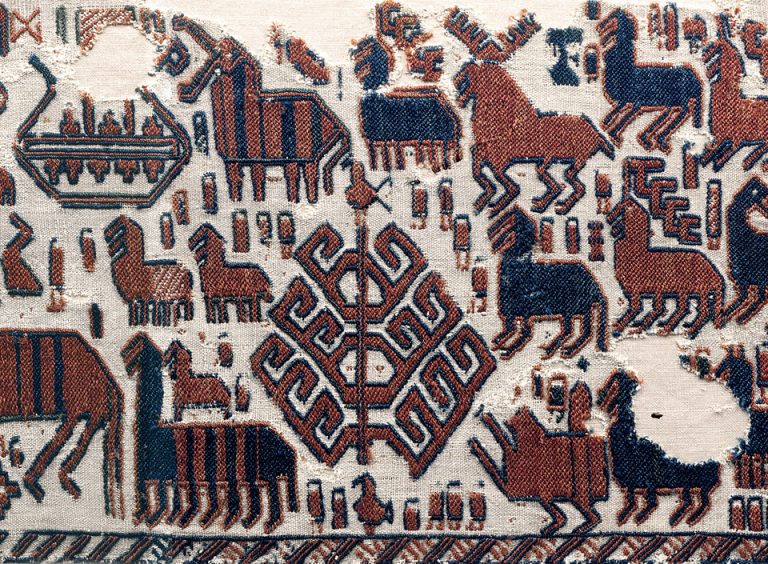 Late Viking Age — Överhogdal tapestrySweden · c. 1070–1140 · Swedish History Museum / Jamtlimuseum identifies a Tree-of-Life / world-tree type motif amid a woven field of people, animals and mythic forms
 Urnes — serpent / beast / ribbon interlaceNorway · c. 1130 · late Viking artistic traditionsnake-like creature · ribbon · enlarged eyes · sweeping symmetrical interlace
Images remain linked to their originating museum, heritage or open-license record. The Met image is public domain; Cleveland identifies the displayed works as Open Access/Public Domain; Walters supplies CC0 collection imagery; the Urnes photograph is Bjørn Erik Pedersen, CC BY-SA 4.0 via Wikimedia Commons.
Yggdrasil is not one fixed “Viking symbol”
There is no securely established single geometric glyph that can simply be called the Viking Yggdrasil symbol. Yggdrasil is a mythological world-tree, and modern commercial symbols labelled “Yggdrasil” are often much later inventions. The useful early material is broader. The Swedish History Museum dates the Överhogdal textiles to roughly 1070–1140 and explicitly notes a Tree-of-Life/world-tree type motif in them. Norse myth itself places nine worlds in Yggdrasil. Meanwhile the Urnes style preserves a different but contemporary visual grammar: an elongated great beast, snake-like forms and thin ribbons woven into sweeping interlace.
That distinction is useful for the Vardath model rather than inconvenient. If the proposed lattice can expand into a mesh and contract into an axial rod, it should not always look like the same emblem. A culture looking at, remembering or diagramming different states and angles could preserve different projections of one structure.
Within the hypothesis, Yggdrasil is therefore most naturally an axial/side view of the system, while Celtic knotwork and Viking animal interlace preserve more of the surface or oblique mesh. The Ethiopian wheel-cross and eight-point textile are closer to an end-on convergence view. The Moche paired serpents, Chinese interlacing dragons and Aztec knotted snake look more like local current channels inside the mesh. This is a Vardath geometric interpretation, not the historical meaning assigned to all of these objects by their cultures.
A new prediction from the “different angles” idea
This produces a stronger test than simple resemblance. If these symbol families are projections of one underlying three-dimensional grammar, then a large image corpus should cluster into a limited set of related geometric classes—mesh, axial, radial/end-on, paired-channel and enclosure—and intermediate objects should combine neighbouring classes in predictable ways. A free-form symbolic theory could match anything; a projection model should instead constrain what combinations and transitions are common.
For example, the model now predicts that paired-serpent imagery should preferentially occur in interlaced or axial compositions; radial wheel/star forms should preferentially carry a central node; and tree/rod compositions should more often acquire paired flanking, winding or branching forms than matched non-axial controls. These can be tested independently on images without using mythology labels at all.
Visual references — Finland, Karelia and the northern world
 The Defence of the SampoAkseli Gallen-Kallela · Kalevala visual traditionThe Sampo appears here as the contested generative centre of the northern cycle: made, defended, broken and dispersed.
 The wild duck and the celestial bodiesJoseph Alanen · Kalevala creation imageryBird, egg, primeval water and the formation of the ordered sky give the enclosure-and-opening branch a direct visual anchor.
Visual references — Near East, Egypt and Mediterranean
 Babylonian mušḫuššuProcessional Way / Ishtar Gate complexA surviving dragon form associated with Marduk, beside the Tiamat/Marduk ordering branch.
 Nut, Shu and GebEgyptian sky / separator / earth grammarArched upper boundary, supporting separator and earth below closely express the enclosure-and-layer geometry used in the model.
 Gilgamesh Flood TabletNeo-Assyrian copy · Tablet XIThe surviving tablet anchors the traveller/survivor/reset side of the Mesopotamian comparison.
Visual references — ark, child, water and passage
Moses on the NileGustave Doré traditionChild + carrier + current + receiving boundary is the human-scale version of the enclosure-through-transition pattern.
Noah's ArkHerat · c. 1428 · David CollectionThe same carrier grammar appears at world scale: preserved life enclosed through destructive water and released into a renewed order.
Visual references — serpent, epic operator and living axis
 Indra and VṛtraVedic serpent / obstruction cycleThunder activation confronts the obstruction and the waters are released: one of the clearest serpent-to-water sequences in the comparison.
 Krishna and the Pandava leadersMahabharata manuscript traditionThe epic operator/witness branch sits beside the larger Vishvarupa reading of hidden total structure.
 Bodhi Tree — SanchiBuddhist sacred-centre imageryThe tree gives the stable human-scale form of the living axis: centre, witness and revelation gathered around one vertical structure.
Visual references — cave, storm and ordered heaven
 Amaterasu and the caveJapanese mythic visual traditionWithdrawal closes the world into darkness; emergence restores light, making the cave a compact closed-boundary / reopening image.
 SusanooJapanese storm-god visual traditionThe storm and serpent-conflict side of the Japanese field complements the creation-by-spear and reopening imagery.
 Jade EmperorMing dynasty celestial hierarchyAn ordered upper realm gives the Chinese comparison a visual counterpart to the model's layered and governed sky-state.
Visual references — world tree, rider, interlace and thunder
 YggdrasilOluf Olufsen Bagge · 1847Multiple regions organised around one living vertical axis: the clearest Norse world-structure image in the comparison.
 Odin on SleipnirIcelandic manuscript · 1760Operator, spear/rod and realm-crossing vehicle are visibly separated into the same three roles used by the Vardath event grammar.
 Book of Kells carpet pageInsular manuscript interlaceA later Christian visual tradition, but an unusually dense surviving example of the woven/interlaced grammar associated with the Celtic/Insular branch.
 PerunHistorical Slavic-mythology illustration · 1918The upper thunder pole of the reconstructed Perun/Veles vertical conflict gives the Slavic comparison its own visual anchor.
Visual references — creator and water power
 Oxalá / Ọbatala visual traditionAfro-Brazilian continuation of Yoruba orisha traditionA modern visual anchor for the creator/ordering figure connected with the Yoruba creation branch; it is not presented as an ancient Yoruba artefact.
 Eyo OlokunLagos masquerade tradition · connected with OlokunThe living sea/water-orisha tradition gives the African comparison a direct visual water-power reference.
Visual references — descent, feathered serpent and rain
 Sky WomanErnest Smith · 1936 · Haudenosaunee creation imageUpper-world descent toward the waters and the formation of land give the American survey a strong boundary-crossing creation image.
 QuetzalcoatlCodex Telleriano-RemensisFeathered serpent, wind and celestial-water associations place movement, atmosphere and serpent geometry in one Mesoamerican figure.
 ChaacMaya rain / water deityThe water-and-storm side of the Mesoamerican field complements the serpent and world-ordering comparisons.
Visual references — creator current and sky/earth separation
 Rainbow SerpentAustralian Aboriginal rock-art photographThe moving creator-current / landscape-water branch that originally began the entire Vardath investigation.
 Ranginui and PapatūānukuMāori creation visualisationSky and earth begin in a closed embrace and are forced apart to create space and light: a direct enclosure-to-separation image.
Working glossary
Axis — central geometric connector: rod, tree, mountain, cross-line or scroll-rod.
Active braid — two opposed strands linking neighbouring stable shell turns.
Aetio/Atel/Ase branch — August 2026 role-equivalence hypothesis around centre/generator/threshold; not an etymological theorem.
Convergence throat — region where surface directions narrow into an axial state.
33rd direction — modern Vardath name for the axis through a 32-bearing surface network; not a historical compass point.
Gate — privileged position/phase where transition or coupling is possible.
Operator — narrative agent associated with controlling/crossing a gate; not necessarily identical with the apparatus.
Vehicle — moving interface such as chariot/wheel/mount; Sleipnir occupies this role in the user’s model.
Manifestation — visible form of the activated structure: eyes, wings, serpents, hourglass, many limbs, etc.
Stabilized turn — world-region after the active braid reopens and its geography settles.
Rubble layer — fractured land material carried and deformed by the hypothetical substrate.
Reset — catastrophic transition involving water/land displacement and subsequent new stability.
JANUS core — frozen audited mathematics. Symbolic/physical comparisons are explicitly outside the theorem core.
Exploration of 8 — state-space/gate research framework that classifies exact mathematics separately from cultural/historical interpretation.
Assistant Notes / Alternative Readings / Reality Checks
This appendix is the assistant’s voice, not Vardath’s. The cosmology above is presented as Stephen/Vardath’s developing model in its own terms. The notes below preserve my separate view: what is established independently, where conventional explanations differ, which mathematical links are exact, and what would discriminate between interpretations.
Keeping this material at the bottom is deliberate. A reader can first understand the Vardath model as Vardath means it, then inspect the objections, source distinctions and unresolved problems without having the main argument interrupted every few paragraphs.
General evidentiary note
Structural resemblance across myths, symbols, maps and numbers is interesting but does not by itself establish a single historical or physical cause. Independent convergence, cultural transmission, ordinary astronomical or geological processes, later reinterpretation and selection effects remain alternative explanations. The strongest version of the Vardath project is therefore the one that eventually produces fixed quantitative predictions.
Squatter Man / Anthony Peratt
Anthony Peratt did publish plasma-physics work comparing high-current Z-pinch morphologies with recurring petroglyph forms, including the “squatter” anthropomorph. That proposal is real, specific and testable, but its archaeological interpretation remains controversial rather than consensus. The further Vardath proposal—that a primordial current persisted long enough to build a material world-body and exactly nine chambers around itself—is a new hypothesis beyond Peratt’s published claim.
Yggdrasil and nine chambers
Norse tradition does contain a world-tree associated with nine worlds. The identification of those worlds with nine plasma-formed chambers is Vardath’s interpretation. A physical model would need to explain why a Birkeland/Z-pinch system selects nine stable large-scale chambers rather than some other number.
Odin, Loki and Sleipnir
The closest recoverable manuscript illustration to the image discussed is NKS 1867 4to, fol. 97v, dated 1760, not medieval. Its catalogue identifies Odin riding eight-legged Sleipnir and holding Gungnir. A related SÁM 66 illustration dates to 1765–1766. I have not independently verified that the rings around the legs or a separate vajra are intended features of the image; those remain points to inspect closely rather than established catalogue facts. The equivalence Loki = Odin = Sleipnir is the Vardath event-reading, not a claim made by Norse sources themselves.
Rod atlas: Apollo, Buddha, Jesus, Moses, saints and rulers
These traditions contain genuine tree, rod, staff, mountain, crossing, radiance, rulership or revelation motifs, but their historical meanings are distinct. The Vardath page intentionally overlays a modern structural interpretation on them. Apollo is now assigned clearly within that system as the radiant/solar face of the rod. Likewise, treating Caesar, Augustus/Octavian, Napoleon or other rulers as humanised versions of the same axial role is a Vardath symbolic reading, not a historical claim that those figures derive from one plasma event.
Gilgamesh / “Gilga-mesh”
Mashu, guarded passage and flood-survivor material belong to the Gilgamesh tradition. “Gilga-mesh” as “mesh” or “silver mesh” is a modern Vardath mnemonic, not an accepted etymology of the name Gilgamesh. That distinction matters even if the mnemonic remains useful inside the cosmology.
Aetio / Atel / Ase / Het / arc / eight
The equation-like relationships among Aetio, Atel, Ase/Àṣẹ, arc, Het, the Ogdoad and 8 are part of Vardath’s symbolic system. I do not regard them as demonstrated historical linguistic or theological equivalences. The strongest defensible reading is functional: Vardath groups them because they occupy the conceptual role of origin, crossing, gate, generative surround or central power.
ARK → ARC → SKY / travelling fingertrap
The ARK → ARC → SKY sequence is Vardath’s geometric reading of one changing enclosure: a narrow carrier state, an opening curved state and a broad canopy state. It is not a claim that English ark and arc share a historical etymology.
Likewise, the waterborne-child images and historical examples show that basket/chest/ark/drum/tube motifs genuinely recur across several traditions; they do not by themselves establish that those traditions historically encoded the Vardath fingertrap cosmology. The useful research question is structural and testable: whether waterborne-child traditions disproportionately preserve woven, hollow, tubular, sealed or reopenable carriers, boundary/gate retrieval, and changed-household or second-birth outcomes compared with appropriate controls.
Revelation
The source text really does contain the clusters used above: seven lampstands/stars and a radiant Son-of-Man figure; throne, lightning, crystal-like sea, four living creatures and many eyes; four horsemen followed later by the sky rolling/receding like a scroll and mountains/islands being moved; the woman, dragon, stars, iron rod and flood in Revelation 12; and river/tree-of-life imagery in the restored world. The claim that these are memories of one plasma/lattice transition is Vardath’s modern synthesis rather than the historical consensus reading of Revelation.
Watchers, eyes, Nut and giants
1 Enoch independently contains the tradition that Watchers descend, take human women and father giants. Egyptian Nut independently functions as a sky goddess and also appears in tree/water imagery. The identification of Watchers with literal luminous/ice “eyes” in a sky lattice, the freezing and thawing of those eyes across world phases, and the interpretation of giant offspring as consequences of contact with a larger shell chamber are Vardath hypotheses. A physical scale law linking chamber size to organism size has not yet been derived.
Water, telluric currents and the upper ocean
Electric fields can orient water dipoles and influence local hydrogen-bonding and electrohydrodynamic behaviour. That is very different from an established mechanism capable of coherently supporting or transferring ocean-scale quantities of water between world-chambers. The newer Vardath proposal—that directional telluric currents hold the upper ocean as the lower boundary of the world above, and that eye/canopy thaw releases substantial atmosphere into the chamber—therefore needs quantitative field strengths, pressure/support conditions, stability analysis, atmospheric mass balance, mass-flow rates and an energy budget.
Waking-world biological phase
The proposed link from a denser, oxygen-rich, electrically active chamber to rejuvenation, greatly prolonged growth, extreme body forms and unusual new life is not established biology. Changes in pressure, oxygen, temperature and radiation can affect organisms, but they do not by themselves demonstrate the much larger effects proposed in the Vardath model. This branch therefore needs explicit environmental values, biological mechanisms and independent evidence before the mythic giant/monster traditions can be treated as physical confirmation.
Sleeping / frozen / returning-god motif
Many traditions do contain sleeping, dying-and-returning, winter, underworld and restoration motifs, but they arise in distinct religious and literary contexts. The Vardath interpretation that these stories record a cooled axial current and a physically dormant world phase is a modern synthesis. It becomes testable only if the model can independently identify physical markers of alternating active and quiet environmental regimes.
Cross-cultural lattice-art corpus test
The first large pre-registered artwork test is more informative than a collection of hand-picked parallels. It scanned 575,927 records from The Met, Cleveland Museum of Art and Walters Art Museum, retained 260,336 dated premodern records and compared 1,028 mesh/interlace records with 1,028 controls exactly matched by museum, broad culture group and catalogue-text-length bin. The predicted >=2-companion package occurred in 5.64% of mesh records versus 2.72% of controls (risk ratio 2.07). Serpent/dragon imagery was the strongest individual association: 10.12% versus 2.63% (risk ratio 3.85), while enclosure/circle imagery was 1.90× enriched.
I regard this as partial support for the visual-grammar prediction, not evidence that the cosmology is physically correct. The important negative result is that three-or-more companion families were not enriched, and the water family was flat. More importantly, unrelated ornamental controls also rose: flowers 2.11×, birds 1.96× and lions 1.60×. That shows a genuine confound—interlace occurs on richly ornamented objects and those objects receive richer catalogue descriptions. The serpent association is still notable because it is stronger than any tested negative-control family, but the next test should operate on the images themselves through blind human coding or computer vision. If the effect disappears when catalogue words are removed, the current result was largely metadata bias.
Tiamat, Apsu and Kingu
The Mesopotamian source material genuinely places Apsu and Tiamat at the primordial beginning and has Tiamat’s defeated body used in cosmic ordering; Kingu carries the Tablet of Destinies and is later used in the human-creation episode. The provisional physical assignments on this page remain unsettled. Tiamat-as-structural-body is currently the strongest fit inside the model; Apsu-as-deep-water substrate and Kingu-as-activated/information-bearing phase are working interpretations, not resolved identifications.
Cronus, Zeus and the celestial bodies
Greek myth describes Cronus swallowing his divine children and Zeus forcing their release; it does not straightforwardly say that Cronus literally swallowed the astronomical planets. The newer Vardath mechanism—planetary phenomena as electromagnetic convergence nodes temporarily incorporated into a coherent Squatter-Man/rod body and later released—is more mechanically specific than the earlier symbolism, but it remains hypothetical until one model reproduces observed solar, lunar and planetary motions.
JANUS
The audited JANUS mathematics is real within its chosen axioms. The clean boundary remains: formal results such as the operator relation, 3–4–5 decomposition and determinant results should stay distinct from physical claims about cosmology, plasma, shell cycles or mythology unless an explicit physical bridge is derived.
Chronology and φ growth
The 138/~395/792 constructions are useful internal tests, but the current simple models do not derive all periods exactly from one law. The near 2:1 relation remains interesting; whether it is physically meaningful needs a fixed chronology and a model that predicts withheld dates rather than being recalibrated to them.
Maps and the 33rd direction
I regard the polar/portolan comparisons primarily as projection analogies. Ordinary map-projection geometry strongly constrains literal flat-map interpretations. The “33rd direction” is a modern three-dimensional Vardath interpretation of a 32-bearing surface system, not a historical extra compass point. The latest version no longer requires every convergence centre to contain 32 lines or represent a permanent geographic tree; it treats different line counts as possible stages or memories of convergence growth. That developmental sequence is testable only if the maps can be ordered by one fixed geometric rule rather than explained individually after the fact.
Persistent-current energy source
The model now proposes that recurrent resets are pulses of the original Birkeland-like current rather than unrelated new currents. That reduces the number of mechanisms, but it does not eliminate the energy problem. A physical theory still has to explain how such a current could persist over the required timescale, what circuit closes it, where its stored or supplied energy resides, what sets the timing and amplitude of the pulses, and how much heating could plausibly come from electrical versus mechanical work.
Geology, tectonic plates and the deeper-driver proposal
Plate tectonics currently provides a quantitative framework for measured plate motions, mountain belts, trenches, faults, spreading ridges, subduction zones and GPS vectors. The latest Vardath model no longer treats tectonic plates as something to discard; it treats them as the observable crustal layer and proposes that a deeper lattice may organise or drive their motion. That distinction makes the hypothesis cleaner but also more demanding: one fixed subsurface lattice-flow field would have to reproduce the already measured directions, relative velocities and boundaries of the plates without being retuned region by region. Until it does, the lattice remains a proposed deeper driver rather than an established extension of plate tectonics.
Meltology and materials
I treat claims that large natural formations are transformed buildings as unestablished. A useful version of the idea is testable: claimed samples can be examined with petrography, XRD, chemistry, microstructure and dating. Ordinary fired clay shows phase changes, thermal expansion, vitrification and shrinkage, but those processes alone do not imply mountain-scale expansion of masonry. If a plasma-reset mechanism is proposed, it should predict distinctive material signatures before samples are examined.
What would most change my assessment
The most persuasive advances would be: a globally fixed deformation field that predicts tectonic vectors; a physical shell metric reproducing real distances and celestial observations; a mechanism deriving the nine-chamber count; a quantitative current-and-water model supporting the proposed canopy; a specified atmospheric/biological regime that makes testable predictions; an image-level lattice-art test that reproduces the first metadata association; a chronology model that predicts holdout events; or material samples whose laboratory signatures clearly require the proposed reset mechanism. Those tests would move the project from symbolic synthesis toward independent physical evidence.
Unresolved problems / notes to self for the next session
- Why nine? Derive—or fail to derive—the nine world/chamber count from an explicit current and boundary model.
- Convergence growth. Test whether sparse and dense historical compass/convergence centres can actually be ordered into one developmental sequence from few strands to a mature directional node and axial rise.
- Lattice-art image test. Repeat the new corpus test at the image level with blind coding or computer vision, expand beyond the three current bulk collections, and test whether serpent/enclosure enrichment survives when catalogue wording is removed.
- Odin manuscript inspection. Examine the NKS/SÁM images closely for the remembered rings, paired contacts and possible vajra-like feature; do not assume them from memory.
- Four towers / four rivers / four horsemen. Formalise the exact mapping among four main supports, eight contacts, four rivers, Saint Christopher and Revelation’s four horsemen.
- Sun, Moon and planets. Build an explicit stable-sky model that reproduces observed celestial paths, then show how convergence, temporary incorporation into the rod-body and release change those paths.
- Watchers and eyes. Specify whether an “eye” is a plasma knot, aperture, ice body, local rod-end, celestial convergence node or a phase-changing combination, and define what physically freezes and thaws.
- Giants. Derive a scale relation between shell/chamber size and organism size and separate that mechanism from any proposed local atmospheric growth effect.
- Waking-world biology. Specify the atmospheric and electrical conditions and derive testable predictions for growth, development, mutation and lifespan.
- Upper-ocean support and transfer. Quantify how the directional telluric mesh could support the upper water boundary, how much water and atmosphere can move through the rod, in which direction, and on what timescale.
- Tiamat / Apsu / Kingu. Resolve whether these are three physical substrates/phases, one world-body plus waters plus activation, or something else.
- Land-flow field. Convert the regional S-shape narrative into one fixed global vector field and compare it against faults, trenches, mountain belts and GPS motion.
- Meltology signature. Define the material changes uniquely predicted by a plasma reset and identify samples where those predictions can be tested.
- Persistent-current physics. Specify what maintains the primordial current, how its circuit closes, what determines the timing and strength of later pulses, and how much event heating is electrical versus mechanical.
- Chronology. Clarify the physical meaning of half-cycle/full-cycle in the ~395/792 relation and how Phoenix strength levels fit the same mechanism.
- 144,000. Consolidate the day-count, Maya, Revelation and possible shell-scale uses without mixing units or assuming a relationship that has not been derived.
Freemason / alchemical corpus test — evidence boundary
This metadata-level result does not prove a physical event or historical transmission of the Vardath cosmology. The primary ≥3-family prediction failed; explicit pair combinations were sparse; the aggregate Masonic gate/ladder effect was mostly document-channel driven; the aggregate alchemical paired-polarity effect was also document-channel driven and disappeared in the historical ≤1930 check; and one negative-control family, furniture, was enriched. The most robust historical/source-channel findings are the Masonic four/eight signal and the alchemical serpent/braid visual signal. A blinded image-level test is the appropriate next discriminator.
Waterborne-child travelling-fingertrap v2 result
The completed frozen test is materially stronger than the earlier anecdotal comparison. It had 203 waterborne targets and 160 non-water controls, so it cleared the pre-declared 25/25 sample floor. The primary two-of-three package passed at 54.2% versus 30.6% (risk ratio 1.77, Fisher p≈7.37×10⁻⁶); strict enclosure geometry passed at 2.43× enrichment; boundary/receiver language passed at 1.53×; and the full three-part package occurred at 8.87% versus 1.25% (risk ratio 7.09, BH q≈0.00360). Identity/change language by itself did not pass, and the unrelated negative-control vocabulary was flat.
My separate evidentiary assessment is therefore: the predicted textual structure is genuinely enriched in the automatically assembled corpus, but the physical cosmology is not thereby demonstrated. Manual inspection found semantic false positives among automatically eligible records—modern media, general-topic pages and place records as well as genuine mythic narratives. Because the protocol was frozen, those records should not be selectively deleted after seeing the result. The correct follow-up is a new holdout study whose inclusion rule is fixed in advance and whose universe is restricted to curated myths, fables, epics and religious narratives. Survival of the primary and three-part effects there would materially strengthen the motif claim; disappearance would show that this first result depended heavily on classifier contamination.
Comparative mythology survey — source boundaries and my reading
This note is the assistant’s voice. The new comparative-mythology section above presents the Vardath structural reading in the main narrative, as requested. My evidentiary boundary is narrower: recurring eggs, waters, axes, world trees, serpents, floods, enclosures and renewed worlds establish a large comparative motif field, but resemblance alone does not show that the traditions preserve one literal physical event. Cultural transmission, common human experience, recurrent natural phenomena and independent symbolic convergence remain live alternatives.
The source types are also very different. The comparison places oral traditions, scriptures, compiled epics, ritual cosmologies and later literary witnesses beside one another because the Vardath question is structural. Their dates and transmission histories should not be treated as interchangeable. The Kalevala, for example, was assembled by Elias Lönnrot in the nineteenth century from older Finnish and Karelian runo-song material; the compilation date is not the origin date of every motif it contains.
Finland and the related northern material
The Finnish/Karelian comparison is genuinely interesting. The Kalevala creation cycle contains primeval water and an egg whose broken parts become ordered parts of the cosmos, while the Sampo has long attracted cosmological interpretations. Britannica describes the Sampo as most likely a cosmological pillar or similar support, so comparing it with an axis is not invented solely for this website. What is specifically Vardath’s interpretation is identifying that support with the same contracted finger-trap / scroll-rod mechanism proposed elsewhere on the page.
Finnish/Karelian, Estonian and other Baltic-Finnic traditions, Sámi traditions, and Komi, Mari, Mordvin, Udmurt and other Uralic traditions should remain distinct. They are related or neighbouring in different linguistic and cultural ways, but they are not one religion. The page groups them for comparison because cosmic-egg, primordial-water, world-pillar/tree and layered-world motifs recur across parts of this northern field; it does not make them interchangeable.
Other comparison limits
The same caution applies to Norse Yggdrasil, Hindu/Buddhist Meru, Slavic Perun–Veles reconstruction, the Japanese heavenly bridge and spear, the Yoruba descent-to-water creation traditions, Haudenosaunee Sky Woman, and Māori Rangi–Papa. Their historical meanings belong first to their own traditions. The Vardath layer is the additional proposal that their geometries can be mapped onto one phase sequence.
The new second-pass matrix is useful because it forces the same sequence across every tradition instead of letting each story be compared by a different rule. It is still a hypothesis-organising device, not a demonstration of common origin. The next stronger step would be to convert that matrix into a frozen coding protocol, score a curated multilingual myth corpus blind to tradition names, and test whether the complete sequence is enriched beyond matched controls and known diffusion families.
Several especially strong-looking correspondences deserve testing rather than extra interpretation. The most useful future study would freeze a small sequence such as enclosure → axis/gate → boundary crossing → catastrophe/transfer → renewed world, score it blind across a curated multilingual myth corpus, and compare it with matched narrative controls while accounting for known cultural contact and genre. That would test whether the complete package is unusually concentrated, rather than simply collecting famous examples after the fact.
Water horse / Ceffyl Dŵr / Sleipnir — linguistic and historical boundary
The Welsh name Ceffyl Dŵr means water horse: ceffyl is “horse” and dŵr is “water”. The phrase World Door on the main page is therefore a deliberate Vardath sound/meaning bridge, not an established Welsh translation or historical etymology. It should not be presented as proof that the name originally meant a portal between worlds.
The folklore comparison itself is real but narrower. Welsh Ceffyl Dŵr belongs to a wider water-horse family that is compared with the Scottish kelpie, Irish/Scottish each-uisge and related Celtic forms; Nordic folklore has its own nix/nøkk or brook-horse traditions. Ceffyl Dŵr accounts place the being around mountain pools, waterfalls, rivers and seashores and sometimes describe extraordinary speed, flight, mist/air disappearance and shape-changing. Those features make it reasonable to compare the creature functionally with a liminal transport motif.
Sleipnir is historically a separate Norse figure, not a water horse. The comparison on the main page is functional: both the water-horse family and Sleipnir can act as supernatural mounts associated with movement beyond ordinary travel. Sleipnir is the eight-legged horse of Odin and is used in stories of travel among realms, including the journey to Hel. The Gotland image-stone tradition is especially useful because it gives an archaeological visual record of rider + extraordinary horse, but it does not demonstrate that Sleipnir derives from Welsh or Celtic water-horse lore.
A good future test would therefore compare liminal horse traditions against ordinary heroic/war-horse traditions using frozen criteria such as water edge, mist, bridge, cave, underworld, sky, funeral context, realm crossing, abrupt disappearance and return. That would directly test the Vardath claim that the relevant horse motif clusters around transition boundaries rather than horse symbolism in general.
Methodological notes moved out of Vardath’s overview
The overview was moved to the top of the main page and left in Vardath’s voice. My separate assessment remains here: JANUS and Exploration of 8 provide exact mathematics inside their chosen definitions but do not by themselves establish the proposed cosmological physics. The 138/~395/792 timing work supplies useful targets, but the simplest clock models did not derive all periods from one law and the φ fits remain conditional. Old polar maps are better treated as projection analogies unless a literal-geography model survives geodetic controls. A deeper lattice-driver proposal has to reproduce measured plate vectors and boundaries with one fixed field, and Meltology claims require material signatures that standard geology and materials science cannot explain.
My standing rule is unchanged: a correspondence becomes much more informative when it survives controls, negative cases, measurement and a prediction fixed before the result is known.
Revelation comparison — source boundaries and alternative readings
This note is the assistant’s voice. The main Revelation section above presents the Vardath reading in its own terms. The textual motifs it uses are real: Revelation 1 has the seven lampstands/stars and fiery-eyed figure; Revelation 4 has the open heavenly door, lightning, seven lamps, crystal-like sea and four many-eyed beings; Revelation 6 has the four horsemen, falling stars, the sky rolling/receding like a scroll and displaced mountains/islands; Revelation 12 has the woman, Sun, Moon, dragon, stars, male child, iron rod and flood/river; Revelation 16 returns to earthquake and geographic displacement; Revelation 19 returns to the fiery-eyed rider and iron rod; Revelation 21–22 end with a new world, gates, river and tree of life.
My boundary is that this does not by itself show that Revelation records the proposed Vardath mechanism. Revelation is an apocalyptic religious text saturated with earlier biblical imagery. The sky-scroll language in Revelation 6:14 closely echoes Isaiah 34:4; the living beings and eyes are strongly related to Ezekiel’s throne visions; horse imagery also has prophetic precedents such as Zechariah. Literary inheritance therefore explains part of the clustering without requiring a common physical event.
The book also need not be read as one simple chronological technical sequence. Scholars and religious traditions have long differed over whether seals, trumpets and bowls are strictly consecutive, partially recapitulate one another, or organise the vision thematically. The Vardath phase map is therefore an interpretive overlay on the text’s imagery, not a recovered engineering diagram.
The 144,000
Revelation really does repeat 144,000 in chapters 7 and 14, but the text gives that number a theological/apocalyptic role. Nothing in the text independently establishes the Vardath day-count, shell-scale or state-space interpretations. Keeping those possible meanings separate until one predicts something measurable is the right discipline.
Artwork
The Revelation thumbnails are historical receptions of the biblical text, not independent evidence for the cosmology. The Bamberg and Trier Apocalypses, Durer prints and Walters manuscript are valuable because they show how different periods visualised the same source passages. They should not be treated as eyewitness images of the event proposed by Vardath.
What would make this comparison stronger
A useful next test would freeze the sequence axis/central figure → opened upper boundary → fourfold activation → celestial disturbance → contraction/rolled sky → terrestrial displacement → cross-boundary transfer → renewed ordered world and score it against other apocalyptic and prophetic texts selected without reference to the hypothesis. If Revelation carries the complete package substantially more often than matched texts, the sequence comparison becomes more informative than motif collecting alone.
Yggdrasil time-switch — source boundaries, useful parallels and testable consequences
This note is the assistant’s voice. The section above presents the Vardath interpretation in its own terms. The historical Norse source structure underneath it is real: Yggdrasil is the cosmic ash; Snorri places Mímir’s well beneath one root and Urðr’s well beneath another; Odin leaves an eye as a pledge for wisdom; the named Norns are Urðr, Verðandi and Skuld; and Hávamál gives the nine-night hanging, spear wound, “self to self” sacrifice and acquisition of the runes.
The boundary is that none of those texts describes a literal mechanism in which temporal layers exchange land. The reading of Yggdrasil as a finger-trap time-switch, Odin’s separated temporal selves meeting at the gate, and the Norns as routing functions are Vardath-model interpretations. They are useful because they generate a more precise mechanism, not because the medieval sources independently establish that mechanism.
The Norns and time-language
It is common to summarize Urðr, Verðandi and Skuld as past, present and future, but the Old Norse names carry more grammatical and semantic nuance. Urðr is tied to what has become / fate, Verðandi to becoming, and Skuld to obligation or what should / shall be. The main section therefore uses them as temporal relations rather than three literal chronological compartments.
Mirror selves in modern stories
The NeverEnding Story and Annihilation are useful narrative parallels for the threshold-and-double motif, but they are modern works and cannot serve as independent evidence that an ancient time-door tradition existed. Their value is comparative: both dramatize identity becoming unstable at a boundary, which helps articulate what the Vardath model means by a self encountering another position of itself.
The Mad Hatter distinction
Lewis Carroll’s tea-party scene is specifically a stopped or trapped-time joke: after the Hatter’s quarrel with Time, it remains six o’clock at the table. That fits the proposed model only as an analogy for a locally closed temporal route. It should be kept distinct from the larger Vardath claim that an event can actively reroute people and geography between layers.
Tartaria and the Maya
These should remain test cases rather than examples already counted in favour of the model. “Tartary/Tartaria” is well documented as a broad and shifting European cartographic label for regions of northern and central Asia; its disappearance from later maps has ordinary cartographic and political explanations. The Classic Maya political collapse involved major regional transformations and abandonment of some centres, but Maya populations and cultures continued. Neither case currently demonstrates transfer between temporal layers.
A stronger search would therefore look for signatures that ordinary history has difficulty explaining: paired discontinuities at two locations, a coherent transferred geological boundary, abruptly inserted material cultures without plausible migration paths, or chronologically displaced objects that survive careful provenance and dating checks. The prediction should be stated before candidate cases are chosen.
Plenum
The Cartesian plenum is a historical analogy, not a current physical theory. Descartes identified material body with spatial extension and rejected empty space; his cosmology used interlocking vortices of matter. That makes “no empty slot — motion requires coordinated displacement” a good conceptual comparison for the Vardath exchange idea. Modern physics does not require Descartes’ plenum, so the analogy should not be presented as scientific support for the cosmology.
Source links used for this section
Project Gutenberg — The Younger Edda contains the English prose account of Yggdrasil, Mímir’s well and the Norns. Stanford Encyclopedia of Philosophy — Descartes’ Physics explains the Cartesian identification of space with body, rejection of vacuum and vortex/plenum cosmology. The artwork cards link to their individual Wikimedia Commons source pages and are historical illustrations, not eyewitness records.
Central spire / Fountain of Youth — physics boundary and useful analogies
This note is the assistant's voice. The section above is a speculative extension of Vardath Cosmology. Established physics does not currently provide evidence for a terrestrial world-tree, temporal spire, plasma fountain that opens a time gate, or a mechanism that makes past, present and future layers physically touch in the manner proposed there.
Plasma motion and time dilation
Plasma does not receive a special form of time dilation merely because it is plasma. In special relativity, any sufficiently fast-moving matter is time-dilated relative to another inertial frame. A relativistic plasma therefore carries ordinary velocity-based relativistic effects, but its motion does not by itself make nearby stationary clocks run faster. Plasma can also contain enormous kinetic, thermal, electric and magnetic energy; in general relativity all stress-energy contributes to spacetime curvature, although the gravitational effect of ordinary laboratory plasma is far too small to create dramatic clock-rate changes.
Propagation delay is not clock-rate change
Plasma can strongly alter the propagation of electromagnetic waves. Radio pulses passing through an ionized medium can arrive at different times depending on frequency. That is a real timing effect used in astronomy, but it is a delay in signal propagation rather than local time itself accelerating or slowing. The Vardath section therefore treats plasma as a possible visible accompaniment to the proposed door rather than claiming that ordinary plasma dispersion creates the temporal effect.
Fast world-time versus traveller-time
The phrase "time moves quickly" is potentially ambiguous. If 1,000 years pass in one region while a traveller experiences only one year, then the world has accumulated much more elapsed time than the traveller. From the traveller's perspective the outside world has advanced rapidly, while the traveller's own proper time has been small. That is the version most naturally connected to a Fountain-of-Youth story, because the traveller would return relatively young compared with the world that continued to age.
Wormholes are a closer mathematical analogy than plasma
General relativity contains mathematical spacetime geometries in which distant regions can be connected by short paths, and theoretical wormhole discussions show how differing histories of two mouths can create a time offset between them. These are useful analogies for the Vardath idea that a short local route might connect widely separated temporal addresses. They are not evidence that traversable wormholes exist in nature, and known traversable constructions generally require physical conditions not demonstrated at macroscopic scale.
The strongest formulation of the idea
The most internally consistent version is therefore not "fast plasma makes time run fast." It is: a hypothetical change in spacetime or world-layer connectivity produces a large difference in elapsed time; an energetic plasma-like flow may accompany that change; the central spire is the region of maximum temporal gradient; and a traveller's own elapsed time may remain small even while the connected world accumulates a much larger interval.
This preserves the distinction between the Vardath model and established physics while also giving the model a clearer test target: any real version would need evidence of anomalous clock-rate differences or temporal displacement that cannot be explained by ordinary relativity, signal delay, geology, chronology or conventional historical processes.
453-post consolidation — evidence and source audit
The new archive-consolidation sections above are a modern Vardath synthesis of the 453 WordPress articles. Their purpose is to preserve ideas and distinctions developed across that article bank without reproducing 453 posts verbatim. A motif appearing in several traditions remains a comparative pattern, not independent proof that those traditions record one physical event.
Regional sequences are analytical reconstructions
The Chinese, Japanese, Polynesian, Mesoamerican, Egyptian, Finnish/Karelian, Yoruba, Haudenosaunee, Diné, Andean, Hopi, Kongo, Norse, Celtic/Insular, Slavic and other “sequences” on the page combine material from different texts, periods, genres, communities and ritual settings. They should be read as Vardath role-maps: an attempt to see where motifs sit relative to separation, support, boundary, transit, catastrophe, recovery and stable-world phases. They are not claims that each culture historically possessed one hidden technical master narrative.
Indigenous traditions need an especially narrow comparison rule
Aboriginal Australian, Haudenosaunee, Diné, Hopi, Andean and other Indigenous materials belong to living and historically specific peoples. The consolidation uses only broad publicly discussed motifs already present in the article bank. It must not imply that restricted knowledge has been recovered, that separate nations share one doctrine, or that sacred geography is secretly a literal electromagnetic infrastructure. The Australian branch is deliberately presented as a network of publicly comparable functions, not as “the Aboriginal cosmology.”
Controlled passage, catastrophic contact and ordinary symbolism are not the same evidence class
Jacob’s ladder, Miʿrāj ascent, a mound entrance, a cave journey, a water horse, a beanstalk, a flood and a world-ending apocalypse can all occupy gate-related roles inside Vardath’s grammar, but that does not make them equivalent historical reports. The distinction among quiet separation, selective/controlled passage, local threshold opening, regional activation and global reset is internal to the Vardath model and remains unverified physically.
Changed adjacency is still a hypothesis, not established spacetime physics
The archive’s mature definition of a gate as a temporary change in effective adjacency is conceptually cleaner than a permanently open portal. It can also explain why extraordinary journeys are described as bypassing ordinary distance. But no measured Vardath metric, topology or field equation currently demonstrates that macroscopic world-regions can become adjacent in this way. “Impossible distance” stories therefore remain narrative analogies, not evidence for literal shortcuts.
Gate capacity and cargo sorting are physically sensible questions, not demonstrated event mechanics
It is reasonable that gases, liquids, heat, sediment, large debris and organisms would cross a hypothetical throat differently. That does not establish that such a throat exists. Any serious physical version needs geometry, cross-sectional area, duration, pressure and temperature differences, transport laws, mass balance, energy balance and survivability constraints. The same applies to proposed counterflow between neighbouring world-turns.
Water as tracer is a useful discipline
The claim “geometry changes first; water writes the change across the surface” is best treated as a modelling rule. Water really is highly responsive to topography, pressure and boundary conditions, so flood should not automatically be treated as the root cause of every deformation. The specifically Vardath step—attributing the changed geometry to a deeper woven world-lattice—remains the unverified part.
Dynamic equilibrium and reset ≠ rewind improve internal consistency
Defining the quiet world as dynamic rather than motionless is compatible with ordinary physical systems. Likewise, a post-event world could not literally be a rewind if sediment, biological populations, coastlines and material distributions changed. These refinements make the speculative model more coherent but do not independently support its shell/lattice premise.
Negative space, paths and local centres
The Australian “Emu in the Sky” comparison usefully reminds the project that perceived structure can be defined by absence as well as luminous points. Songlines and ceque systems demonstrate historically that cultures can organise geography through routes and relational networks. Omphalos, paqarina and regional sacred mountains demonstrate that multiple local centres can coexist culturally. None of those facts implies a hidden physical lattice; they are constraints on how cautiously the analogy should be made.
Saint Christopher and Jack and the Beanstalk are deliberately late analogies
The Christopher river-crossing and the beanstalk gate are retained because they mirror carrier/axis/gate functions unusually cleanly. They are not ancient independent witnesses. Christopher’s famous river-and-child narrative belongs to medieval hagiographic development; the recorded beanstalk tale belongs to the modern literary/folkloric period. Their proper role on this page is research history: examples showing how the Vardath grammar can also describe later narrative constructions.
Polynesian and Australian consolidation
The added Polynesian sequence is a modern ordering of motifs such as sky-earth separation, emergence into light, island fishing/raising, solar regulation and boundary/death themes; it does not claim those episodes form one original physical chronology. The Australian section is even less chronological: it deliberately preserves a distributed relation among serpent/water, song routes, withholding/release, stellar journeys, negative-space constellations and the Milky Way.
Navigation and duplication note
The archive consolidation now uses real H1 website sections for its substantive additions, so they are indexed directly in the global sidebar like the rest of the Cosmology. The compact archive jump index is retained as a secondary shortcut. Older sections remain where they document the model’s historical development; the new top-level sections add later distinctions rather than silently replacing that history.
What would falsify the consolidated model rather than merely one analogy?
The archive-wide synthesis becomes substantially stronger only if several currently separate demands can be met at once: a defined shell/lattice geometry; measured or derived gate conditions; a fixed global deformation field consistent with plate observations; a quantitative water/atmosphere transfer model; a stable-sky model reproducing real celestial observations; and independently testable material, chronological or biological predictions. Failure of one mythic comparison does not falsify the whole speculative geometry, but repeated failure of these quantitative bridges would.